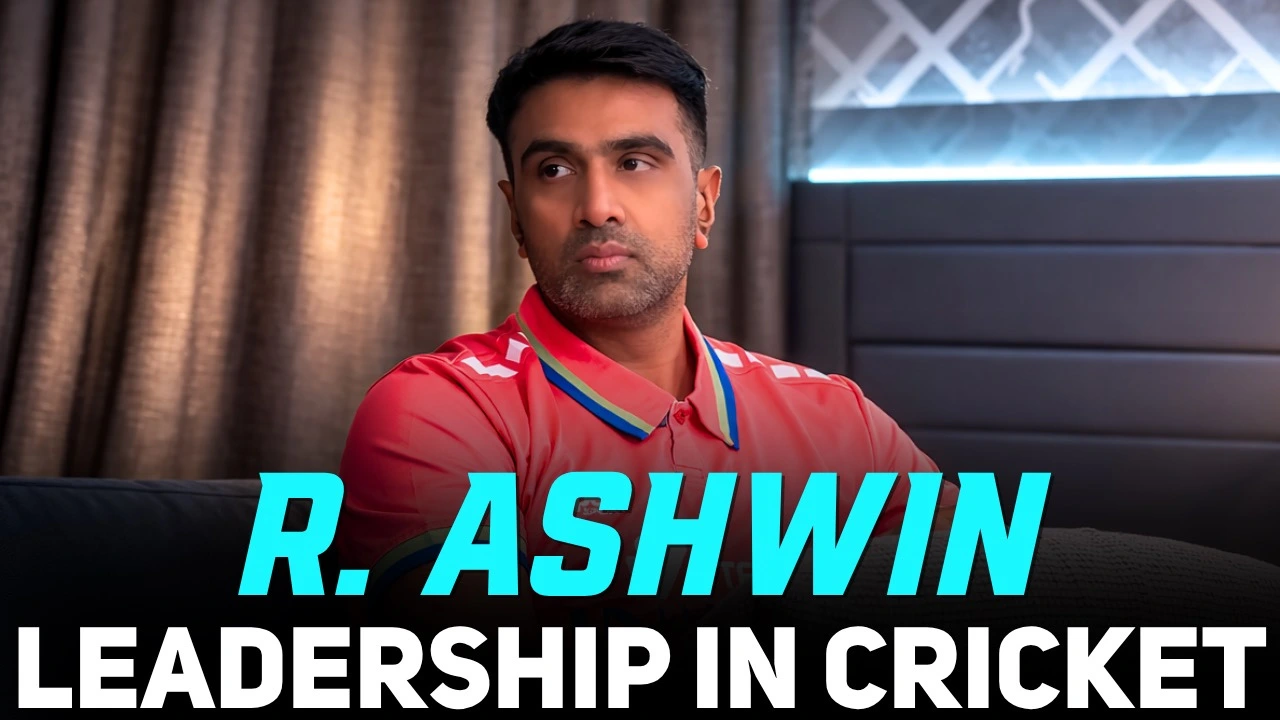
In this episode, Ravichandran Ashwin sits down with cricexec’s Zee Zaidi for a wide-ranging conversation that goes far beyond cricket.
Ashwin reflects on the role of failure in shaping success, sharing why setbacks — not achievements — have been the most important lessons of his career. He opens up about his early challenges, the influence of his father as a mentor, and how sport became a foundation for discipline, problem-solving, and personal growth.
The discussion explores themes that resonate equally in business and life — from sustained performance and passion-driven work to leadership, mentorship, and the importance of letting go. Ashwin also offers insight into his post-playing journey, including his role as an ambassador for the game, his approach to entrepreneurship, and why joy — not money — drives his decisions.
Blending personal stories with thoughtful perspective, this episode is a deep dive into mindset, resilience, and what it truly means to keep evolving — on and off the field.
Leadership in Cricket is the series of The Business of Cricket Podcast that talks to players and coaches the way you’d talk to any high-performance leader — because that’s what they are. Each episode is an in-depth conversation with a current or recent international player, captain, or head coach, focused not on technique or tactics but on the leadership questions that sit underneath them: how to set culture in a dressing room, how to make decisions under enormous pressure, what failure has taught them, how they think about authority, accountability, and identity in a career measured in public. It’s a sports leadership conversation built for an executive audience.
Transcript
Ravichandran Ashwin:
If you don’t fail, you don’t win. And it’s very easy to sit here and advise another person, but trust me on this — you fail, you will eventually learn how to win.
Zee Zaidi:
We’re here with the legendary Ravichandran Ashwin, who is without doubt one of the greatest cricketers of all time, India and otherwise. Ravi, thank you so much for coming to the event, but also for joining us for this discussion.
Ravichandran Ashwin:
Yeah, pleasure is mine. Wonderful to be here in America. I think it’s got a lot of potential in terms of what cricket can achieve in this country. Hopefully, there’s a starting point of something memorable, and we can pass on some knowledge to the amateurs that are going to be playing around. This part of my journey is more about giving, and I’ve had a first chapter that’s been quite relentless. I look forward to enjoying this chapter.
Zee Zaidi:
Great. So now let’s shift gears a little bit to you and your career, and lessons that we can draw from it in the cricket and the business world. If we look back at your development as a player, even early on — you talk about it in your book I Have the Streets, which you co-authored with my friend Sid Monga — you had health challenges as a child. There were times you had trouble breathing and faced a lot of adversity really early on in your life. How do you think that shaped you and helped you perform later in life?
Ravichandran Ashwin:
Pretty impressive to ask questions and prepare for a podcast like this. I must commend you on that.
Look, I think sport is a very small encapsulation of what we might encounter in life. Everybody goes through their journey very differently.
If you take up sport, it’s just like any other walk of life. I believe every child needs to take up some sport in life because there is nothing better that will teach you how to stay humble in success and how to stay steadfast and disciplined when you fail.
Going forward, I think the next generation most essentially needs to learn how to fail and deal with it. For me, the biggest lesson is not what I’ve got out of success in my life. I’m extremely thankful for the sport for giving me so many failures, because without failures — like they say, it’s the old adage — failures are a stepping stone to your success.
Failures are not just stepping stones; they are pathways for you to get better as a person in life. Every single time you fail, you’re amidst a challenge where you’re trying to find solutions. Life is all about finding solutions. It’s about solving problems, just like how they teach you in school.
So for me, sport is the greatest teacher, especially through the thick and thin of having failed. It’s that one moment — you prepare, prepare, prepare — and you don’t know when that moment is going to arrive. Are you prepared enough to take that moment with both hands? You prepare day in and day out for that particular moment.
Like any other business, as you said, if you don’t fail, you don’t win. It’s very easy to sit here and advise another person, but trust me on this — you fail, you will eventually learn how to win.
Any business is not going to be a cakewalk. You have to fail. You have to learn how to address the failure. And if somebody says they woke up one morning, went to work, and succeeded, I would say they’re lying.
So sport is the greatest synergy you can have in life about how you get better as a person. Don’t focus on success — get better as a person or as an entity or as an enterprise — and one day you will find success.
Zee Zaidi:
Well put. Moving on from that — coaches play a really big role in shaping players in sport, but also managers in business. For those of us who’ve spent time in the corporate field, it can make or break your development.
When people ask me what style of coaching has worked well in my career, it’s tough love — someone who has expectations for you, is disciplined, but wants the best for you.
The first figure in your life who really seems to have driven you cricket-wise is your father. He comes across as a disciplinarian, someone who did everything properly, but also someone passionate about cricket. Talk about how that shaped your development, and then we’ll discuss other coaches.
Ravichandran Ashwin:
I think modern-day sport, especially cricket, is seeing a lot of fathers becoming coaches. Technology, videos — everything enables parents to train kids better, and accessibility to infrastructure is greater.
When you say coaching, I always look at stories of Sachin Tendulkar and his coach Ramakant Achrekar. He was a very famous coach in Mumbai and very successful.
The beauty of coaching is unconditionally giving to someone. If you asked Achrekar what his expectations were from Sachin, he would probably say nothing — it was just his passion for the game passed on to a young kid.
Coaching and mentorship have evolved over time. Today, people mentor and coach, but are they prepared to let go?
I think of it like this — you catch an injured bird, nurture it, give it first aid. But when it’s time, you have to let it go, because the essence of a bird is to fly. What’s the point of nurturing something and then clipping its wings?
Life is like that. The animal kingdom teaches you every day how important it is to let go. I’m most thankful to my dad for doing that. He was always with me, teaching me, taking me around. But when it came to dealing with problems, he allowed me to do it myself.
That’s the beauty — I need to learn, survive, and solve problems on my own. Parents often fear letting go, but when the time is right, they must.
There’s a saying: when the student is ready, the guru arrives. When knowledge is imparted, it’s important for the guru to leave as well — that’s when respect doubles.
So pass on knowledge, but when it’s time, let go. Don’t clip the wings — let the bird fly.
Zee Zaidi:
Very well put. Another key to success in business is consistent performance over a long period. There’s no finish line.
When I look at your career — across formats — you’ve been Man of the Series in Tests 11 times, named to the ICC Test Team of the Year five times, and part of the Team of the Decade.
What does it take to have that kind of sustained performance?
Ravichandran Ashwin:
Sustained success is always from the outside. When you look at someone else’s book, you’re not reading all their pages — you don’t know what’s missing.
There are always setbacks. Sustained success is through the eyes of others.
Life is about moving on. Any moment that’s missed is gone — you can’t go back and change it.
For me, cricket felt like a calling. Many people play for what the game gives them — money, fame — but I never picked up the bat or ball for that. I played for the joy.
We played in the gullies of Chennai. Even today, I drive past those streets and think about those moments. I don’t dream about wickets or runs, but I constantly think about those early days.
That’s the joy the game gave me. It’s been my calling.
Even today, I stay connected to the game not for money or business, but because it gives me joy. If you’re passionate about something, there is no finish line.
You look at Ratan Tata — he worked till the end. Not for money, but because it was his calling.
At some point, giving unconditionally becomes the purpose. For me, that giving happens through the sport.
Zee Zaidi:
Let’s talk about what you’re doing now — being an ambassador to the sport, helping grow cricket in this country. Why is that important to you?
Ravichandran Ashwin:
Like I said, it’s about giving back what the game gave me.
I coach kids — not because it benefits me, but if one of them becomes better than I was, that would be a great moment.
The next generation will always be better than us. It’s important to pass on knowledge. I derive joy from that. I’ve never had insecurities about sharing what I know.
The game is the hero — I’m just a servant of the game.
Zee Zaidi:
Is there something about facing Chris Gayle that brings back memories?
Ravichandran Ashwin:
I hope he’s half as good as he was before. He was a monstrous player — massive respect for what he did. I look forward to seeing him hit a few sixes — maybe not against me.
It’s a gathering of so many great cricketers — people I’ve played with and against like Ravi Bopara, Cheteshwar Pujara, and Jason Roy.
It’s old memories coming back, while also making new ones.
Zee Zaidi:
Rapid fire — toughest batters and bowlers you’ve faced?
Ravichandran Ashwin:
I never viewed it that way. I saw every batter as a problem to solve.
But one batter I admired was Joe Root — especially how he evolved against spin.
One bowler I had massive respect for was Kagiso Rabada. I also thought Pat Cummins was excellent at one stage.
Zee Zaidi:
Last question — you’re now an entrepreneur as well. What from cricket helps in that journey?
Ravichandran Ashwin:
I wouldn’t say I became an entrepreneur now — I always had that streak. Even while playing, I ran a coaching institute.
Teaching others helped me improve as a cricketer. I’m also passionate about chess — I play, get frustrated, and want to improve my rating. It’s just the competitive streak.
I don’t do things to make money. I do things that make me happy. If you enjoy what you do and bring people along that journey, money becomes incidental.
Where I don’t find passion, I don’t go. Even if returns are less, it’s okay — the game has given me enough.
Life is about enjoying what you do, not chasing what others envy. The biggest joy comes from small things. If you can’t enjoy those, what’s the point?
For me, it’s about putting a smile on my face and enjoying what I do.
Zee Zaidi:
Great words to live by. Thank you so much for joining us.
Ravichandran Ashwin:
Pleasure is mine. Thank you.