
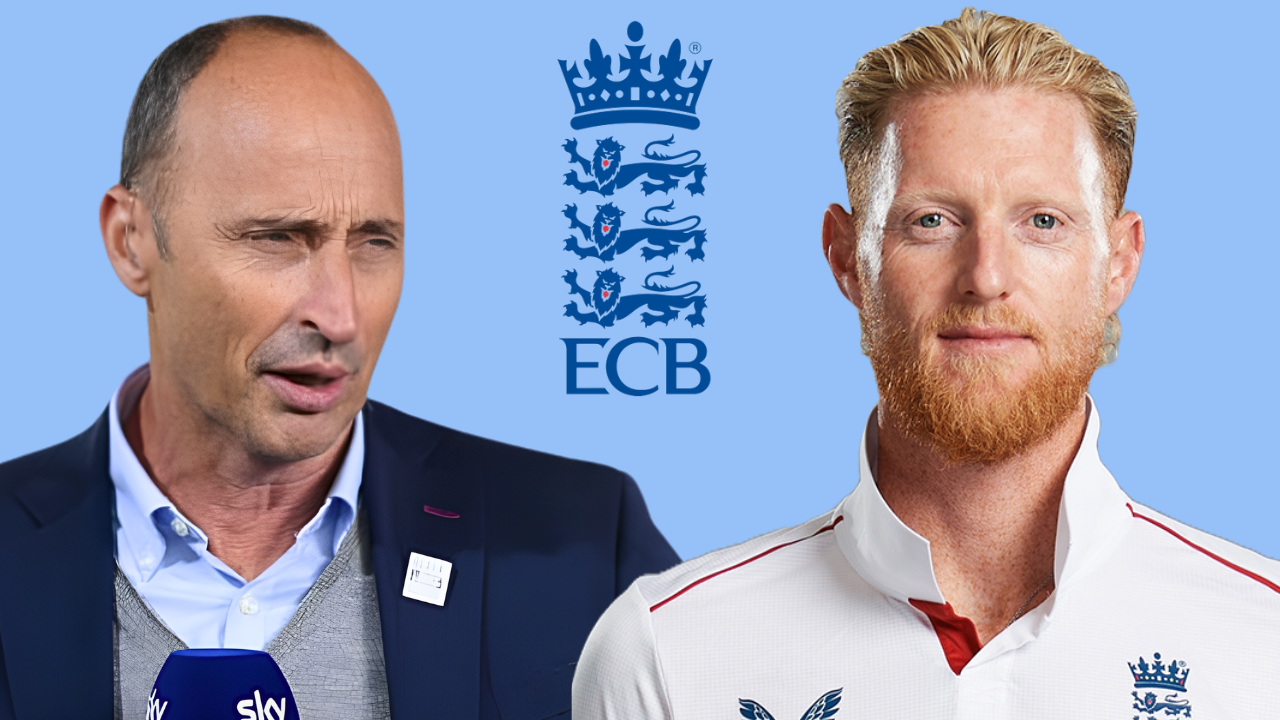
Few leadership decisions in English cricket have generated as much debate in recent days as the handling of Ben Stokes following the curfew breach that overshadowed England’s opening Test victory over New Zealand. With Stokes and Gus Atkinson left out of the second Test squad while an ECB investigation continues, questions have emerged not only about discipline and accountability but also about how England should support one of the defining figures of its modern Test era. Writing in his column for Sky Sports, former England Captain Nasser Hussain said he believed the ECB could have shown stronger backing for Stokes while still addressing the seriousness of the incident.
The controversy stems from a nightclub visit after England’s victory at Lord’s, which resulted in Stokes and Atkinson breaching team curfew rules. The decision to omit both players from the ongoing second Test at The Oval handed captaincy responsibilities to Joe Root, with England attempting to build on their 1-0 lead in the series. At the close of day two, New Zealand had been dismissed for 391 and England were 222 for 6 in reply.
Support for Stokes despite disciplinary process
Hussain argued that the challenge facing English cricket’s leadership was balancing accountability with support for a player who has carried significant responsibility for the national side over a prolonged period.
Reflecting on the situation, Hussain wrote: “It’s not easy because it’s a difficult balance to strike, but I would have backed my captain a little bit more, if I’m perfectly honest.”
While making clear that he was not excusing the breach itself, Hussain questioned whether the public response adequately reflected Stokes’ contribution to the England team.
He added: “I’m not condoning anything he’s done in any way. I said at the top of the show today it was unacceptable, breaking your own curfew. But that captain has shown a lot of emotional intelligence with a lot of people in that team who have, at times, messed up either off the field or on the field. Ben Stokes has been the first one to put his arm around people in that team. I just think with what Ben has done for this cricket team over time, I would have liked someone just to go, ‘you know what, he’s got it wrong, there’s an investigation going on, but he is my captain’.”
England’s leadership question
The fallout has inevitably reignited discussion around England’s captaincy, particularly with Root leading the side during Stokes’ absence. For Hussain, however, there is little uncertainty about who should still be regarded as England’s leader.
Addressing that debate, he stated: “Right now, as we speak, if you’re asking me who is England captain, Joe Root or Stokes? Stokes is my England captain. Unless I hear differently, he’s still my England captain.”
Hussain’s comments come amid broader scrutiny of England’s handling of the episode, with discussions extending beyond the disciplinary process itself and into questions about team culture and leadership.
Criticism of wider reaction
Beyond the specific circumstances surrounding Stokes, Hussain also took aim at some of the measures and conversations that have emerged following the incident.
Discussing team rules, he wrote: “Firstly, curfews are a nonsense. You’ve lost the team if you’ve got to have a curfew.”
The former England Captain suggested the focus had drifted away from the most important questions facing the team and its leadership structure.
Why Stokes still matters to England
Even as debate continues over Stokes’ place in the side, Hussain maintained that England remain a stronger team with him involved.
Assessing his value to the current setup, he noted: “Is Stokes still your best captain? Yes, he’s one of the best captains I’ve seen lead this England side. Does he get in the side still? A little bit debatable recently, but as we see with the balance of the side for this Test, if you don’t have Stokes, it becomes a bit complicated.”
The comments highlight the distinction Hussain draws between recent performances and the broader impact Stokes continues to have on the structure and identity of the team.
The bigger issue facing every captain
While defending Stokes, Hussain also pointed to a longer-term challenge that eventually confronts every international captain regardless of results or reputation.
He wrote: “And the third, and the most important thing, does Ben Stokes still want to do the job? This job, the captaincy, drains you more than anything else in cricket. Has he still got the energy to do it?”
For Hussain, that question ultimately carries greater significance than many of the arguments that have dominated discussion in recent days.
Closing his assessment, he stated: “Get rid of the nonsense, talk crystal clear conversations, and pose the questions I’ve just asked. If you’re asking me, who would I have as captain at Trent Bridge for the next Test match? I would have Stokes.”
With the investigation continuing and England still in the middle of a Test series against New Zealand, the debate around Stokes’ future role is unlikely to disappear quickly. Hussain’s position, however, is clear: accountability and support are not mutually exclusive, and he believes England should continue to view Stokes as the man best placed to lead the side.


