
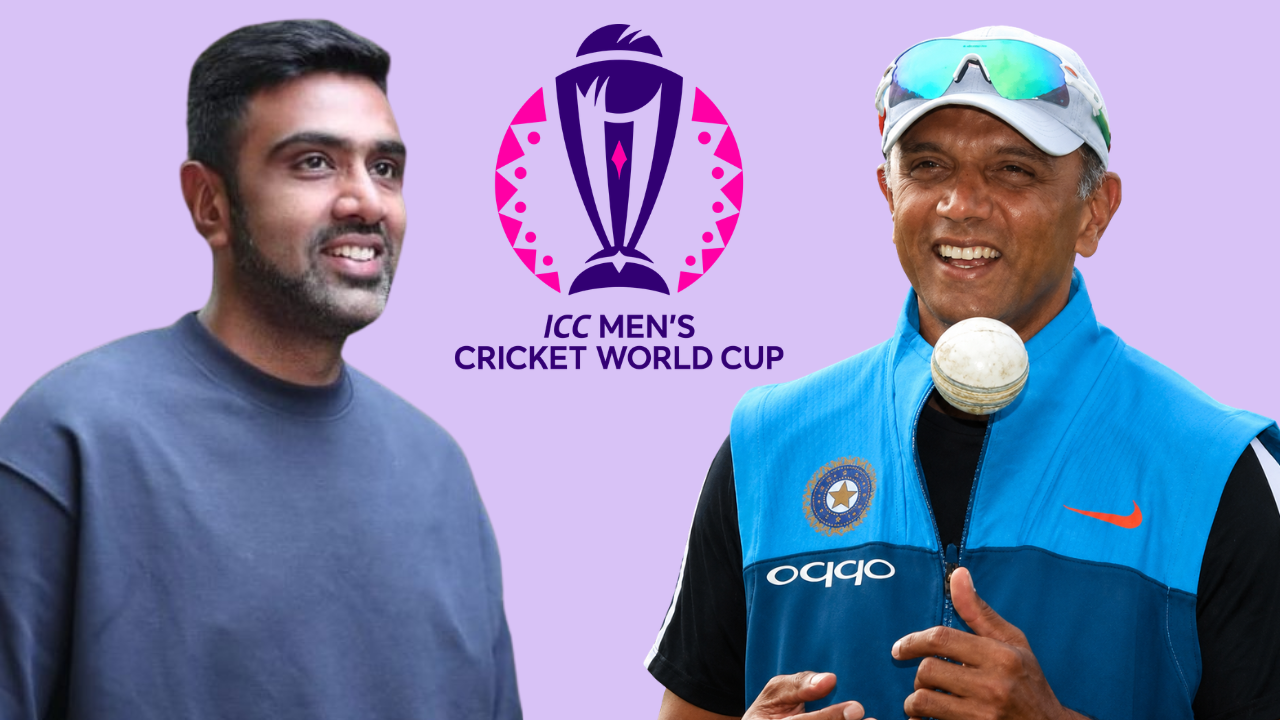
Ravichandran Ashwin has held up Rahul Dravid’s tenure as India’s Head Coach as a model of planning and selection stability at a time when the national team’s combinations, player roles and long-term direction are facing renewed scrutiny ahead of the 2027 ODI World Cup.
The former India spinner’s intervention extends beyond an assessment of Dravid’s record. It raises a broader high-performance question over how India identify their preferred players, communicate selection decisions and preserve continuity while moving between formats and planning for the next global tournament.
Selection changes sharpen the stability debate
Recent selection decisions have brought the issue of sustained player backing into focus. Sanju Samson, who played an important role in India’s 2026 T20 World Cup triumph, was left out after low scores across two matches against Ireland and the opening T20I against England, which was eventually washed out due to rain.
Vaibhav Sooryavanshi replaced him for the next three matches before also being omitted from the fifth T20I, when Samson returned to the side. The sequence illustrated the challenge of balancing immediate performance with longer-term confidence in players who have already delivered in major tournaments.
Speaking on his YouTube channel, Ashwin stated: “Everyone can criticize. But can someone say that Dravid did something without planning, or that someone was dropped out of nowhere without being given a long rope, or that he didn’t provide stability? The way he backed Hardik Pandya and used him was remarkable. It was very unfortunate that he got injured in the 2023 World Cup. He backed Shubman Gill as an opening batter. He backed KL Rahul. During Rahul’s stint, KL Rahul became one of the best Test batters India had. He gave a long rope to Shardul Thakur at number eight in overseas games. He gave a place to Kuldeep Yadav as the third spinner for India.”
The examples identified by Ashwin reflect a coaching philosophy built around defined roles and extended opportunities. Dravid’s tenure began in late 2021 and included India’s run to the 2023 ODI World Cup final before the team won the 2024 T20 World Cup.
Role clarity remains a central concern
Kuldeep Yadav’s position has become another focal point in the discussion around India’s selection strategy. The left-arm wrist-spinner did not feature in any of the three ODIs against England despite entering the series as India’s highest-ranked ODI bowler, intensifying questions over where he sits within the team’s plans.
The issue is not limited to whether a player is selected for an individual match. For teams working towards a World Cup, clarity over specialist roles, preferred combinations and the conditions in which players are likely to be used can be as important as the selection itself.
Ashwin noted: “Players never felt a lack of stability. You can’t fault that. I worked closely with him. People can criticize, but they criticize the best in the business too. Tell me one thing: is there anyone who hasn’t been criticized? Everything attracts criticism. Leave social media criticism aside. That is not the point. Ask any of the players from Rahul bhai’s stint how he was as a coach. Then tell me. Players will tell you. Everybody will. Is there anyone who does everything well?”
That emphasis on the players’ experience places internal communication at the centre of the selection process. A team can make changes while retaining stability, provided those decisions form part of a clearly communicated strategy rather than a series of isolated reactions.
Rohit speculation highlights the planning challenge
Questions over India’s long-term ODI direction also surrounded Rohit Sharma before the third ODI against England at Lord’s. Reports suggested that the former Captain had been informed he might not feature in the management’s plans for the 2027 World Cup, raising the possibility that the series finale could be his last ODI.
The BCCI publicly rejected that suggestion, with Secretary Devajit Saikia saying no decision had been taken and that Rohit remained part of India’s ODI plans. Rohit then answered the speculation with 138 in the final match, although England won by 27 runs to complete a 2–1 series victory.
Against that wider uncertainty, he stated: “I have said this so many times. When there is a 2027 ODI World Cup on the horizon, once the 2023 World Cup is over, you have to plan how the team will shape up over the next four years. Which combinations to find, who the 50-over specialists are, and whom we are going to back. If the workload is high, while managing that workload, we have to preserve players for ODIs. All this planning should have happened. So who was the coach after 2023? Rahul bhai. Rahul bhai must have asked for plans until 2027. And if not, if Rahul bhai was saying that he would be there only until 2024-25 before leaving, then his planning should have been documented.”
Ashwin’s argument places institutional continuity above the tenure of any individual Head Coach. World Cup planning, in that view, should survive leadership transitions through documented strategies covering selection, workload management, succession and the development of format-specific players.
Coaching succession forms part of the same strategy
Ashwin also argued that long-term planning should extend beyond the playing squad to the coaching setup. He pointed to the working relationship between Rahul Dravid and VVS Laxman as an example of the importance of communication and continuity behind the scenes.
Ashwin added: “Exactly. The way you groom players and create options, similarly, the coaching staff also have to be groomed. Under-19 cricket is different. NCA is different. Coaching the Indian team is different. Coaching the India A team is different. There is a lot of difference between the India A coaching setup and the senior team coaching setup. Rahul used to coach here and had a lot of workload. Laxman used to travel to Zimbabwe. We would talk to them. Whether they agreed or not, that is not how it works. But at least we talked. They used to find a middle ground and work together. You don’t know how Laxman works. For a Zimbabwe tour or any tour he goes on, he starts preparing 20 days in advance, as if he is going to play himself.”
With India now navigating selection changes, workload pressures and uncertainty around several roles, Ashwin’s assessment has shifted attention towards the processes behind those decisions. His central contention is that preparation for the 2027 ODI World Cup must be based on an established plan that provides clarity to players and remains intact across changes in personnel and leadership.


