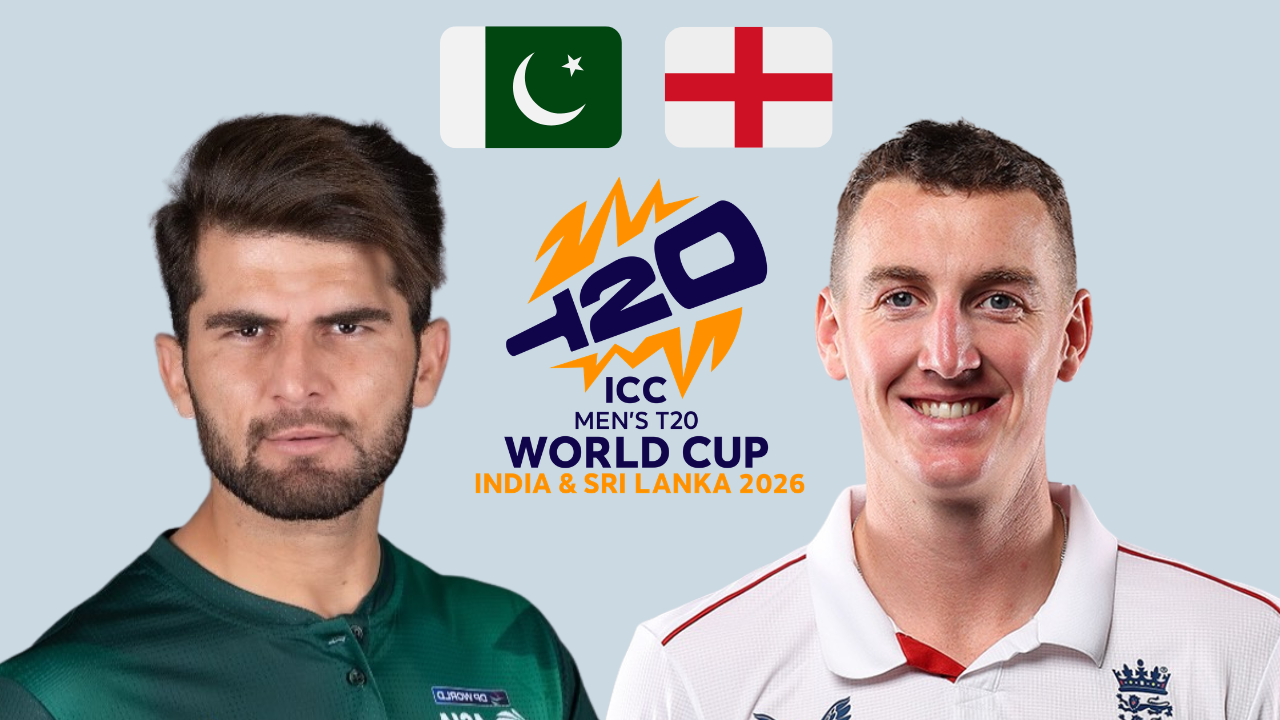
In a tournament defined by fine margins, one gesture stood out amid the intensity. After dismissing Harry Brook moments after the England captain brought up a stunning hundred, Shaheen Shah Afridi walked up and shook his hand — a rare image of admiration in the heat of a World Cup battle.
Pakistan had begun brightly in the Super 8 clash, but Brook’s counterattack transformed the match and tilted semi-final momentum England’s way. Speaking at the post-match press conference, Afridi framed the handshake not as theatre, but instinct.
“He deserved it because he played a world-class innings. I think he’s one of the best. Harry and I have a very good friendship as well; we played together in the PSL for Lahore Qalandars. When anyone plays an innings like that, you should appreciate them,” he reflected, underlining both professional respect and shared history.
A captain’s innings under pressure
Brook’s promotion to number three came after early wickets had rocked England’s chase. Afridi himself had removed key batters in a fiery opening spell, yet the innings that followed redefined the contest.
“In my opinion, this will be the best innings of his life,” Afridi assessed, describing the knock in emphatic terms. “It wasn’t an easy pitch to bat on, but he took the game away from us.”
What struck the Pakistan quick most was Brook’s composure amid chaos. “If you see one side, Harry Brook, the way he went, wickets were falling, but he was still in the crease,” he observed. “He was rotating the strike and building the partnership. I think we missed that opportunity.”
The technical clarity also impressed him. “I’ve never seen a batsman like him. He was properly ready for every ball to hit it. He was well prepared for us.”
Afridi traced Brook’s growth back to their time in franchise cricket. “When we picked him in PSL Lahore, I don’t think he played for England at that time,” he recalled. “He was just playing county cricket. But he played on Asian wickets and improved a lot. Today he came at number three. You need a leader who can take responsibility in big games.”
Pakistan’s middle-overs gap
For Pakistan, the loss exposed familiar structural issues. Despite a promising start, the innings never accelerated into a match-defining total.
“On a wicket like this, you need a partnership and you need a set batsman in that position who can bat throughout those middle overs. Unfortunately, we lost wickets back-to-back, which is why we didn’t get that 180-190 score,” Afridi admitted.
That theme returned repeatedly in his assessment. “I think we missed this opportunity for partnership. Yeah, we just missed that opportunity,” he acknowledged, contrasting Pakistan’s approach with Brook’s stability at the other end.
Clarity in role, clarity in execution
Afridi’s own performance — four wickets and early breakthroughs — briefly swung the contest. His approach with the new ball was deliberate.
“Whenever I play, my job is to take wickets early. That’s why I bowl the first over. Today I was just planning how I can take wickets.”
Conditions dictated his method. “If the wicket depends on length, why not go for length balls?” he reasoned. “They were struggling and I was just trying to bowl the same length.”
The outing also came after scrutiny over selection. “Yes, you said I was dropped,” he noted. “But my focus was to work on my bowling, how to come back, and maintain my normal things so that I can give good results.”
Selection debates, he insisted, do not alter intent. “I don’t need to prove to anyone,” he stated, reinforcing that commitment further: “I don’t have the need for a place. I always try… there was always room for improvement. Doesn’t matter if I am dropped, my job is to whenever I have an opportunity, I’ll go and give 100% for my team.”
Tactical questions and accountability
Beyond individual performances, broader strategic questions surfaced around team composition and philosophy. When pressed on coaching direction, Afridi paused. “Hard question,” he responded before adding, “Look, he [Hesson] has a mindset, he is a head coach. I think he knows better than us how to run a team. And he is responsible for that. I can’t give you the answer.”
The defeat leaves Pakistan’s campaign hanging in the balance. “These things happen in cricket,” Afridi reflected, balancing realism with belief. “We know our fate is not in our hands,” he conceded.
Yet hope remains. “But we are still in the tournament, anything can happen. We are thinking that we get this one opportunity. Firstly, we should win this match. I hope New Zealand loses their match.”
However, New Zealand did exactly the opposite. They defeated Sri Lanka convincingly, strengthening both their points position and net run rate.
After being reduced to 84 for 6, New Zealand recovered to post 168 for 7 in 20 overs, with Mitchell Santner leading the revival with 47 off 26 balls. Sri Lanka never mounted a serious chase in response, losing a wicket on the very first delivery and finishing on 107 for 8. The 61-run victory significantly boosted New Zealand’s net run rate to 3.050.
Pakistan, by contrast, remain on -0.461, widening the gap in the Super 8 standings and making the qualification equation even more complicated than Afridi had hoped.
He clarified the equation further: “But we need to beat Sri Lanka in our last match and then hope other results go our way. It’s not ideal, but it is what it is.”
For England, the night belonged to their captain. For Pakistan, it was a reminder of the margins that separate progress from permutations. And for Shaheen Afridi, the handshake symbolised something beyond rivalry — recognition that even in defeat, excellence deserves acknowledgement.