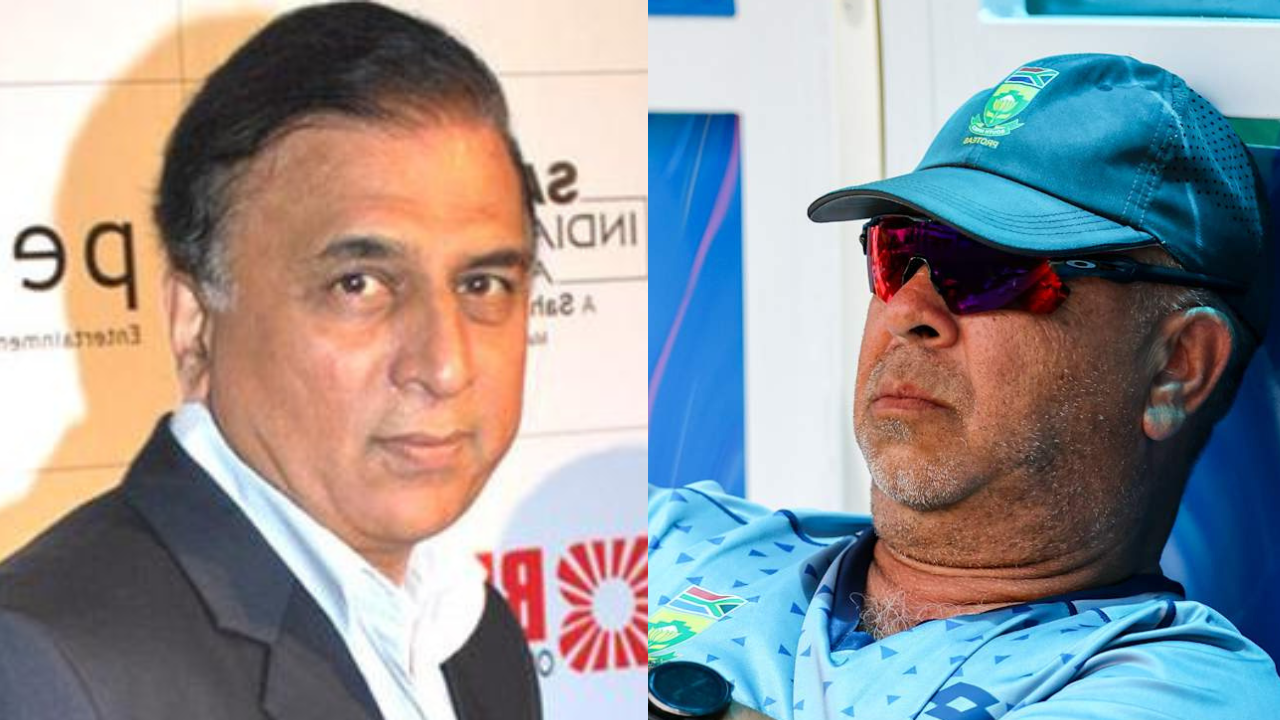
Gavaskar hits back at ‘grovel’ comment after South Africa’s Test dominance
Sunil Gavaskar has sharply criticised South Africa head coach Shukri Conrad for using the term “grovel” while describing his team’s strategy against India during the second Test of the recent series.
The comment came at the end of Day 4 in Guwahati, where Conrad outlined South Africa’s intent to wear India down and push for a win.
“And then, obviously, we wanted the Indians to spend as much time on their feet out in the field, we wanted them to really grovel, to steal a phrase, bat them completely out the game, and then say to them ‘Come and survive on the last day and an hour this evening.’ So, so far so good, but we also know that they’re not just going to roll over, we’re going to have to be at our very best in the morning,” Conrad said during the post-day press conference.
His choice of words drew instant criticism, with Gavaskar addressing the issue during the Jio Hotstar show Cricket Live, aired during the India–South Africa first ODI in Ranchi.
A historical parallel: the weight of the word ‘grovel’
Gavaskar’s criticism wasn’t just about language — it was about legacy. In 1976, England captain Tony Greig had infamously used the same word ahead of a Test series against the West Indies, sparking outrage and accusations of racial insensitivity. The phrase has since carried an uncomfortable historical weight in cricketing circles.
“India enabled South Africa’s return to world cricket”
Gavaskar reminded Conrad — and the global cricket community — of India’s foundational role in South Africa’s re-entry into international cricket after decades of isolation during apartheid.
“The Indian cricket board played a huge role in South Africa’s re-entry into international cricket. This is why I think there should have been an understanding from South Africa’s end that if they are in international cricket today, it is due to Indian cricket. The first tour they did after their readmission was that of India. Keeping this in mind, they shouldn’t have used this word,” Gavaskar said.
He reiterated this point with added historical clarity, saying:
“You could say it was an ill-advised use of the word. We need to look back at South Africa’s re-entry into international cricket. It was the Indian Cricket Board that proposed South Africa’s re-admission after more than 20 years of isolation. And their first international match on return was played in India,” he noted.
Indian-owned SA20 franchises have transformed South African cricket
Beyond history, Gavaskar turned the spotlight on present-day realities. He pointed to the overwhelming presence of Indian investment in South African cricket, particularly in the SA20 league.
“Another big point is that the Indian franchises are in majority in the SA20. Five out of the six franchises are Indian-owned. The employment for South African players is thus created by the Indian cricket franchises. So they need to show a little gratitude towards that. It was a wrong word (used by Conrad),” he added.
He further elaborated on how these investments benefit not just the top-tier cricketers, but emerging talent as well:
“When you consider the current landscape of South African cricket, especially the SA20, five out of the six franchises are Indian-owned. These owners are significantly supporting South African players–not just the international stars who are well taken care of, but the fringe players as well–giving them opportunities to build strong careers,” he continued.
No apology needed, but acknowledgment is
Gavaskar made it clear that while he doesn’t expect an apology, he believes Conrad should publicly address the remark and its implications.
“I hope that in his next media interaction, he addresses it. I don’t think an apology is necessary; I personally don’t believe in apologies. But acknowledging it and making up for it would be accepted by everyone. These things happen. In the heat of the moment, you can get carried away and say something that goes a bit over the top. Given the strong connection between Indian and South African cricket over the last 30 years, I think he can simply clarify that he got a bit carried away,” he added.
Gavaskar concluded with a broader perspective on the enduring relationship between the two cricketing nations.
“Indian and South African cricket have shared a positive, collaborative relationship for decades. Across all the years and encounters between the two teams, the cricket has always been competitive and tough, but never hostile. I have witnessed nearly every India-South Africa contest, and it has always been hard, fair cricket. Nothing beyond that. So yes, it may have been an ill-advised remark–wrong time, wrong place,” Gavaskar stated.
Test series result adds intensity to controversy
The context around Conrad’s remark adds to the tension. South Africa had already dominated the series, defeating India 2-0. After defending a modest target in Kolkata in the first Test, they crushed India by 408 runs in the second Test at Guwahati — a performance that gave weight to Conrad’s assertion, but also raised questions about sportsmanship and perspective.
Gavaskar’s intervention ensures the episode won’t be brushed aside quietly — especially when history, economics, and diplomacy are all so closely tied to one poorly chosen word.
India, however, responded swiftly in the ODI series opener in Ranchi. Powered by Virat Kohli’s commanding 135 off 120 deliveries, India posted a formidable 349. South Africa came close in the chase but could only manage 332, giving India a 17-run win and an early momentum shift in the white-ball leg of the tour.