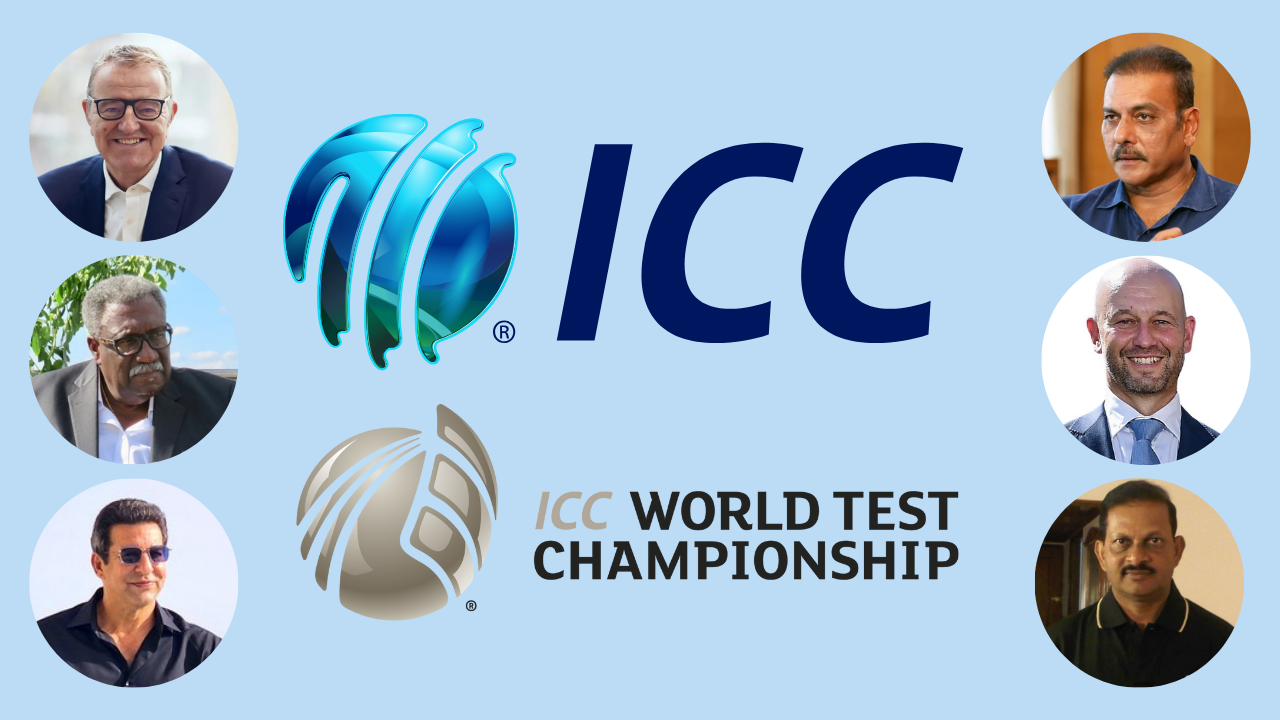
ICC scraps two-tier WTC model after widespread resistance
A proposed two-tier model for the World Test Championship (WTC), long under discussion as a way to bring more competitiveness and structure to Test cricket, has been officially shelved after it failed to gain the necessary support among Full Member nations. According to a report by ESPNcricinfo’s Tristan Lavalette, the International Cricket Council (ICC) has instead decided to expand the WTC to include all 12 Full Member teams in a single division starting with the 2027–29 cycle.
This recommendation came from a working group led by former New Zealand batter Roger Twose, formed during the ICC’s annual conference in July. The group was tasked with addressing structural concerns across all three formats, particularly with Test cricket’s long-term viability.
The expanded model aims to ensure broader participation, with a board director telling ESPNcricinfo, “It guarantees that everyone is playing Test cricket.” The director added, “Those that really want to play the format now have opportunities and there is an incentive for other teams to play them.”
Concerns over relegation and financial risk stall the plan
The idea of relegation within the two-tier system met stiff resistance — not just from potential second-tier teams like West Indies, Pakistan, and Sri Lanka, but also from powerhouses wary of their own future competitiveness.
In an interview on BBC’s Test Match Special in August 2025, ECB chairman Richard Thompson expressed strong concerns over the implications: “There are many options on the table. Tiers are one of them. But if England has a dip in form, should that mean we’re dropped into Division Two and don’t play India or Australia? That shouldn’t happen. We need to apply some common sense.”
Thompson also emphasized the current model’s emotional and sporting value: “The WTC has helped create a narrative and added meaning.” Reflecting on South Africa’s win in the last cycle, he said, “Seeing South Africa win was powerful. I know people like Graeme Smith, and to see him in tears on the outfield showed how much it meant.”
Akram, Lloyd, PCB reject ‘elitist’ system
Among the most forceful critics of the two-tier concept was Pakistan legend Wasim Akram, who challenged the premise entirely during the 2025 Cricket Impact Summit & Expo: “First of all, who’s deciding this? Whose idea was it?” he asked. “I can understand if there were 20 teams — then maybe you can have two tiers. But there are only ten or eleven. That doesn’t make any sense.”
Akram voiced concern over further isolating smaller teams: “Usually India, South Africa, England, Australia, New Zealand — they play mostly among themselves anyway. So why have two leagues? It doesn’t make sense.” Calling for pragmatism, he added, “I hope somebody puts some sanity into this idea.” Instead, Akram proposed a merit-based solution: “There should be qualifying rounds — simple math. Nobody will complain.”
Former West Indies captain Sir Clive Lloyd echoed these sentiments, calling the plan inequitable and damaging. As quoted by the Trinidad & Tobago Guardian, he said: “It will be detrimental to all those countries that work so hard to achieve Test-match status, as they will end up playing among themselves in a lower tier.” He asked, “How are they supposed to reach the top? Competing against stronger teams helps you improve. That’s how you determine how good or bad you are. I am very disturbed by this.” He concluded, “The system is not equitable.”
The Pakistan Cricket Board (PCB) also strongly opposed the move, calling it exclusionary and short-sighted. A senior PCB official told Cricket Pakistan, “Cricket is not the property of just a few powerful nations.” The official warned, “Smaller teams can only improve if they are given regular opportunities to play against top-level competition.” Highlighting the broader impact, they added, “Even if we make Division One, what about the rest? This isn’t just about Pakistan. It’s about keeping Test cricket alive beyond five or six countries.” The official also asked, “If you isolate teams like Bangladesh or West Indies from playing top-tier opponents, how will they ever improve?”
Some voices still see merit in a tiered model
Despite its abandonment, the two-tier WTC proposal had influential supporters. Former India coach Ravi Shastri, speaking to SEN Radio earlier in 2025, stressed the need to showcase top teams to retain fan engagement: “It serves as a strong reminder to the ICC that the best teams should compete against each other for Test cricket to thrive. There is too much clutter otherwise.”
During the final Test match between India and Australia in Sydney in January 2025, Ravi Shastri expressed his satisfaction with the crowd turnout and emphasized the importance of showcasing the best teams to ensure the survival of Test cricket. Shastri went further: “This match highlights the necessity for a two-tier system, featuring the top 6-8 teams, along with promotion and relegation. We will not attract these kinds of crowds unless we have two competitive teams playing against each other.”
Similarly, Lalchand Rajput, current head coach of the UAE, backed the idea as a way to increase competitiveness. “Such a system would foster healthy competition and enhance the excitement of the sport,” he said. “In this setup, the best teams would face each other more frequently, while lower-ranked teams would have a clear incentive to perform well in order to climb into the top tier.” He also proposed a model inspired by India’s domestic structure: “Following a World Test Championship (WTC) cycle, the bottom two teams from the top six could be relegated to the second tier, while the top two teams from that tier could be promoted.”
Cricket Australia calls for balance
Cricket Australia CEO Todd Greenberg, speaking to SEN Radio, offered a conditional stance. While acknowledging the challenges faced by smaller boards, he urged solidarity among top nations: “Those countries can’t do it alone. We all need to help. I’ve spoken to many board CEOs and there’s a shared understanding that some changes are needed to bring more value to Test cricket.”
As for the two-tier idea, Greenberg remained open but cautious: “If it gives them more resources and opportunities, I’ll support it. But if it ends up hurting them, then I won’t.”
ODI Super League revival back on the table
While the Test model saw major pushback, the ICC appears to be considering a revival of the ODI Super League, which was previously scrapped after the 2023 World Cup. The original 13-team league was created to inject meaning into the 50-over format but was short-lived due to scheduling pressures.
According to the same ESPNcricinfo report, there is renewed optimism that the structure could help restore the ODI format’s relevance. One administrator said, “The Super League could help revitalise the 50-over format.” The administrator added, “Maybe the problem is not that the format is necessarily dead, it’s finding the proper structure.”
The league could return no earlier than 2028, though exact details on team numbers and scheduling remain under discussion.
Looking ahead: balancing legacy and evolution
Despite the intense debate and polarised viewpoints, the ICC’s decision to maintain a unified World Test Championship reflects a growing consensus that inclusivity and opportunity must guide the sport’s future. As the next cycle approaches, cricket’s leadership will continue to face the challenge of balancing commercial interests with the game’s global growth — a task that will define the direction of Test cricket for years to come.