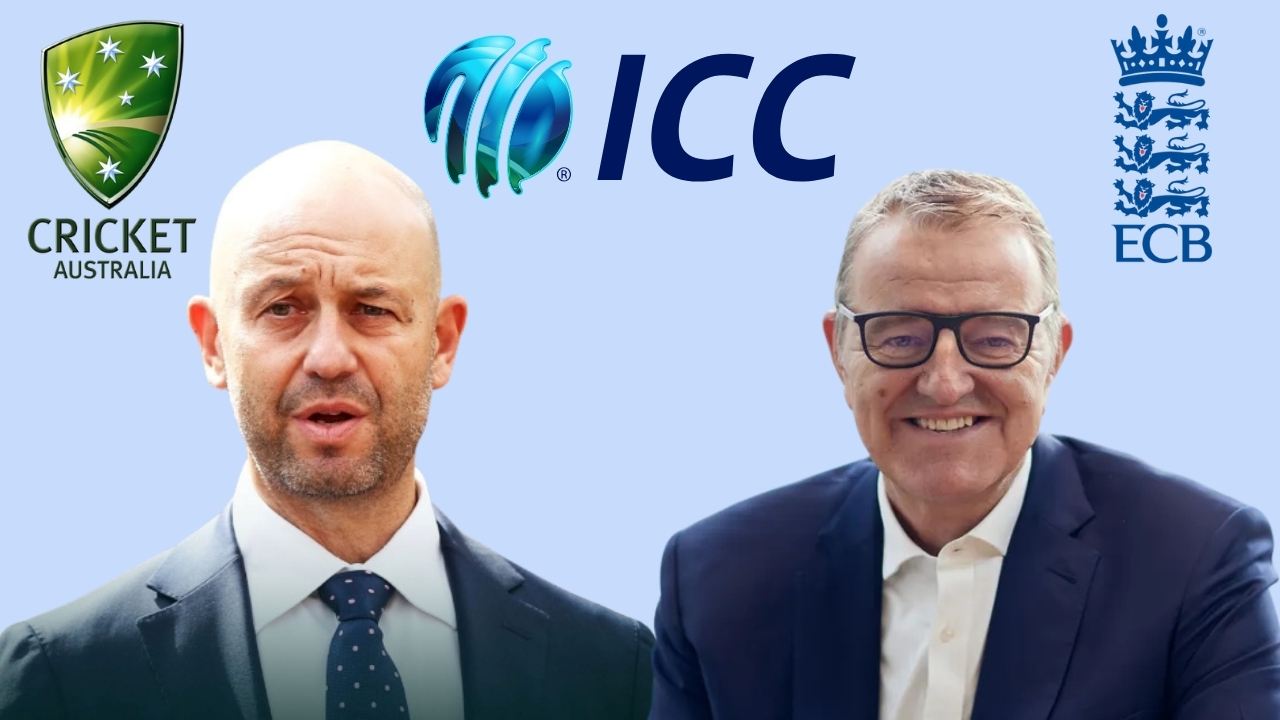
The England and Wales Cricket Board (ECB) has voiced concerns over a proposed two-tier Test cricket structure, warning that it could jeopardize marquee series against India and Australia. The idea, under renewed discussion by the International Cricket Council (ICC), is aimed at revitalizing the longest format amid a congested global calendar.
The ICC recently set up a working group to explore reforms for Test cricket, with the two-tier model — long debated since at least 2009 — emerging as a key option. Under the proposal, the current nine-team World Test Championship (WTC) would expand to two divisions of six teams each.
ECB fears competitive drop could block key fixtures
ECB Chairman Richard Thompson acknowledged the model is among several being assessed but stressed the need for “common sense” to preserve the sport’s most valuable rivalries.
“There’s a lot of options that we’ve got to look at – tiers would be one of them,” Thompson said on BBC’s Test Match Special at the start of the England-India Oval Test.
“We wouldn’t want, as England, we may go through a fallow period, and that means, what, we fall into Division Two and we don’t play Australia and India? That couldn’t happen. There has to be a sense that common sense needs to play out here,” he added.
Thompson also praised South Africa’s recent WTC title win and backed efforts to strengthen the tournament’s structure, but cautioned against changes that could reduce the appeal of flagship series. Ultimately Thompson indicated that minor changes, rather than a complete overhaul, may suffice:
“The reality of it is, the World Test Championship, if it was improved upon and certain changes were made, maybe you don’t need two tiers of Test cricket. What you do need is a schedule that makes a lot more sense than it currently does, and that must include the volume of bilateral cricket that you play, white-ball and red-ball, and recognising that from 2028, we have an Olympics.”
Cricket Australia calls for global Test strength
Cricket Australia CEO Todd Greenberg expressed a similar balance of caution and openness to change, framing the issue as a responsibility for leading nations to help others thrive in Test cricket. Speaking to SEN Radio, he explained:
“When I say we, those three countries that [are] putting resources and energy into Test cricket, what role do we have to help others make sure that they step up because it’s in our interest to see a strong West Indies, a strong Pakistan, New Zealand, [and] South Africa.
“We want those countries being strong in this format of the game, but clearly they’re going to need help. They can’t do it alone. It’s incumbent on all of cricket to help.”
Greenberg made clear that his support hinges on whether the model delivers real benefits to emerging and mid-tier cricket nations.
“My open mind is in reference to, if it helps grow the opportunities for those other countries to be stronger, and have better resources in Test match cricket, if it does that, then I’m open for it,” he said.
“But if it doesn’t achieve that, and it actually affects the opposite, then I wouldn’t be supportive,” he concluded.
“Talking to CEOs of the West Indies and other [boards], when I was with them recently, everyone’s got a very open mind to this because they know that we’re going to need some level of change in order to extract value in this part of the game.”
Long-running debate with no easy answer
The two-tier Test concept has split opinion among full ICC members for over 15 years. Proponents argue it could create more competitive matches and opportunities for developing cricket nations, while opponents warn it risks sidelining storied rivalries and locking lower-ranked teams out of lucrative series.
With the ICC review ongoing, the challenge will be finding a model that balances competitiveness, commercial appeal, and the survival of traditional Test contests that remain the format’s greatest draw.