
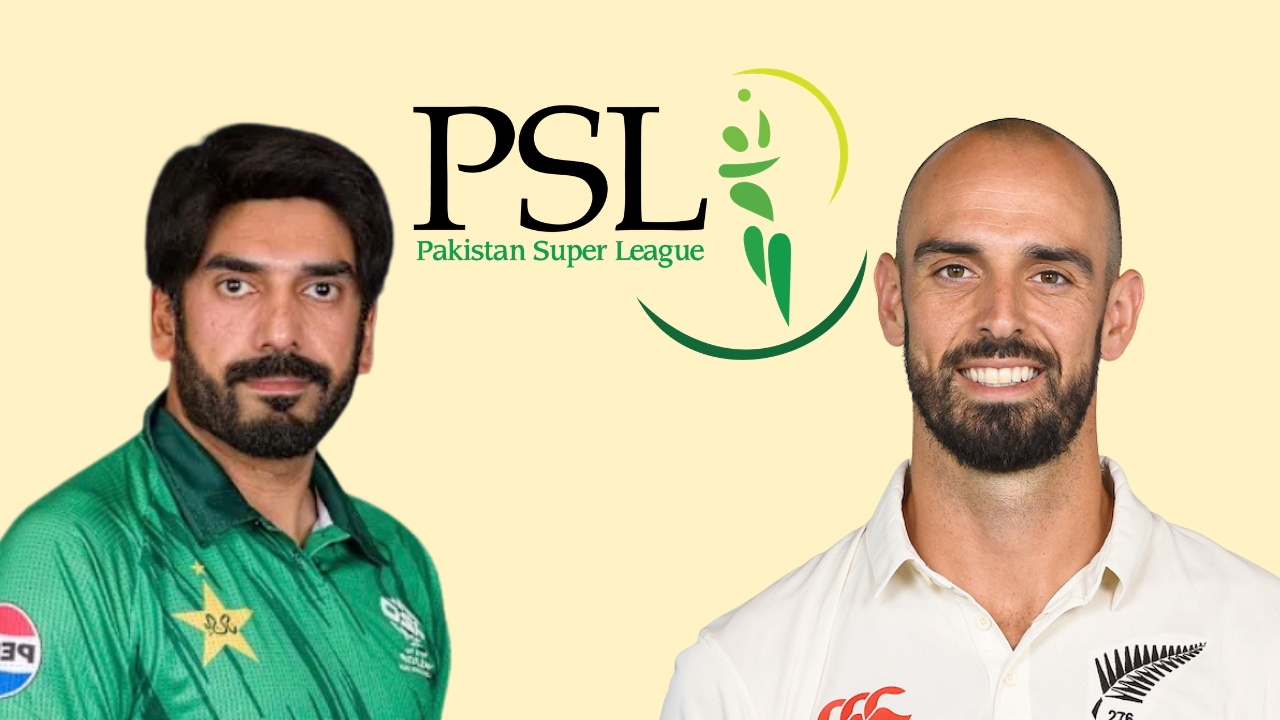
Cricket has always made room for the unorthodox. But sometimes an unusual technique goes from being curiosity to controversy — and on April 10 in Karachi, Usman Tariq reached that point in the space of a single over.
What unfolded during Quetta Gladiators‘ PSL 2026 clash against Rawalpindi was a moment that pulled in umpires, former internationals, and social media in equal measure.
The over that started it all
Quetta had posted 182/6 in 20 overs, with Rilee Rossouw’s 53 providing the foundation. Rawalpindi’s chase never gained traction, and by the time Tariq came into the attack in the middle overs, the match was already tilting.
The off-spinner’s action is distinctive by any measure. He employs a stop-and-pause, side-arm technique that disrupts a batter’s rhythm and makes the point of release difficult to anticipate.
Daryl Mitchell, facing Tariq during the ninth over at the National Stadium, was visibly unsettled. He backed away from his stumps more than once, signalled to the umpire that he was not ready, and made his discomfort clear.
The on-field umpires intervened, held a brief discussion with Mitchell, and allowed play to continue. Mitchell was eventually dismissed for 30 off 32 balls, caught and bowled by Saud Shakeel, as Rawalpindi were bowled out for 121 — losing by 61 runs. Tariq finished with two wickets from four overs.
Ashwin steps in — and takes a clear position
It was Ravichandran Ashwin who gave the incident its sharpest analytical framing. The former India off-spinner, who had previously discussed Tariq’s action on his YouTube show and even advised batters to use the laws of the game as a counter, took to X to weigh in directly. “Now it’s up to the umpires and match referees to time the pause for his delivery. If the pause isn’t consistent, then the batter has every right to move away. The captains & opposition batters should raise this issue with the umpires and match referees before the game begins. Well done Mitchell,” he wrote.
Now it’s upto the umpires and match referees to time the pause for his delivery.
If the pause ⌚️ isn’t consistent, then the batter has every right to move away.
The captains & opposition batters should raise this issue with the umpires and match referees before the game begins.… https://t.co/16dreiVxlL
— Ashwin 🇮🇳 (@ashwinravi99) April 11, 2026
The post cut to the heart of the debate. Ashwin’s position was not that Tariq was doing anything illegal — it was that consistency is the standard by which the action must be judged, and that the burden of establishing that consistency falls on officials, not on batters to simply absorb the disruption. Responding to a fan who pushed him further on the matter, he added, “Mitchell is right So is Tariq The timing of the pause should be timed to see if he delays it ball to ball.”
Mitchell is right✅
So is Tariq ✅The timing of the pause should be timed to see if he delays it ball to ball. https://t.co/nOeEsJh6vw
— Ashwin 🇮🇳 (@ashwinravi99) April 11, 2026
Ramiz Raja’s on-air moment
The incident had already drawn attention in the commentary box during the match itself. Ramiz Raja, calling the game on air, captured the confusion in real time. “Can he withdraw from the action?” he asked — a question that, in the moment, had no clean answer. His follow-up was more measured, balancing the batter’s frustration against the need for composure. “I think the umpire is going to sort this out. I think Daryl Mitchell has got to be just a way bit better than that,” he said.
Tariq’s action — the history behind the pause
Tariq’s technique has attracted scrutiny well before this PSL season. He has been reported for a suspect action twice and cleared on both occasions, but the questions have never fully gone away. Speaking to The National during the ILT20 in January 2026, he addressed the physical reality behind his style. “There are two corners on my elbow which make it hard for me to straighten fully,” he said — an explanation that locates the action not in deliberate manipulation but in anatomy.
On the broader question of his clearances, he was equally direct. “As history shows, whenever spinners are accused of chucking, they go for lab tests, modify their action, and work on the correct degree of flexion. That sometimes confuses spectators. I have undergone two official tests in Pakistan, and my action was cleared. Unlike others, I didn’t have to change anything. I am confident because I know I am not throwing,” he told The National.
It is worth noting that Ashwin himself experimented with a pause in his bowling action earlier in his career — one that was ultimately ruled illegal as it was deemed a deliberate attempt to distract the batter under MCC laws. In Tariq’s case, the pause is considered a natural feature of his action, a distinction that has so far kept him within the laws but has not silenced the debate.
Tariq fires back — with the rulebook
Speaking at a PSL press conference, Tariq described the exchange with Mitchell in his own words, recounting it with a calm that suggested he had expected the confrontation. “When Daryl Mitchell stepped back, I asked him what happened. He said, ‘You were taking a pause.’ I replied that I could take a pause a second time, a third time, and even a fourth time. Then it was clarified to him that he cannot do that; Usman’s action is within the laws,” he said.
His response to Ashwin’s public remarks came via Instagram — and carried a pointed edge. Citing the laws around unsporting conduct, Tariq posted: “Unsporting Conduct (Foul Play): If the batter does this continuously to deliberately distract the bowler or waste time, it can be deemed unfair play. The umpire has the discretion to warn the batter, and if it continues, issue a penalty (usually 5 penalty runs to the fielding side). Happy to hear 5 penalty runs. Keep it up.”
The post flipped the framing entirely — positioning Mitchell’s repeated withdrawals not as a legitimate protest but as potential foul play in its own right, and inviting officials to make that call if they wished.
A question the game must answer
What the Karachi incident ultimately exposes is not a flaw in Tariq’s action or a failure of nerve from Mitchell. It is a structural gap in how cricket’s officiating framework handles bowling techniques that sit at the edge of convention. Ashwin’s call for pre-match discussions between captains, batters, and match officials is a practical first step — but it also underlines how reactive the current system is, addressing these situations after they boil over rather than before.x


