
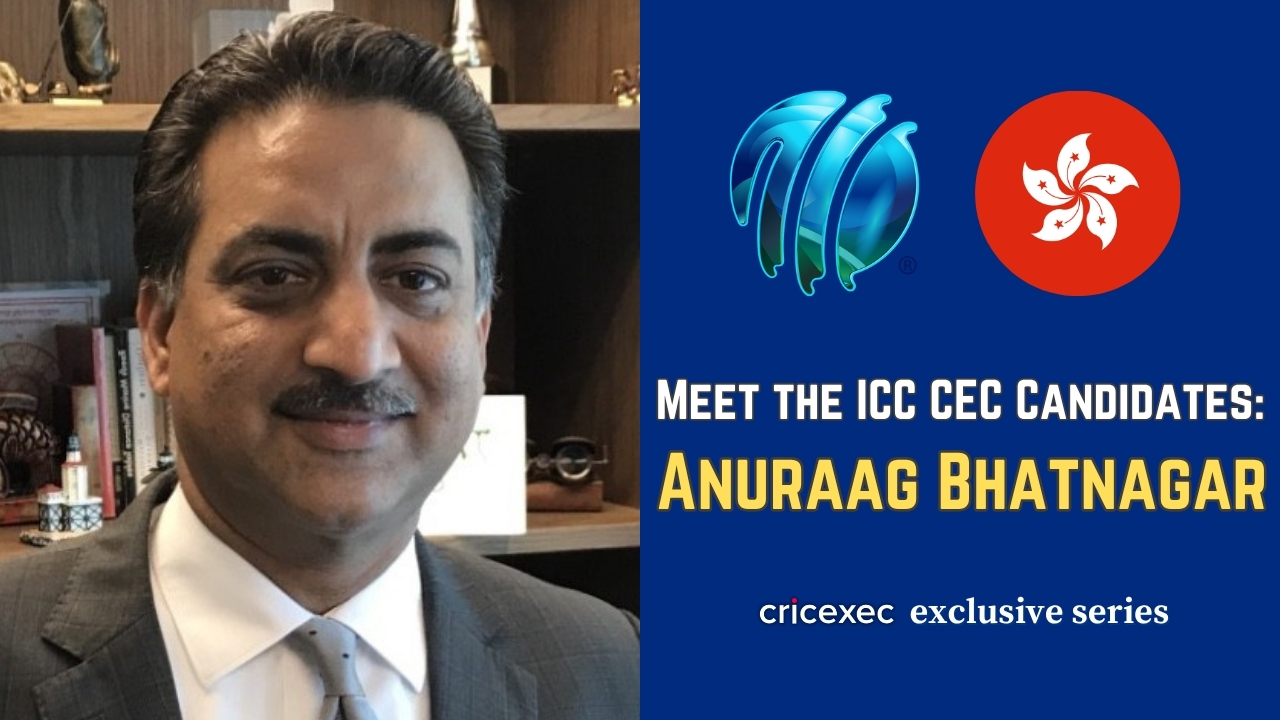
cricexec’s feature this week – “Meet the ICC CEC Candidates” — spotlights the eight Associate Member chiefs contesting for three seats on the International Cricket Council’s (ICC) Chief Executives’ Committee (CEC).
Anurag Bhatnagar is currently Member, Board of Directors and Director – Marketing of Cricket Hong Kong
What is one of the most pressing issues facing the cricket world today and what should be done to address it?
Cricket is presently thriving, with record revenues and viewership. It will be a medal event at the LA Games in 2028, the first time after the Paris Summer Olympics in 1900. A great place to be for the sport.
But if we analyze the numbers, a majority of the revenue and viewership is generated from a handful of countries, with India leading both categories by a margin.
While India will continue to be the major contributor, it is important to develop the sport geographically and in new markets that have the potential to contribute to the growth of the sport.
One of the pressing issues facing the world of cricket is the growing gap between the 12 major Test playing nations and the Associate Member nations. Within the Associate members there are a few that are high performing, some that are hovering around that and the others where the sport is in its nascent stage and is developing.
Each member of the ICC has its unique challenges, but the two most obvious and common ones across all Associate members are :
- the lack of infrastructure and
- the lack of resources
Success breeds success. The best example is India. While cricket was a well-loved sport in the country, prior to the 1980s, performances on the world stage were at best patchy. There were limited successes in bilateral series, but nothing significant. Corporate interest was restricted to the public sector and wealthy benefactors. Private enterprise was all but absent from the sport.
Things started changing rapidly after the world cup win in 1983. There was more interest from corporate sponsors and liberalization of the economy gave a timely fillip and things started improving rapidly from 1991. With multiple television channels, came competition, and competition led to a continuous increase in commercial valuation of the sport in the country. The advent of the IPL boosted the popularity and the commercial value even further. This in turn led to the rapid development of infrastructure and therefore a massive increase in the talent pool. With proper strategy and management, India today has become arguably the colossus amongst cricket playing nations in the world.
Associate members are at a stage where they require support to be able to develop and keep pace with the majors. Closing the gap will then be a matter of dedication, effort, strategic planning and execution.
While the ICC does support all members with competition and score card grants, I believe that more can be done especially on the development of infrastructure in the Associate member countries. That would help smaller cricket playing countries in being able to develop proper development programs, attract the youth, both girls and boys into cricket, organize a proper domestic structure as well as international tournaments and events. Over time generating interest from local governments and corporates and be able to raise non-ICC revenue.
There are specific strategies that can be worked out for the development of Infrastructure, for regions and/or individual members, based on multiple variables. One size in this case certainly will not fit all.
The first step towards such an initiative would be increased interaction and communication between all stakeholders, transcending regional and individual agendas.
Continuous growth is the only solution for long term sustainability and there is a huge, barely tapped pool in the 96 countries that are Associate Members, with immense potential, both talent wise and financially.
Bio:
See Anurag Bhatnagar’s LinkedIn Profile
Candidate Position Statement:
I would like to work on
- Better and more frequent communication amongst the Associate Members and well as with the CEC
- Sharing of feedback in a timely manner
- Working with the CEC and the Board on solutions to help Associates with infrastructure development


