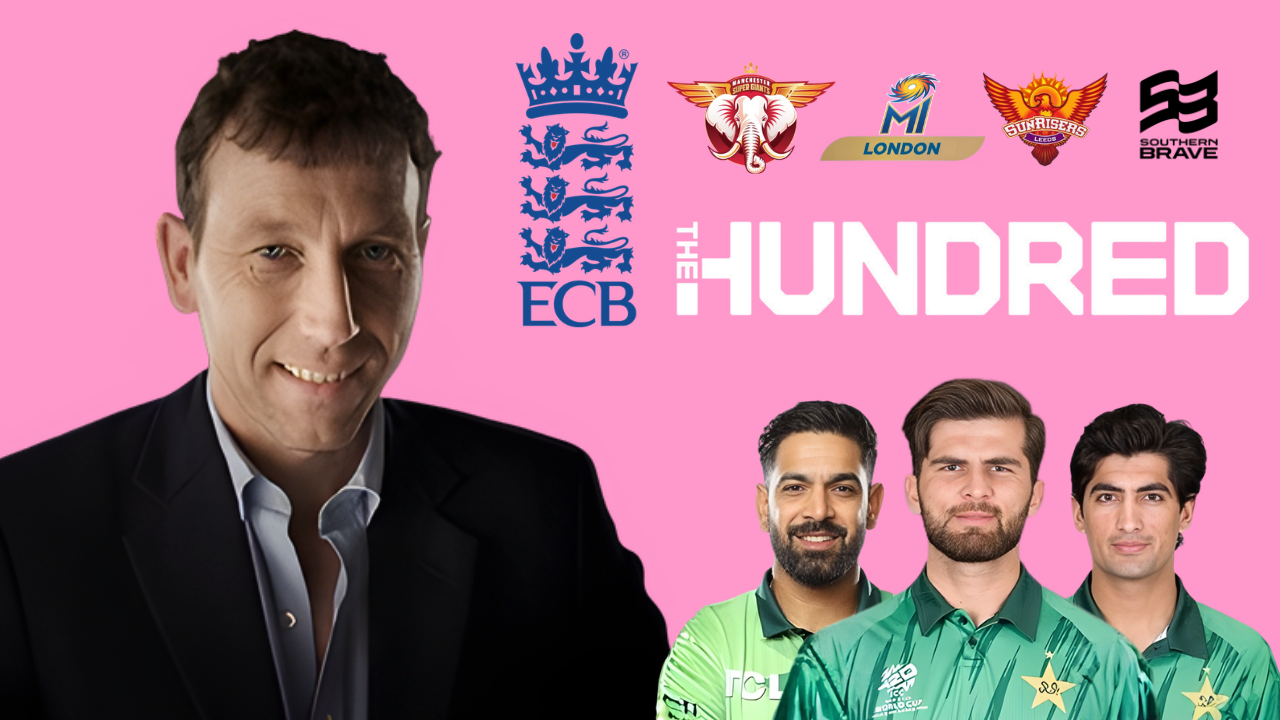
The Hundred’s first season under private franchise ownership has not yet begun — but already the competition finds itself at the centre of a governance test that could shape its global credibility.
Concerns over the potential exclusion of Pakistan players from IPL-linked Hundred teams triggered swift intervention from the England and Wales Cricket Board, prompting a formal letter to franchise owners and a coordinated public response. Writing in The Times, former England captain Michael Atherton argued that any move toward nationality-based exclusion would represent a fundamental threat to the tournament’s future.
Commercial and regulatory risk in focus
Atherton framed the issue not as theoretical noise, but as a serious governance flashpoint for English cricket’s flagship short-format competition. He wrote that the ECB’s rapid reaction highlighted “how important an issue this is — and how potentially risky it could be from a legal, regulatory and reputational perspective for the governing body’s flagship competition.”
The concern stems from the expanding footprint of IPL ownership groups across global franchise leagues. Four Hundred teams — Manchester, Leeds, Southampton and the Oval — now have IPL-linked investors, raising questions about whether geopolitical tensions in the subcontinent could spill into English domestic cricket.
Atherton warned that such a development would not be tolerated domestically, stating that “no one in England would countenance supporting a tournament that excludes players from Pakistan.”
ECB and franchises issue united response
In response to the speculation, the ECB and all eight Hundred franchises issued a joint statement reinforcing their position on inclusion and merit-based selection.
The governing body and team owners declared:
“The England and Wales Cricket Board and all eight of The Hundred team franchises reaffirm their commitment to ensuring The Hundred continues to be a competition that is inclusive, welcoming and open to all.”
They reiterated the founding purpose of the tournament:
“The Hundred was established to reach new audiences, grow the game of cricket and ensure that everyone regardless of their ethnicity, gender, faith, nationality or other – can feel they belong in our sport. This has been a guiding principle from the outset and remains at the heart of everything we do.”
The ECB underlined its regulatory authority over the competition, stating that there is no tolerance for discrimination and that “Players must not be excluded on the grounds of their nationality.”
All eight franchises further committed to selection being “based solely on cricketing performance, availability, and the needs of each team.”
The statement concluded by emphasising ambition beyond compliance:
“We want The Hundred to feature the very best talent from across the world, and will continue working proactively to ensure that the competition is a benchmark for inclusivity.”
IPL influence and shifting power dynamics
Atherton’s broader argument places this moment within a changing global cricket economy. Once a domestic Indian competition, the IPL’s financial strength has enabled its ownership groups to expand into South Africa, the UAE, the Caribbean, the United States and now England.
He noted that the intersection of commercial expansion and political climate has reshaped player mobility in certain markets, writing that “the way that subcontinental politics could come to influence domestic cricket in other parts of the world — were harder to foresee.”
The Hundred, however, operates under ECB jurisdiction and UK law. That distinction, Atherton implied, carries both regulatory responsibility and reputational consequence.
A wait-and-see moment for private ownership
While no exclusion has taken place and no auction has yet occurred under the new ownership structure, Atherton described the current phase as “a wait-and-see situation, as the owners will be judged on actions as well as words.”
He cautioned that if a discernible pattern were to emerge suggesting exclusion on grounds of nationality, race or religion, it would become “a fundamental threat for the competition: supporters, broadcasters, sponsors and, one imagines, players would not stand for it.”
For franchise investors who have committed significant capital in expectation of long-term returns, reputational stability is integral to valuation.
Inclusion as competitive advantage
Beyond risk mitigation, Atherton also pointed to opportunity. Rather than mirroring restrictive trends seen elsewhere, The Hundred could differentiate itself through openness.
He concluded that “Sport remains a vehicle for bringing people together and offering a welcoming hand across whatever divide exists.”
For a tournament still defining its global identity, the coming recruitment cycles will serve as an early test of whether principle aligns with practice.
The ECB and its franchises have publicly drawn a clear line. The market, supporters and players will now watch closely to see how that commitment translates when squad selections begin.