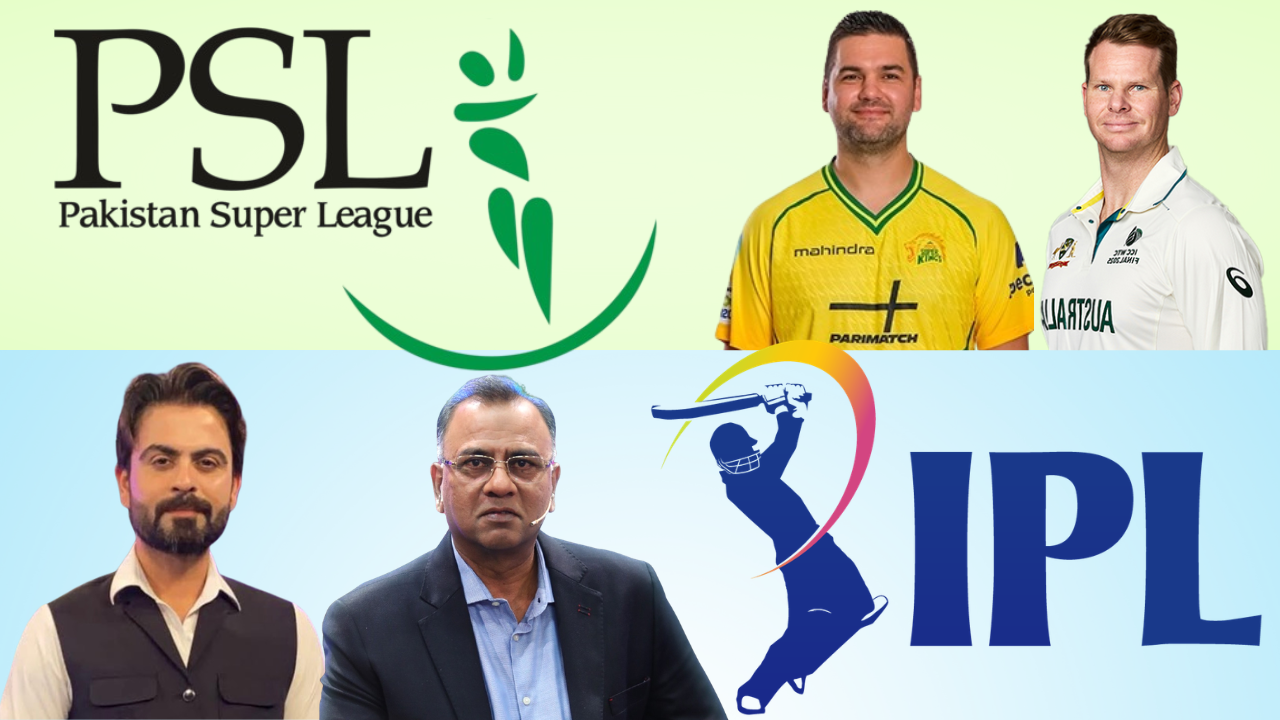
The overlap between the Indian Premier League and Pakistan Super League in 2026 has reignited a familiar but increasingly sharp debate, with players, pundits, and administrators drawn into a narrative that now stretches beyond simple comparisons and into questions of credibility, player movement, and media influence.
Basit Ali dismisses comparison culture as attention-driven
At the centre of the debate, Basit Ali used a recent appearance on a YouTube show to question the very foundation of IPL versus PSL discussions, framing them as driven more by visibility than substance. “Comparison karne wale bewakoof hein. Churan bikhta hai na? IPL pe sawal kardo, woh simple highlight ho jata hai. India mein aap Pakistan ke baare mein baat nahi kar sakte. Waha pe churan nahi bikta. (People who make comparisons are fools. It’s all about selling hype! Just talk about IPL and it will easily get you the attention. In India, you can’t talk about Pakistan. They don’t sell hype there),” Basit Ali said on Game Plan YouTube show.
His remarks reflect a growing sentiment within sections of Pakistan’s cricket discourse that the debate itself has become performative, amplified by viral clips and repetitive questioning rather than grounded in structural realities. The timing of overlapping seasons has only intensified this trend, with international players frequently being asked to weigh in, often in contexts that prioritise headlines over nuance.
Ahmed Shehzad questions player pool and PCB decisions
While Basit Ali targeted the narrative, Ahmed Shehzad directed his criticism toward both the system and its outcomes, particularly in relation to player availability and governance decisions. “The only players you have left in the PSL are those who retired from the IPL, went unsold in the IPL or have no IPL careers left in the IPL (David Warner, Steve Smith). Anyone at all who have a chance to play will only select the IPL. So how many more players you will ban?” Ahmed Shehzad said on his YouTube channel.
The comment came in the backdrop of the Pakistan Cricket Board’s decision to impose a two-year ban on Blessing Muzarabani after he withdrew from PSL commitments to participate in the IPL, a move that further exposed the tension between contractual enforcement and player preference. Shehzad extended his criticism to the handling of media interactions, pointing to the nature of questions directed at overseas players. “Kusal Mendis is playing, performing in PSL, and he is being asked questions like ‘sir, last time you left and went to IPL, what do you think about that?’ Look at what kind of questions they are asking,” Shehzad added.
That scrutiny also extended to player comments themselves, particularly those made in the heat of the ongoing debate. “Look at Rilee Rossouw – there is no clarity about his performances (in PSL), but he has made statements. And when he was asked about IPL – that what do you think about IPL – so while playing PSL, you obviously cannot praise IPL. So in that, he said, ‘Oh, that is a Bollywood movie. The cricket is happening here in PSL’” Shehzad stated.
Rossouw comments and Oram response add fuel to debate
The remarks referenced by Shehzad trace back to comments from Rilee Rossouw that quickly gained traction, as previously reported by cricexec, highlighting how player perspectives can rapidly shape wider narratives. Those comments were later addressed by Jacob Oram during a post-match press conference, where he responded candidly when asked about the comparison.
“Did you say like a movie?” Jacob Oram said at a post-match press conference.
That response came after Rossouw had earlier remarked in a sideline training ground interview, “Both leagues have their pros and cons. IPL is a very long tournament, and PSL is a much more compact tournament where the competition is a lot more fierce. IPL obviously has the whole Bollywood behind it, so it’s a lot more of a movie than actual cricket.” Oram then shifted focus to his own experience within the tournament environment, saying, “This is my first opportunity in the PSL and I’m loving it. The Islamabad United group, from staff to players, have been so welcoming. We are well looked after, well catered for, so far, so good here,” before adding, “I’d love to have crowds here for that vibe and atmosphere.”
Steve Smith offers on-ground perspective from PSL
Amid the noise surrounding comparisons, Steve Smith provided a more grounded view based on his first-hand experience in the league. “This is my first time experiencing the PSL. So far, it’s been fabulous. We’ve played some obviously really good cricket so far,” Steve Smith said in a video segment released by Multan Sultans.
His perspective introduces a contrast to the broader debate, focusing on the quality of cricket rather than the narrative surrounding it.
A debate shaped by perception, not just performance
What emerges from these layered viewpoints is a debate increasingly defined by perception gaps rather than purely on-field metrics. The IPL’s longer history since its 2008 launch, combined with its financial scale and global reach, continues to shape player preferences and media framing, while the PSL, established in 2016, operates within a different structural and commercial context.
At the same time, repeated questioning of players like Kusal Mendis has highlighted how the conversation itself can become a pressure point, forcing comparisons even when they are not organically raised. The resulting narrative loop — media prompts, player responses, and public reaction — continues to sustain a debate that figures like Basit Ali argue lacks genuine substance.
As the two leagues continue to overlap, the challenge for the PSL may not lie in competing directly with the IPL, but in redefining its own narrative — one that shifts focus from comparison-driven discourse to building a distinct identity in an increasingly crowded global cricket calendar.