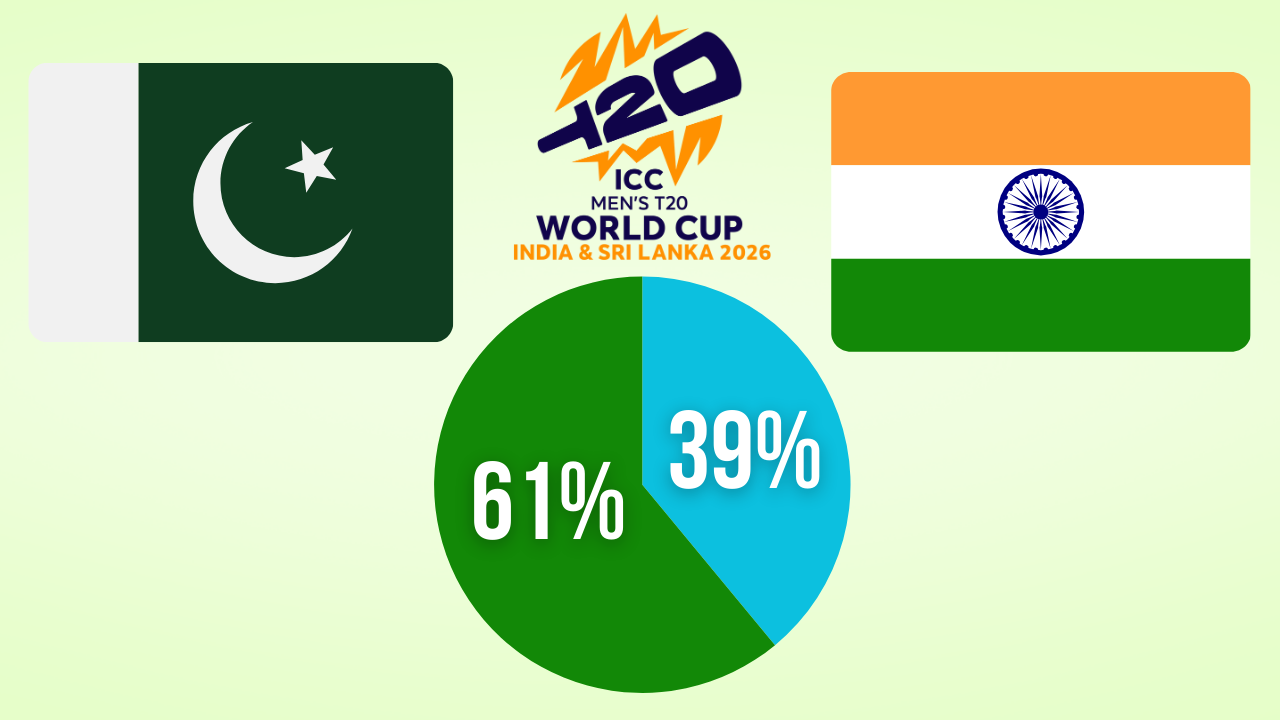
A new cricexec poll of global cricket industry executives suggests a clear — though contested — tilt towards Pakistan’s decision to boycott its February 15 T20 World Cup match against India in protest of Bangladesh’s exclusion from the tournament.
Asked whether Pakistan is justified in refusing to take the field against India while still participating in the ICC Men’s T20 World Cup 2026, 61% of respondents said yes, while 39% said no.
The result reflects a growing unease within the industry about ICC governance, consistency and precedent — even as a significant minority warns that selective participation risks undermining the very foundations of global tournaments.
A boycott framed as solidarity, not withdrawal
Pakistan’s position has been explicit from the outset: this is not a World Cup boycott, but a refusal to play a single fixture — the tournament’s most valuable — as an act of solidarity with Bangladesh.
That stance was formalised in a statement issued by the Government of Pakistan on X, which read: “The Government of the Islamic Republic of Pakistan grants approval to the Pakistan Cricket Team to participate in the ICC World T20 2026; however, the Pakistan Cricket Team shall not take the field in the match scheduled on 15th February 2026 against India.”
Pakistan Prime Minister Shehbaz Sharif has repeatedly underlined that the decision was political, deliberate and collective. Addressing his cabinet, Sharif said:
“We have taken a very clear stand that we will not play the match against India.”
He added: “We have taken this stand after careful deliberation and [decided that] on this matter, we must stand with Bangladesh and support them.”
And framed the rationale explicitly: “Pakistan believes that this is sport, not politics, and there should be no politics in sport.”
For many executives who voted “yes” in the poll, those statements matter. They place responsibility firmly at the level of government — not players or administrators — and align the move with past instances where government directives shaped participation without triggering sanctions.
Bangladesh’s exclusion as the trigger point
The boycott cannot be separated from the ICC’s decision to remove Bangladesh from the tournament after it refused to play its matches in India over security concerns — a request the ICC rejected.
That decision has become the emotional and ethical core of Pakistan’s position. Bangladesh’s Youth and Sports Adviser Asif Nazrul publicly welcomed Pakistan’s stance, writing: “Thank you, Pakistan.”
Former ICC and PCB chairman Ehsan Mani has argued that the ICC’s failure to accommodate Bangladesh created the conditions for the current crisis.
“There should definitely have been accommodation for Bangladesh’s concerns,” Mani said. “If Bangladesh had been accommodated, we wouldn’t find ourselves in this position now.”
Latif framed the boycott not as a sudden flashpoint, but as the result of a breaking point reached over time.
“Pakistan generally don’t take such decisions. The PCB is not even scared of sanctions. It will have a big impact,” Rashid Latif said.
He pointed to the fact that the two boards had recently found a workable rhythm, arguing that the rupture came only after the Bangladesh episode disrupted what had been an uneasy but functioning arrangement.
“Till now, everything was going well. Pakistan and India both agreed that we would play in a hybrid model for the next three years… Everything was going well, but things have changed since the Bangladesh episode happened.”
Mani has also been blunt about what he sees as inconsistency at the heart of the ICC’s response. “There can’t be any sanctions against Pakistan if it follows the government instructions. That was the basis on which India refused to play its 2025 Champions Trophy matches in Pakistan. You can’t have double standards.”
For executives aligned with this view, Pakistan’s refusal is less about India — and more about challenging what they see as uneven application of principle.
ICC pushes back on “selective participation”
The ICC, however, has drawn a firm line.
In a strongly worded statement, the governing body warned that Pakistan’s position was incompatible with the structure of global events. “This position of selective participation is difficult to reconcile with the fundamental premise of a global sporting event where all qualified teams are expected to compete on equal terms per the event schedule.”
The ICC went further, stressing that: “ICC tournaments are built on sporting integrity, competitiveness, consistency and fairness, and selective participation undermines the spirit and sanctity of the competitions.”
It also cautioned Pakistan about future consequences: “The ICC hopes that the PCB will consider the significant and long-term implications for cricket in its own country as this is likely to impact the global cricket ecosystem.”
Those warnings align closely with the 39% of executives who voted against Pakistan’s stance — a group that sees the boycott as a precedent that could be difficult, if not impossible, to contain.
Players stuck between politics and performance
While the debate rages above them, players have been clear that the decision is not theirs.
Pakistan captain Salman Ali Agha said: “It’s not our decision. We can’t do anything about it. We will do whatever our government and the PCB chairman say.”
He later added that even knockout scenarios would require political clearance: “If we have to play them in the semi-final or the final, we will go back to them and act on their advice.”
From India’s side, captain Suryakumar Yadav confirmed his team would follow ICC protocol regardless of Pakistan’s stance, saying: “We have not said no to playing the match. It came from the other side. ICC has given the official fixtures… Our flight is booked for Colombo. So we are going for sure.”
This imbalance — one team preparing to play, the other preparing not to — sits at the heart of concerns about competitive integrity.
Principle versus pragmatism
Reactions from former players and administrators mirror the poll split.
Mohammad Yousaf framed the boycott as a moral necessity: “A tough but necessary stand by our Government. Principles must come before commercial interests.”
Shahid Afridi echoed that support while challenging the ICC directly: “This is the moment for ICC to lead and prove through decisions, not statements, that it is impartial, independent and fair to every member.”
Others have urged restraint. Former England captain Nasser Hussain said on the Sky Sports Podcast: “I quite like Bangladesh sticking to their guns… I quite like Pakistan sticking up for Bangladesh as well. At some stage, someone should say, enough with this politics, can we just get back to playing cricket.”
Hussain also posed a question that has resonated across the industry: “If India, a month before a tournament, said ‘our government does not want us to play in a country for a World Cup’, would the ICC have been so firm?”
For others, the debate quickly turns from principle to consequence, particularly when it comes to the commercial weight carried by an India–Pakistan fixture at a global tournament. Rashid Latif was candid about the scale of what is at stake, pointing out that the rivalry drives a disproportionate share of World Cup attention, regardless of where the match is played.
“Whether it is in India or Pakistan, 60–70 percent of people watch the World Cup because of India–Pakistan matches,” Latif said.
That reality, Latif suggested, inevitably pulls broadcasters and commercial stakeholders into the centre of the standoff, making a clean resolution far harder to achieve.
“You know how powerful broadcasters are. They will find some solution,” he said.
Latif also warned that the consequences of a forfeit would extend well beyond India and Pakistan, affecting the wider balance of the international game and the boards that rely on ICC revenues.
“Now that Pakistan has joined, it will impact Australia and England financially as well… The businessmen are above our governments. Now the game has gone out of their hands.”
What the poll really tells us
The cricexec poll does not suggest comfort or consensus. Instead, it highlights a sport wrestling with its own governance framework.
A majority of executives appear willing to accept Pakistan’s boycott as justified — not because it is ideal, but because they believe the ICC’s handling of Bangladesh left little room for principled alternatives.
At the same time, a substantial minority fears the consequences of normalising selective participation.
As Ehsan Mani warned: “It will not be a simple matter of sanctioning the PCB. The Pakistan board would have a very strong defence.”
At 61–39, the industry verdict is clear — but fragile. Whether the ICC chooses enforcement, compromise or quiet diplomacy, the outcome is likely to shape not just this World Cup, but how global cricket navigates politics, precedent and power in the years ahead.