
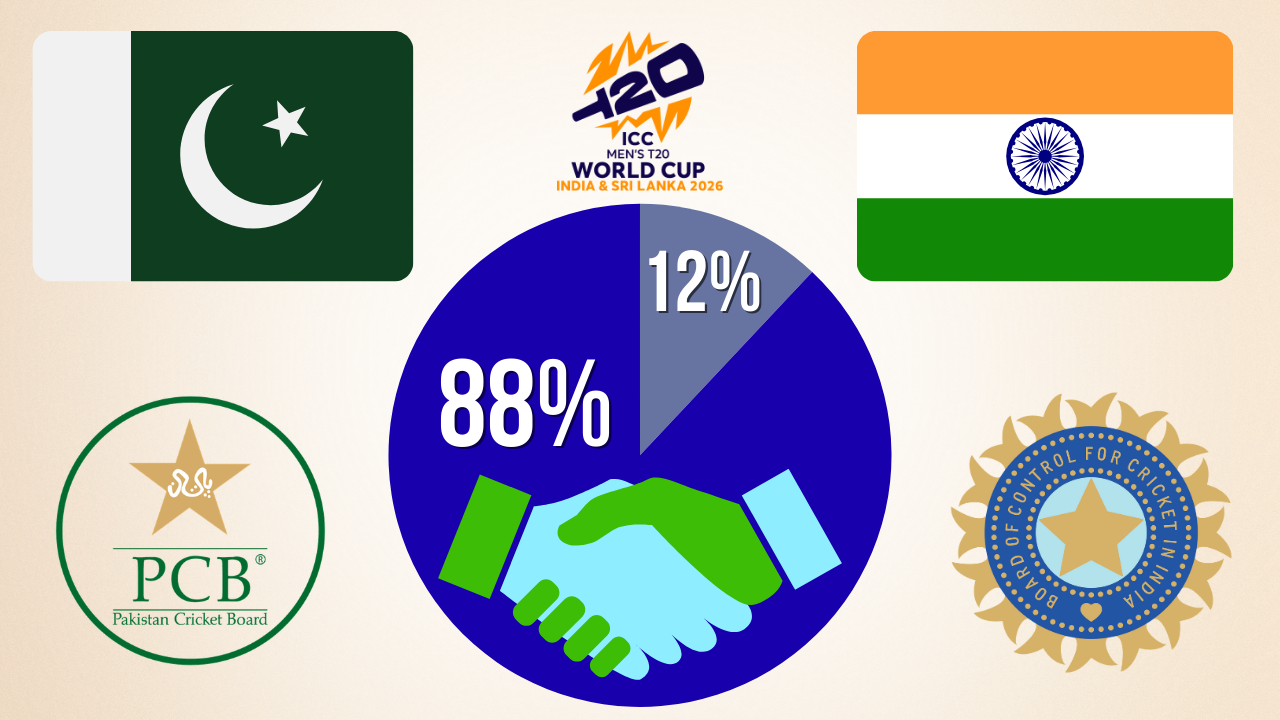
As India and Pakistan prepare to meet in Colombo on February 15 in the ICC Men’s T20 World Cup, one of cricket’s most symbolic questions has returned to the forefront: will there be a handshake?
A new cricexec poll of leading global cricket industry executives suggests the business and governance community believes there should be.
Asked, “Should India’s players now shake Pakistan players hands at their Feb 15 Men’s T20 World Cup match?” an overwhelming 88% said yes, with just 12% opposed.
The result marks a decisive shift in tone as cricket’s most commercially valuable fixture returns after weeks of diplomatic turbulence — and after months of controversy that have turned a simple sporting ritual into a geopolitical flashpoint.
From solidarity to standoff
India’s no-handshake policy began in the wake of the Pahalgam attack and first surfaced publicly during the Asia Cup 2025. At the time, India captain Suryakumar Yadav was unequivocal.
“Our government and BCCI, we were aligned. Together, we came here, we took a call,” he said. “I feel a few things in life are ahead of sportsman spirit.”
He went further, dedicating the victory to victims of the Pahalgam attack and to India’s armed forces.
A senior BCCI official reinforced the position, stressing that the handshake is “a goodwill gesture and a sort of convention, not law.”
The stance was later echoed by BCCI secretary Devajit Saikia, who said: “Everything is dependent on the geopolitical situation. The situation is not very conducive till now.”
From India’s perspective, the refusal was a sovereign symbolic act — not a breach of cricket’s laws.
Pakistan’s response: “Against sportsmanship”
Pakistan’s reaction was swift and emotional.
Head coach Mike Hesson said after one Asia Cup clash: “We were ready to shake hands at the end of the game. We were disappointed that our opposition didn’t do that. That was a disappointing way for the match to finish.”
Team manager Naveed Akram Cheema described the refusal as “against sportsmanship,” while PCB chairman Mohsin Naqvi called it “utterly disappointing” and warned that “dragging politics into the game goes against the very spirit of sports.”
Naqvi later clarified Pakistan’s position: “If they don’t want to shake hands, then we have no particular desire to do so either. Whatever happens, it will happen on an equal footing with India.”
The standoff escalated beyond gestures. Trophy presentations were disrupted. Post-match ceremonies were delayed. The Asia Cup silverware itself became symbolic collateral.
ICC neutrality, but no mandate
The International Cricket Council has consistently framed the matter as symbolic rather than regulatory. There is no law in the playing conditions that mandates a handshake, and the ICC has not sought to impose one.
“There is no specification about shaking hands with the opposition,” a BCCI official noted, and the ICC has not imposed any mandate requiring it.
When Pakistan reportedly raised the issue in discussions ahead of the February 15 clash, the ICC made clear it would not intervene in matters of custom. In effect, the governing body has drawn a line: participation is mandatory under event regulations — handshakes are not.
A rivalry drifting from ritual
What began with one men’s fixture has since spread across formats. Handshakes were absent at the Women’s World Cup, at the Rising Stars Asia Cup, and even at Under-19 events.
Former Pakistan fast bowler Shoaib Akhtar lamented the symbolism: “Do a handshake. It’s a game of cricket. Show your grace. I would go and shake hands with my enemies.”
At the Cricket Impact Summit & Expo in California, Pakistan legend Wasim Akram delivered a broader warning: “Keep politics out of cricket. Sports should be away from politics. It doesn’t matter which country you are from — this is simple.”
Even India’s 1983 World Cup-winning captain Kapil Dev urged perspective: “We should look into the sports side rather than looking into the politics side… we should stick to sports.”
February 15: a reset moment?
The February 15 World Cup clash almost did not happen. Pakistan initially announced it would boycott the fixture in solidarity with Bangladesh before reversing course.
In its official statement authorising participation, the Government of Pakistan said the decision was taken “with the aim of protecting the spirit of cricket, and to support the continuity of this global sport.”
The ICC underscored its guiding principles of “neutrality and fairness,” while confirming that no penalties would be imposed on Bangladesh and that members must honour participation commitments.
With the boycott threat lifted, cricket’s most commercially significant fixture was preserved.
Now, the cricexec poll suggests that industry leaders see the handshake as the final symbolic test.
Why the industry is leaning “yes”
The 88% result is striking not simply because it favours handshakes — but because it comes after months of escalation.
Executives who overwhelmingly opposed India’s original Asia Cup stance are now signaling that this is the moment to de-escalate.
In a commercial ecosystem built on broadcast rights, sponsorship stability and global optics, symbolism matters.


