
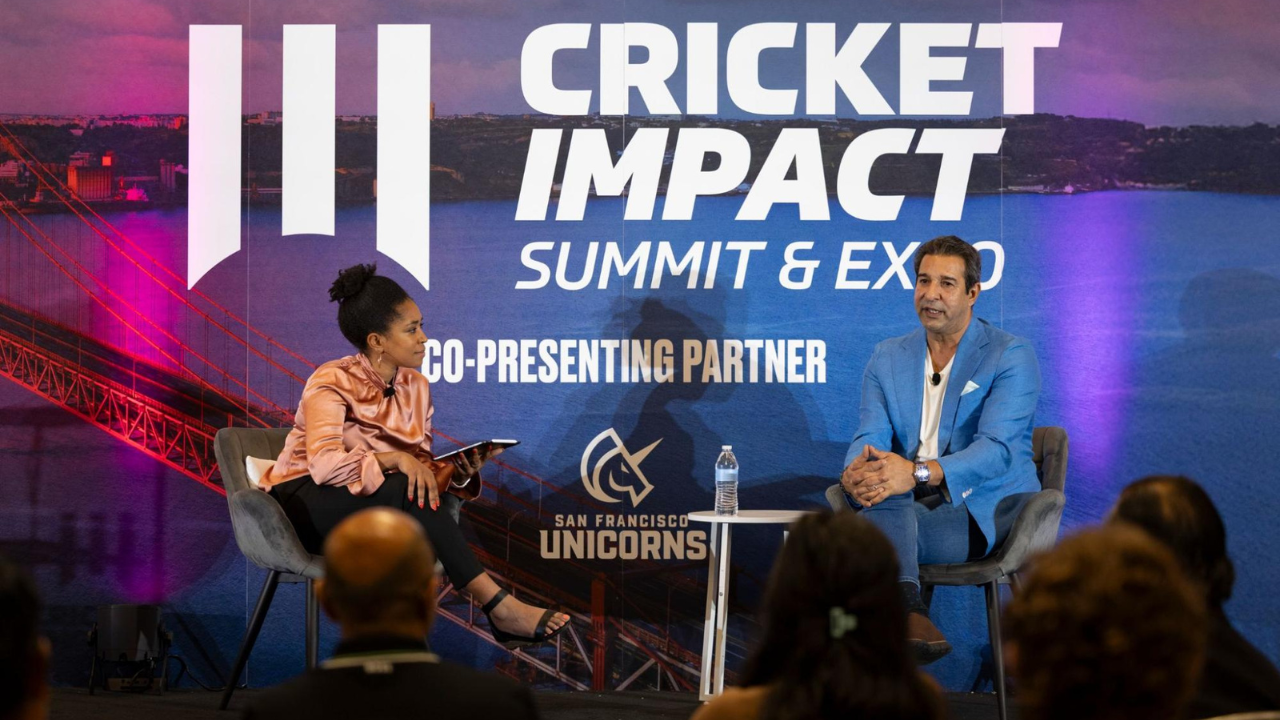
SANTA CLARA, CA — At the Cricket Impact Summit & Expo 2025, Pakistan legend Wasim Akram used his on-stage interview with Ebony Rainford-Brent MBE to deliver a clear message that resonated far beyond the ballroom: cricket must never become hostage to politics.
Speaking to a packed audience in Santa Clara, Akram reflected on his playing days and the spirit that defined cricket’s fiercest rivalry — India versus Pakistan.
“We were friends. We shook hands with each other — even when the politics between our countries was tense,” he said. “Our job as players is to create harmony and love between each other. The people will follow — not the other way around.”
Akram recalled that even during moments of military tension between the two nations, respect and camaraderie on the field always came first.
“Even in 1999, when things were difficult politically, players were fine,” he said. “Our job is to create harmony, love, and respect. The people will follow.”
The 1999 citation is a reference to the Kargil conflict between Pakistan and India.
He shared how senior players and captains from both sides made it a point to build friendships off the field — a tradition he believes helped defuse the intensity of the rivalry.
“Our captains used to tell us to go out, have dinner with the opposition, get to know them,” Akram said. “Once you know someone as a person, it’s much harder to see them as an enemy.”
Over the years, Akram formed enduring bonds with many of India’s greats — friendships that stood as proof that sport can rise above politics. He spoke warmly of Sunil Gavaskar, whom he credits for always showing him respect even in his early days, and of Ravi Shastri, affectionately calling him “Shaz.” He also reminisced about facing a teenage Sachin Tendulkar, remembering their first encounter in Karachi.
“He was only 16,” Akram laughed. “We had read in the papers about this amazing young talent from India, and I thought, how good could he really be? But after a few balls, I realized — welcome to Test cricket. He was something special.”
The former Pakistan captain contrasted that era of friendship with today’s polarized climate, warning that the game’s unique ability to bridge divides is being undermined.
“I think the first suggestion I would give is: keep politics out of cricket,” Akram said to applause. “Sports should be away from politics. It doesn’t matter which country you are from — this is simple math. I hope people understand that life should be that simple.”
Rainford-Brent’s conversation with Akram, part of the Summit’s “Legend Session,” was one of the event’s most talked-about moments. While sharing memories of the 1992 World Cup and his leadership journey, Akram repeatedly returned to the idea that cricket carries a moral responsibility — to model respect in times of division.
A timely warning amid India–Pakistan tensions
Akram’s comments came just weeks after one of the most politically charged flashpoints in modern cricket — India’s refusal to shake hands with Pakistan after their Asia Cup clash in Dubai. India’s captain Suryakumar Yadav later admitted the move was premeditated and coordinated between the BCCI and the Indian government, calling it “a statement of solidarity” with terror victims and saying, “I feel a few things in life are ahead of sportsman spirit.”
The gesture drew sharp backlash across the cricket world. A Cricexec poll of industry executives found that 82% opposed India’s stance, with only 18% in support, warning that politics was “overshadowing cricket’s spirit of sportsmanship.”
Pakistan’s team and officials condemned the act as “unsporting” and “against the spirit of the game,” while other voices like Shoaib Akhtar urged perspective: “Do a handshake. It’s a game of cricket. Show your grace.”
Akram’s words in Santa Clara echoed that sentiment — a reminder from one of cricket’s most respected figures that gestures of respect matter as much as results. His call to “keep politics out of cricket” stood as both a rebuke of the current hostility and a plea to return to the values that once defined the rivalry.
Rejecting a two-tier Test system
Akram also weighed in on another debate shaking world cricket — the proposal to introduce a two-tier structure for Test matches. His view was blunt.
“First of all, who’s deciding this? Whose idea was it?” he asked. “I can understand if there were 20 teams — then maybe you can have two tiers. But there are only ten or eleven. That doesn’t make any sense.”
He warned that such a system would further isolate smaller nations and entrench inequality.
“Usually India, South Africa, England, Australia, New Zealand — they play mostly among themselves anyway,” he said. “So why have two leagues? It doesn’t make sense. I hope somebody puts some sanity into this idea.”
Instead, Akram urged cricket’s administrators to expand the game through inclusion and fairness, not exclusion.
“There should be qualifying rounds — simple math. Nobody will complain,” he added. “Cricket belongs to everyone.”
A message beyond borders
In an age where geopolitics and sport often collide, the 414-Test-wicket icon reminded the audience that the game’s greatest power is moral, not monetary.
For a room filled with executives, owners, and players shaping cricket’s future in new markets, Akram’s words served as both reflection and warning — that the sport’s expansion will mean little if it loses its soul.


