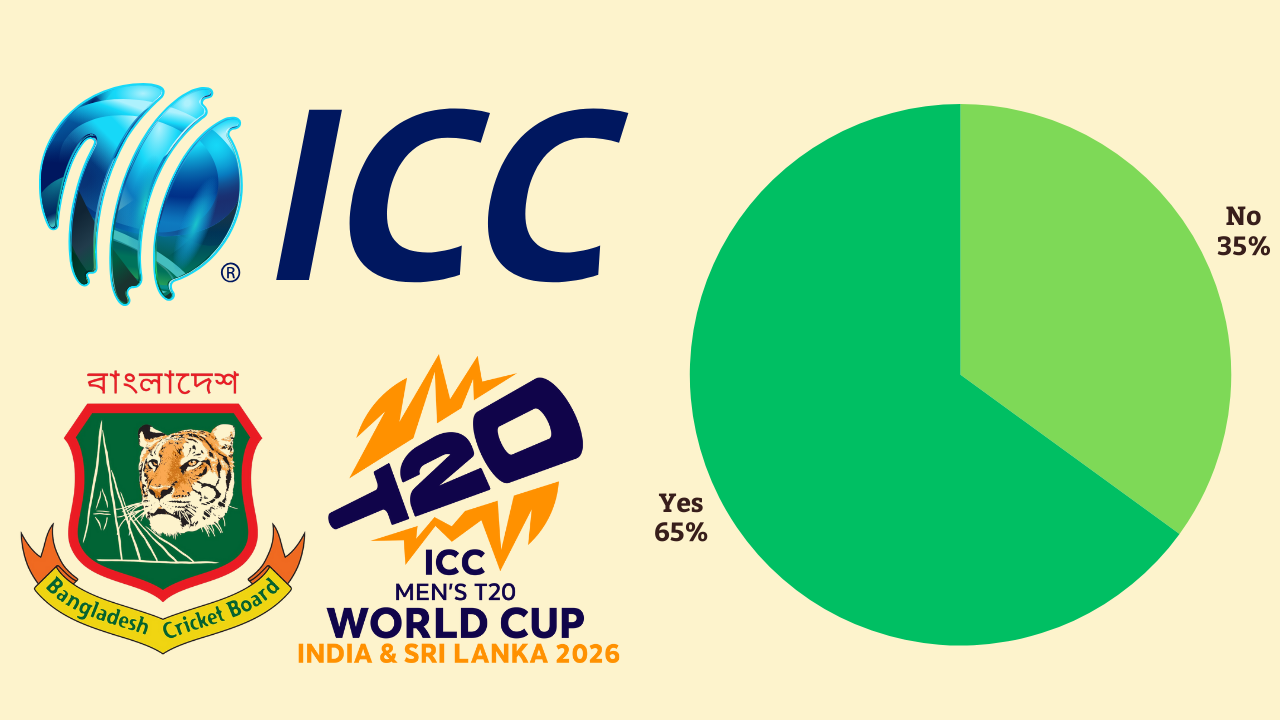
A new cricexec poll of global cricket industry executives has placed the International Cricket Council’s (ICC) decision about Bangladesh’s participation in the ICC Men’s T20 World Cup under renewed scrutiny.
Asked whether the ICC should have allowed Bangladesh to play its matches in Sri Lanka instead of India, 65% of respondents said yes, while 35% said no.
The result reflects growing unease across the cricket industry over how the ICC balances security concerns, political pressure and tournament integrity — particularly when geopolitics intrudes into global events.
Bangladesh’s request and the roots of the dispute
Bangladesh’s position was made clear well ahead of the ICC’s final decision. The Bangladesh Cricket Board (BCB) said it had reviewed the situation carefully before refusing to travel to India under the existing schedule.
In an official statement, the BCB said:
“The board reviewed the situation in detail, taking into account developments over the last 24 hours and expressed deep concern over the overall circumstances surrounding the participation of Bangladesh in matches scheduled to be played in India.”
It added:
“Following a thorough assessment of the prevailing situation and the growing concerns regarding the safety and security of the Bangladesh contingent in India and considering the advice from the Bangladesh Government, the Board of Directors resolved that the Bangladesh National Team will not travel to India for the tournament under the current conditions.”
The board formally requested intervention from the ICC:
“In light of this decision, the BCB has formally requested the International Cricket Council (ICC), as the event authority, to consider relocating all of Bangladesh’s matches to a venue outside India.”
Government backing raises the stakes
The issue escalated beyond cricket administration when Bangladesh’s government publicly backed the board’s stance. Asif Nazrul, adviser to Bangladesh’s Ministry of Youth and Sports, framed the decision as a matter of state responsibility.
He said:
“We welcome this decision taken in the context of the extreme communal policy of India’s cricket board.”
Nazrul added:
“The board said that where a Bangladesh cricketer can’t play in India despite being contracted, the entire Bangladesh cricket team can’t feel safe to go to the World Cup.”
He was unequivocal about the government’s position:
“There is no scope for changing our decision.”
BCB director Amjad Hossain reinforced that the decision was not purely administrative:
“We were informed by the government beforehand that playing the World Cup in India would not be safe for our contingent.”
He added:
“We have always said that we want to play. The decision was given by the government, and whenever there is any tour, we have to get clearance from the government.”
ICC holds firm on schedule and precedent
Despite the pressure, the ICC rejected Bangladesh’s request, citing multiple security assessments and the risks of setting a precedent.
In a formal statement, the ICC said:
“The ICC, in the absence of any credible or verifiable security threat to the Bangladesh national team in India, rejected the BCB’s demand to move its matches from India to Sri Lanka.”
The governing body stressed the depth of its review process:
“The ICC management engaged in a series of correspondences and meetings with the BCB in a bid to resolve the impasse, sharing detailed information on the event security plan, including layered federal and state law-enforcement support.”
It added:
“The decision was taken after considering all security assessments conducted, including independent reviews, all of which indicated there was no threat to Bangladesh players, media persons, officials and fans at any of the tournament venues in India.”
Crucially, the ICC warned against the wider implications of granting the request:
“Altering the schedule under the circumstances, in the absence of any credible security threat, could set a precedent that would jeopardise the sanctity of future ICC events and undermine its neutrality as a global governing body.”
Replacement and regional reaction
When Bangladesh failed to confirm participation by the ICC’s deadline, the governing body moved ahead with a replacement.
The ICC announced:
“Scotland will replace Bangladesh in the ICC Men’s T20 World Cup 2026 after the Bangladesh Cricket Board (BCB) refused to participate in the tournament per the published match schedule.”
Sri Lanka, the proposed alternative host, sought to distance itself from the dispute. Cricket Secretary Bandula Dissanayake said:
“In these disputes among India, Pakistan and Bangladesh, we are remaining neutral; all of these are friendly nations.”
Precedent, consistency and wider cricket voices
The Bangladesh standoff has also drawn in a wider group of cricket voices, many of whom have pointed to precedent and consistency as central to the debate — particularly how similar situations have been handled in the past.
Former ICC president Ehsan Mani argued that Bangladesh’s concerns should never have escalated to the point they did, especially given earlier decisions involving Indian cricket.
“It should never have been allowed to come to this stage. BCCI, for one, shouldn’t have dropped a player (Mustafizur Rehman) from the IPL after accepting them in the auction and Bangladesh had a case that when India cannot guarantee the security of one player, then a question about their team’s safety is relevant,” Ehsan Mani told Telecom Asia Sport.
Mani also suggested that Bangladesh erred in how the situation was handled institutionally, while still highlighting a clear precedent.
“However, I feel Bangladesh made a mistake — they should have had their government coming to the forefront to forbid them from going to India and not the Bangladesh Cricket Board (BCB). Remember, India did it when they refused to travel to Pakistan for the ICC Champions Trophy, against which Pakistan reciprocated and hence the hybrid model was accepted,” Ehsan Mani told Telecom Asia Sport.
He questioned whether cricket’s governance model is aligned with other global sports.
“If you ask me, it’s a wrong solution as cricket should follow the IOC or FIFA model. Either the hosting country should be in a position to give visas and ensure safety or security of the players or officials, or lose the rights,” Ehsan Mani told Telecom Asia Sport.
Former Australia fast bowler Jason Gillespie raised similar concerns about consistency, directly referencing past accommodations. In a social media post that was later deleted following online abuse, Gillespie asked:
“Has there been an explanation from the ICC why Bangladesh could not play their games outside of India? From memory, India refused to play Champions Trophy matches in Pakistan and they were allowed to play those games outside of Pakistan. Can someone make this make sense?”
Former England batter Mark Butcher expanded on that argument, pointing to a long history of tournaments being reshaped to accommodate individual teams.
“There have been a lot of pre-ceding events – not to this particular farrago – that have parallels. Obviously, the India Champions Trophy issue with Pakistan and how that ended up being resolved with India playing matches in Dubai, including the final. We’ve had tournaments, kind of re-jigged and re-arranged to accommodate one team or another throughout the history of the game of cricket, but perhaps not quite in the way that we’ve seen in recent times,” Butcher said on the Wisden podcast.
Butcher acknowledged geopolitical realities while questioning whether they should outweigh sporting principles.
“I think the India example for the Champions Trophy, everyone could see that coming, that was so obvious that you could see it from space that that was going to be the position. I’m certainly not being naive in thinking that everyone else stands in the same position in India does because they don’t. That’s visible from space. However, the integrity of the sport should still be more important than where most of the money comes from,” Butcher said on the Wisden podcast.
Ultimately, Butcher argued that cricket needs a clearer, fairer framework for dealing with such disputes in future.
“It’s a horrible, horrible mess, and I think the only way through it going forward is that if you know for some reason you are the problem, or you have a problem with the tournament or where the tournament is being held or who’s running the tournament or whatever the hell else it is then it’s up to you. You either go and you play, get your security sorted out as many countries have done travelling to many other different countries, and you play the tournament, or you step aside and somebody else does. I think that’s the only fair way to go forward,” Butcher said on the Wisden podcast.
What the poll result signals
The cricexec poll’s 65%–35% split suggests that a clear majority of industry leaders believe the ICC should have shown greater flexibility, even at the risk of operational complexity. For many executives, the Bangladesh case appears to have crossed from routine scheduling into a broader question of player confidence, government influence and the limits of centralised governance.
At the same time, the sizeable minority backing the ICC’s stance highlights persistent concern over precedent — and the fear that accommodating one request could open the door to many more.
As global cricket becomes increasingly entangled with politics and security considerations, the Bangladesh episode may prove to be more than a one-off dispute. If the poll is any indication, pressure is mounting on the ICC to define — more clearly than ever — where neutrality ends and accommodation begins.