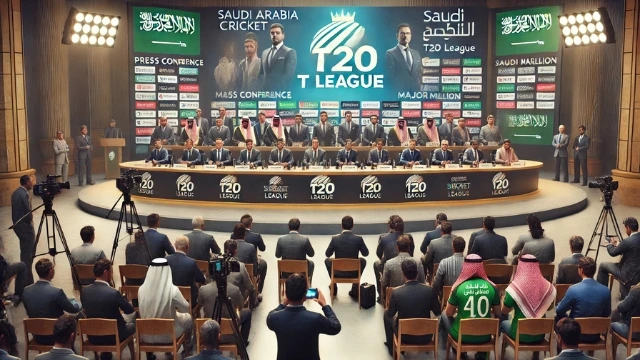
Saudi Arabia is setting its sights on a revolutionary shift in global cricket with its proposed $500 million-backed Twenty20 (T20) league. The initiative, designed to challenge the dominance of leagues such as the Indian Premier League (IPL) and The Hundred, seeks to attract top international talent, reshape cricket’s financial model, and establish Saudi Arabia as a serious stakeholder in the sport. However, opposition from key cricketing boards, logistical challenges, and concerns over player workload present significant hurdles to the league’s success.
The vision: a global, year-round T20 league
The blueprint for Saudi Arabia’s T20 league is unlike anything seen before. Unlike single-country franchise leagues such as the IPL or the Big Bash League (BBL), the proposed tournament would feature eight franchise teams competing in multiple locations worldwide over the course of a year. This Grand Slam-inspired approach would differentiate it from existing leagues and enable participation from a wider pool of cricketers.
Key elements of the proposed league include:
- Men’s and Women’s Tournaments: The league aims to equally promote both male and female competitions, signaling an inclusive approach to cricket’s future.
- Rotating Global Venues: Unlike traditional leagues confined to one country, matches would be staged in multiple nations, expanding the sport’s reach.
- A Grand Finale in Saudi Arabia: Reports indicate that Saudi Arabia will likely host the final match, cementing its position as a cricketing hub.
The tournament is expected to be primarily financed by SRJ Sports Investments, a subsidiary of Saudi Arabia’s $1 trillion Public Investment Fund (PIF), which has already made significant investments in sports such as Formula 1, LIV Golf, and European football. The mastermind behind the league is Neil Maxwell, a former first-class cricketer who manages Australian captain Pat Cummins and has previously served as a key figure in Australian cricket administration.
The role of the ACA and Neil Maxwell in Saudi Arabia’s T20 ambitions
The Australian Cricketers’ Association (ACA) has emerged as a pivotal supporter of the proposed Saudi T20 league, viewing it as a potential avenue to diversify revenue streams and bolster financial sustainability for Test cricket. ACA’s endorsement aligns with the broader objective of ensuring that cricket’s financial model remains viable, particularly for nations beyond the ‘Big Three’ of India, Australia, and England.
Neil Maxwell, who has been instrumental in shaping the vision of the league, has long voiced his concerns over the structural flaws of international cricket and sees the Saudi-backed initiative as a way to modernize the game’s commercial and scheduling model.
“At a personal level, I feel like the whole system is broken. Completely broken. And it needs to be rebuilt,” Maxwell told the Sydney Morning Herald last year.
Maxwell’s concerns stem from what he describes as a fractured international system, where domestic franchise leagues are expanding rapidly without a cohesive global strategy. He has advocated for a structured club-based model, similar to FIFA’s governance of international football, where international matches are scheduled within clear windows.
“We as a sport are fighting what every other sport in the world does, which is have domestic competitions where players regularly come together to play internationally in select windows. But we’re not creating those windows.”
He warns that if this continues, franchise leagues will inevitably overtake international cricket in priority for top players.
“We’ve got this complete transition happening, which ultimately is going to end up with club dominance, as much as I hate to say it. And the best thing to do is to rationalise the club structure and oversee the international structure like a FIFA does.”
According to Maxwell, cricket has the financial capacity to support both international and franchise structures if the game’s leadership can come to a consensus.
“We could have the most successful sport in the world, with everyone flourishing, because we’ve got enough money, but we can’t seem to agree to where it’s going.”
Cricket’s power struggle: who’s supporting and who’s opposing?
While Saudi Arabia’s T20 league has the potential to attract a wave of interest, it has also encountered strong resistance from the England and Wales Cricket Board (ECB) and skepticism from other major cricketing bodies.
ECB’s opposition: defending The Hundred and player workload
The ECB has publicly rejected the idea of an additional global T20 league, citing an already overcrowded cricket calendar and the need to protect its own franchise competition, The Hundred. ECB Chief Executive Richard Gould was firm in his stance:
“With the busy international calendar, a host of established franchise leagues around the world, and existing concerns about player workloads, there is no scope or demand for such an idea. It’s not something that we would support.”
The Hundred, which recently secured a $1.27 billion investment through private franchise sales, remains a major priority for the ECB. Officials fear that a financially lucrative Saudi-backed league could lure top England players away from their commitments in domestic and international competitions.
BCCI’s stance: the key to the league’s success?
The Board of Control for Cricket in India (BCCI) remains a pivotal decision-maker in the success of the Saudi T20 league. BCCI regulations currently prohibit Indian players from participating in overseas franchise leagues while they are actively playing for India. Without Indian stars, the league may struggle to gain significant traction in the Indian market, which remains cricket’s largest commercial hub.
However, Saudi Arabia has already developed strong ties with India’s cricketing elite. Reports suggest that key figures within the IPL ecosystem, including franchise owners, have engaged in discussions regarding potential collaborations. If Saudi investors successfully influence IPL franchise owners, there could be a pathway for Indian players to participate in the tournament.
Key challenges: scheduling, player workload, and commercial feasibility
Despite the massive financial backing and global ambitions, the Saudi T20 league faces significant logistical and structural hurdles:
- Scheduling Conflicts: With existing international tours, domestic leagues, and ICC events, finding a suitable timeframe for an additional major T20 tournament is complex.
- Player Availability and Fatigue: Workload concerns have already been highlighted by the ECB, and convincing top-tier players to add another tournament to their calendar may prove difficult.
- Establishing Competitive Franchise Bases: While major IPL and PSL franchises are being courted, securing committed long-term investors and a strong fan base across different global venues is a challenge.
The road ahead: can the Saudi T20 league become a reality?
Saudi Arabia’s ambitions for a global T20 league have the financial backing, strategic vision, and international connections to make an impact on world cricket. However, significant challenges—particularly opposition from key cricketing boards, scheduling issues, and the uncertainty surrounding Indian player participation—stand in the way.
The next few months will be crucial as Saudi officials attempt to negotiate with global stakeholders, address concerns about player availability, and finalize a model that fits within the broader cricketing ecosystem. If these hurdles can be overcome, Saudi Arabia may well introduce a transformative force in franchise cricket, further expanding the sport’s global footprint.