When David White walked into the offices of the San Francisco Unicorns for the first time, he didn’t come with a track record of running billion-dollar teams or decades of American sports experience.
What he had was a cross-disciplinary resume from Cricket Victoria, a background in marketing, events, and community strategy, and a phone call from his old boss.
That call—on the heels of Major League Cricket’s inaugural season—was from Nick Cummins, CEO of Cricket Victoria and a close advisor and partner to Unicorns co-owners Venky Harinarayan and Anand Rajaraman. His message was simple: “I think this thing has legs.”
A few weeks later, White was moving to the U.S. to help run one of the most ambitious franchises in the fledgling world of American professional cricket.
A year later, he was promoted to CEO—and under his watch, the Unicorns have built what may already be MLC’s most commercially sophisticated sponsorship engine and one that rivals teams in more established franchise leagues.
As Cummins shared, exclusvely with cricexec: “The Unicorns’ sponsorship revenue for 2025 already puts it within the range generated by BBL clubs.”
Which means it also likely exceeds that of many PSL, CPL, and BPL teams.
Betting big on a first-time CEO
White didn’t come in with an executive-level contract. In his first year, he was technically on secondment from Cricket Victoria, operating as General Manager with a safety net: if things didn’t work out, he could return home.
But after a successful 2024 season—on and off the field—Harinarayan and Rajaraman didn’t just ask him to stay. They made him CEO.
“It was the same role in many ways,” White told Cricexec. “But I think it was more about what’s coming, rather than what was current. We’re setting ourselves up to grow, and Venky and Anand wanted someone to lead that.”
That meant one thing above all: sponsorship.
From handshake deals to enterprise-level partnerships
In the Unicorns’ first year, sponsorship revenue was minimal—just a few handshake agreements managed directly by the owners.
By the time White took over, he knew that building a commercially viable franchise meant flipping that model. “You have to be financially sound,” he said. “You can’t leak money. And realistically, in MLC right now, your primary revenue stream is sponsorship.”
White’s mission was clear: secure significant sponsors, build a legitimate brand portfolio, and position the Unicorns as a premium entry point for tech-facing companies looking to reach a predominantly South Asian fan base.
The Unicorns’ two greatest assets
“If you’re a startup sports team, you have to ask: what’s your Snickers moment?” White said, referencing the turning point when a major consumer brand first signed with Major League Soccer and helped shift the league’s perception from novelty to legitimacy. “For us, that meant: what brands and companies can do that for us?”
To answer that, and to try to land sponsors that would help give the Unicorns and the MLC both credibility and firm financial footing, White leaned on two strategic assets no other MLC team could match:
(1) Geography: The Unicorns were playing in Silicon Valley, home to the world’s most tech-savvy, globally connected, and cricket-curious demographic outside South Asia.
(2) Ownership group: Harinarayan and Rajaraman weren’t just successful tech entrepreneurs and investors—they were power connectors. Their network reads like a who’s who of tech, venture capital, and media. That access was baked into the franchise DNA.
The ownership edge: When venture capital meets cricket
What’s often overlooked in the Unicorns’ success story is just how quietly powerful their ownership group is.
Venky Harinarayan and Anand Rajaraman aren’t your typical sports owners. They’re not real estate magnates or private equity giants. They’re startup operators—founders of Junglee (sold to Amazon), Kosmix (sold to Walmart), and Rocketship.vc (a top-tier early-stage fund).
Venky and Anand obviously bring more than connections to the leagues. They bring startup philosophy. Data-driven decision-making. Talent bets. Brand storytelling. Strategic patience. All of it.
Yet their personal networks in the tech world and Silicon Valley are truly unparalleled. They provide not just prestige but a potential commercial pipeline.
Some of the Unicorns investors and co-owners include:
• Shantanu Narayen, Chairman & CEO, Adobe
• Neal Mohan, CEO, YouTube
• Amit Singhal, Former SVP of Search, Google
• Divesh Makan, Founder & CEO, ICONIQ Capital
• Kunal Nayyar, Actor, The Big Bang Theory
• Aditya Agarwal, Former CTO, Dropbox
• Neeraj Arora, Former Chief Business Officer, WhatsApp
• Kashyap Deorah, Founder & CEO, HyperTrack
• Venky Ganesan, Managing Director, Menlo Ventures
• Schwark Satyavolu, General Partner, Trinity Ventures; Co-founder, Yodlee
• Shashin Shah, Managing Partner, Think Investments
• UC Investments (The University of California)
“These relationships are incredibly powerful,” said White, and he realized early that this network was a critical asset to leverage.
The Qualys deal: beer, timing, and a big bet

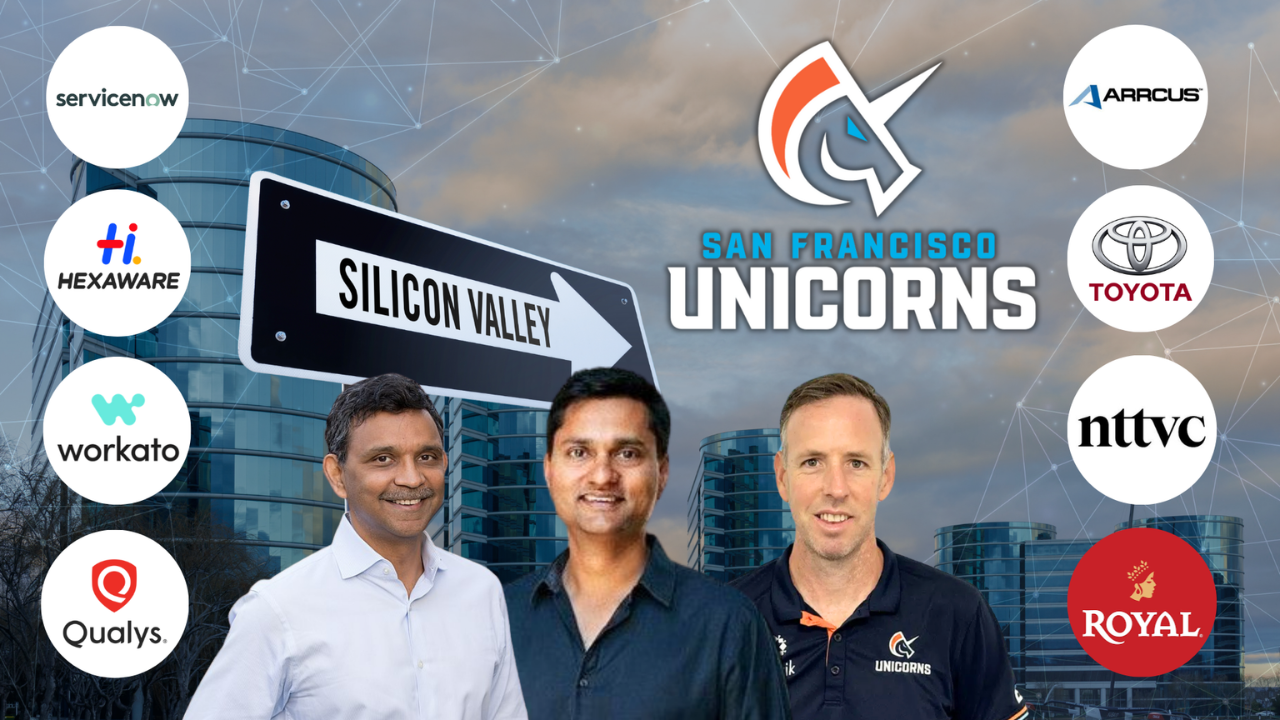
That said, the Unicorns’ biggest commercial milestone to date—landing cybersecurity giant Qualys as their major partner and front-of-jersey sponsor—was not sourced through this network and almost didn’t happen.
The relationship began like many Silicon Valley encounters do: a calendar invite, followed by a last-minute cancellation.
“One of their digital marketing team members reached out,” said White. “Then 10 minutes before the meeting, he canceled. Said they weren’t ready for sports marketing.”
Most conversations would’ve ended there. But White sent a simple follow-up: “Let’s just grab a beer.”
That beer turned into a 90-minute chat in Pleasanton that re-anchored the conversation—not around inventory, but around shared values, growth potential, and what cricket could become in the U.S.
“I didn’t know much about the league,” said Qualys CEO Sumedh Thakar, “But I’ve lived in the Bay Area for over 20 years; and I grew up with cricket in India. So I was naturally curious. Once David walked me through the vision—and showed me our logo on a mockup jersey with Liam Plunkett—that clinched it.”
That visual was the clincher: “Seeing the Qualys logo on a jersey—even in a render—created a moment. That’s when I knew this could work,” Thakar said.
But this wasn’t a vanity play. Internally, the Unicorns’ team built a professional pitch with a focus on outcomes: brand exposure, employee engagement, community integration, and international visibility.
“They came to us with data,” Thakar noted. “It wasn’t just ‘put your logo here.’ It was ‘here’s what you get, here’s who you’ll reach, and here’s how we’ll make you a part of something bigger.’”
That “bigger” included everything from jersey placement and perimeter signage to full-scale marketing activations and player appearances. And for Qualys, it extended globally.
“We have customers all over the world—Australia, UK, India. So getting that kind of brand visibility through cricket just made strategic sense,” Thakar said.
But the intangibles were just as important. “To have these global stars wearing our logo all season—are you kidding me? That was surreal,” he added. “We even had ads running on Willow TV, and people in our network started texting us screenshots. Customers, employees, security leaders… it created buzz.”
Qualys also used the partnership internally. “We hosted a Family Day for our employees at the Coliseum. We did an office-wide watch party in India. Our people loved it,” Thakar said. “It had a really positive impact on employee engagement.”
The move was a first for the cybersecurity industry—and a risk. But for Thakar, it was aligned with the company’s values. “Cricket is a global sport with deep cultural resonance. We’re a global company with a strong South Asian base. This was authentic for us. It made sense.”
Thakar also emphasized the advantage of taking that risk at an early stage of MLC: “We were early,” concluded Thakar. “And I think being early in something that’s going to grow big is where we’ve always liked to be.”
Why sponsors kept buying in: inside Arrcus’ decision to back the Unicorns

If Qualys was the Unicorns’ first home run, Arrcus was their proof of a repeatable concept: a tech startup-turned-premium sponsor that saw the partnership not as charity—but as strategy.
Shekar Ayyar, CEO of the networking software company, had known several of the Unicorns’ owners and investors for years. “Venky, Anand, Amit Singhal—these are people I trust,” he said.
But the actual conversation started with a simple ask from the investor network: “Can you help a friend get IPL tickets?”
White helped. And when he followed up with a casual: “If you know anyone interested in sponsorship, let me know”—and Ayyar, the recipient of the tickets, responded: “Maybe we are.”
That led to a few exploratory meetings with White, Arrcus executives, and the team’s sales agency, PIVOT. What emerged wasn’t a typical sponsor deal—it was a true alignment of values.
“This is a startup league,” Ayyar said. “And we’re a startup too. There’s a kind of kinship there. We’re both building something new from scratch.”
The alignment didn’t stop at culture. It extended to audience: “The people who buy our technology are often South Asian CTOs, CIOs, and network engineers. The people who love cricket? Same exact group.”
Ayyar said the visibility ROI came fast. “I was trying to get a meeting with a CIO of a major company, and he reached out to me first. He said he saw the Arrcus name on the jersey. That changed the tone of the conversation instantly.”
Ayyar also saw internal momentum resulting from the partnership: “It has allowed us to create a new way to excite, bond and accelerate the general momentum around the company. We’ve made t-shirts and we’re going to be distributing those T-shirts to the entire company. We’ve been overwhelmed by internal ticket requests and need to figure out how to handle them!”
For a company early in its marketing evolution, the impact was meaningful: “This was our first foray into broad, non-technical marketing. We’re used to trade shows. This was something bigger—something cultural,” Ayyar said. “I’ve got a lot of personal notes from people in the company thanking me for what we’re doing.”
He also acknowledged the benefit of being first. “We now get to say we were one of the Unicorns’ early backers. As they grow, our brand rides with them.”
Ayyar is already looking ahead. “This isn’t one and done. As cricket grows, as the league grows, and as our company grows, I want this to be something we do more of. Maybe even outside MLC—grassroots, youth, Bay Area community involvement. This partnership opened that door.”
Building the pyramid: ServiceNow, NTTVC and more
From there, White began to methodically fill out the rest of the Unicorns’ inventory—but with a thoughtful tiering strategy. Every logo on the shirt or sleeve was plotted carefully, with exclusivity across tech verticals and clear pricing gradients.
“We didn’t want two security companies competing with each other on our kit, for example,” White said, referring to Qualys. “We had to be mindful of overlapping categories.”
After Arrcus came ServiceNow, which took months of negotiation through multiple executive layers. The connection originated at a cricket match—the India vs Pakistan World Cup game in New York 2024—where White met the company’s future president, then still a Google Cloud senior executive. Then, as White says, “we had stayed in contact for the next few months, and eventually he moved over to ServiceNow” and the Unicorns started discussing a partnership. Still, it took several more months to finalize the deal. “It was a long process, obviously a big company, more levels you have to go through,” added White. Plus, “they are in sports marketing already, so they had a lot of considerations to weigh.”
Other brands like NTTVC (with deep ties to the ownership circle), Hexaware, and Workato rounded out the roster.
White credits the success to careful inventory management and storytelling.
“We priced each kit position according to visibility and aligned each brand with a category niche,” he said. “That helped us avoid overlap and deliver clear value.”
Every deal had a different story. But they all pointed to the same strategy: use Silicon Valley’s network strength and cricket’s cultural power to build a sponsorship base most American franchises would envy.
Landing consumer brands: The Royal partnership

If the Unicorns’ early deals came from the tech world, their next evolution is about consumer connection — and the partnership with Royal, the flagship basmati rice brand of LT Foods Americas, marks a major step.
“One thing you definitely need in this market is a consumer-facing brand,” White said. “The one that really resonates with our fan base is Royal. It’s that product itself.”
The opportunity came in 2024, when the Unicorns’ Family Day coincided with the ICC Men’s T20 World Cup final between India and South Africa. “We ran our Family Day deliberately on the same day as the World Cup,” White explained. “We wanted to give cricket a local presence here in the Bay Area — and it gave sponsors a chance to get in on that in their own way.”
For LT Foods, the timing was ideal. “It doesn’t get bigger than that — World Cup, the right audience, very passionate,” said Mayuri Mukherjee, VP of LT Foods Americas. “Families coming together, sharing the experience — food fit in very well. Just like food, cricket brings people and communities together.”
At the event, Royal distributed jute bags filled with rice samples and created a tangible connection with fans. “While people were enjoying the cricket, they also found time to come to our booth and take it home,” Mukherjee recalled. “It created a connection back from the event to their kitchens — something that lived much longer after the day.”
After the success of that activation, the Unicorns formalized the Royal partnership with LT Foods for the 2025 season. “We sat down in their L.A. office, did the season debrief, ran them through the metrics, and built a partnership around what they wanted to achieve moving forward,” White said. “We created content with our players — product in hand. Taste-testing, players trying different types of rice and naming their favorite. It was fun, authentic, and directly promoted the product.”
Mukherjee said that authenticity and engagement were key drivers for LT Foods. “When we look at any opportunity, it’s about impact on the brand and the engagement piece — how do you really become part of consumers’ lives? That’s where this partnership came into place.”
For White, the partnership shows why teams can deliver what leagues can’t. “You sponsor the league, you probably get more logos on perimeter boards,” he said. “What you don’t get is affinity with the fans — because no one roots for the league. They root for a team.”
That direct connection — players, community, storytelling — turned Royal from a launch-day sponsor into a long-term believer. “The relationship grew because both sides saw the value,” White said. “It wasn’t just branding — it was something fans could taste, touch, and take home.”

The data approach to partnerships
When it came to proving value to partners, David White wanted to replace guesswork with data. “It’s always nice to say it worked and hope that’s enough,” he said, “but it’s not.”
After the 2024 season, the Unicorns began working with Dentsu Analytics, later moving to Nielsen, to evaluate every sponsorship position across jersey, broadcast, and digital. “We did post-season reports for all of our partners that measured all the metrics across social, earned, owned media, and broadcast,” White explained. “We get the broadcast data from the league and feed that in, and it spits out a report we present back along with the intangible components — the branding, VIP experiences, ticketing, hospitality — and we put a value on that overall to say: you invested X, we believe we delivered Y.”
The result was a professional-grade analytics package for every sponsor, something few cricket teams globally could match.
That credibility mattered, especially when negotiating with global companies like ServiceNow. “They go through an intense metrics assessment,” said White. “They want to know your database, your social following, your broadcast coverage — all those questions they should be asking. And lucky for us, we had the data to answer them.”
By 2025, the Unicorns were delivering quantified results — most brands achieving between two and six times ROI through broadcast and digital exposure, flagship partners like Qualys and Hexaware generating millions in earned media value, and over $7 million in total partner value for the season. As White says, the Unicorns “weren’t just saying ‘trust us.’ We backed it up.”
What’s next: Beyond the jersey
With every jersey slot sold, White is already thinking about the next frontier. “There are only so many logos you can fit on a kit,” he said. “So the question becomes: how do you scale commercial growth beyond that?”
The answer lies in two directions — digital monetization and in-stadium activations.
Digitally, the Unicorns are building a content and data platform that captures fan profiles through ticketing, contests, and sponsor activations, opening new possibilities for personalized marketing and engagement. “Our database and our digital following are growing,” White said. “So there are opportunities we can do with sponsors through the digital marketing space.”
Physically, the franchise is focused on its growing footprint – which last season was at the Oakland Coliseum. “The American sports model is built around stadium monetization,” White explained. “Look at the NBA — one logo on the jersey, but a hundred sponsor activations in the arena.” That vision extends to a future purpose-built cricket stadium in the Bay Area. “Even when we have our own stadium, that’s where the opportunity lies,” he said. “That’s where we’ll grow existing partnerships and build new ones focused purely on activation on-site.”
To White, this is how the Unicorns will make the leap from six-figure sponsorships to seven- and eight-figure deals — by thinking like a media and event platform, not just a cricket team. “Once we have our own home ground,” he said, “the sponsorship model transforms. You go from logos to experiences.”
Local ownership and identity
For White, one of the Unicorns’ greatest strengths is their local ownership and presence — a team that truly belongs to its market. “What sets us apart is that we live and work here,” he said. “Our owners are in the Bay Area, our partners are in the Bay Area, and our fan base is here too. That proximity means we can act quickly, listen, and respond.”
Being locally owned gives the Unicorns an advantage that goes beyond sponsorship; it shapes how they operate, market, and build relationships. “When I walk into a meeting with a company in Silicon Valley, they already know who we are,” White said. “They know Venky and Anand. They know our story. There’s a shared sense of pride — that this is their team.”
That closeness allows the Unicorns to stay present all year, not just during MLC’s short season. “It’s a year-round proposition for us,” White said. “We don’t just disappear after the tournament. We’re doing community events, sponsor activations, player appearances. It keeps the brand alive — and it keeps fans and partners feeling connected.”
The local structure also gives the franchise the freedom to move fast and think creatively. “We can make decisions right here in the room,” White said. “If an opportunity comes up, we don’t have to wait for approvals halfway across the world. That agility is important — it’s what lets us experiment and try new things.”
The Silicon Valley experiment
If the Unicorns are not a blueprint, they’re at least a proof of concept — that a cricket team can be built like a startup and scaled like a media company.
White credits the team’s success to the mindset of its ownership group, led by Venky Harinarayan and Anand Rajaraman. “It’s like a startup,” Harinarayan said. “You run, test, learn, iterate — and stay close to your customers.”
That culture, White said, influences everything the team does: data-led decision-making, brand experimentation, and a relentless focus on finding product-market fit. “We treat sponsorship like tech treats product,” he said. “Experiment, measure, optimize, and then scale.”
Because the Unicorns are locally owned and privately run, they can move faster than most. “We can just pick up the phone, make a deal, and make it happen,” says White.
That flexibility — combined with Silicon Valley’s innovation mindset — has allowed the Unicorns to become the sport’s most entrepreneurial franchise. “We’re building something original, something uniquely American,” said Harinarayan. For White, that’s the real experiment: showing that cricket, when built through innovation and community, can find its own voice – and economy – in America.