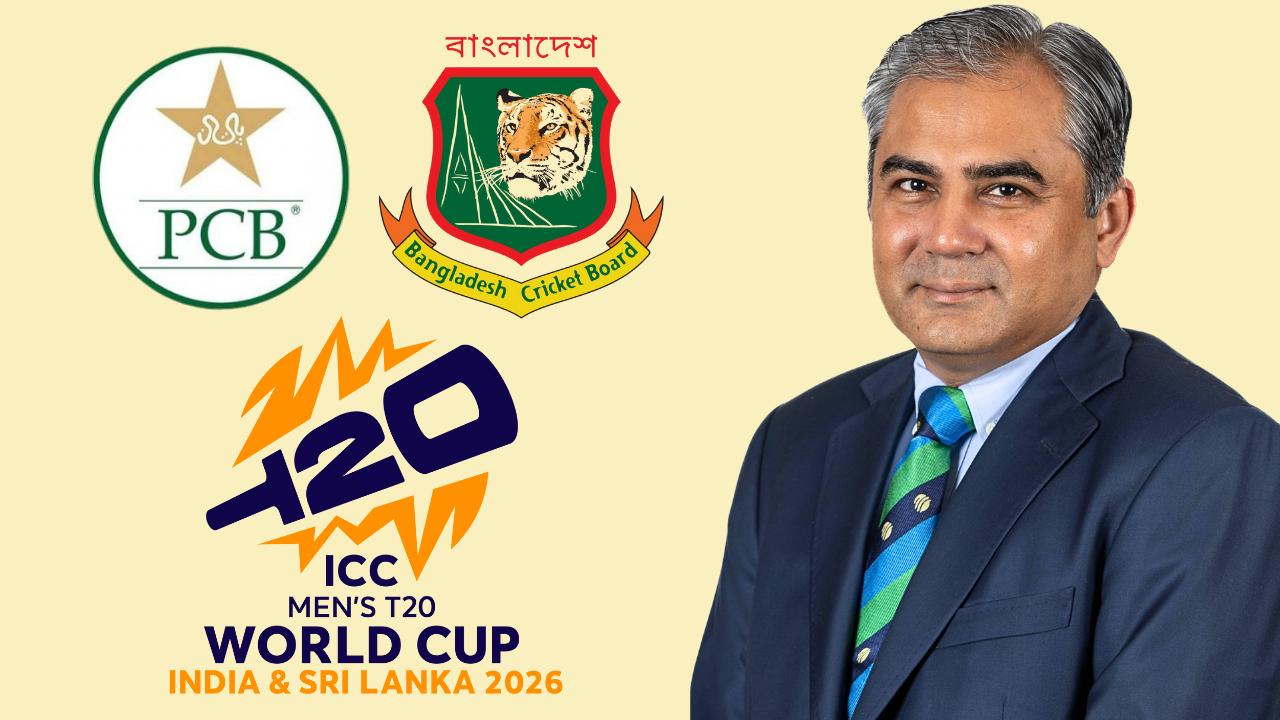
Pakistan’s decision to go ahead with its February 15 T20 World Cup clash against India in Colombo brought an end to a tense diplomatic and cricketing standoff — but the aftermath has been dominated by PCB chairman Mohsin Naqvi’s remarks attempting to reframe the U-turn as a principled act rather than a retreat under pressure.
Speaking informally to the media following the Multan Sultans auction on February 9 in Lahore, Naqvi justified the change of heart by pointing to Bangladesh’s request. “You must have seen Bangladesh’s statement. Bangladesh requested Pakistan to play the match against India. Definitely, their entire matter was resolved — only then did they put forward this request,” he said in a video that quickly spread online.
Naqvi, who also serves as Pakistan’s interior minister, insisted the decision was not driven by self-interest but made entirely in solidarity with Bangladesh. “We took a stand for Bangladesh. We spoke for them. We did nothing for ourselves,” he added in the same interaction.
Mohsin Naqvi Statement on India Vs Pakistan match #PAKvIND #Pakistan pic.twitter.com/Mm523Uldb3
— Ravish Bisht (@ravishbofficial) February 9, 2026
Naqvi rejects pressure claims, invokes military symbolism
At a more formal press conference earlier, held moments before those informal post‑auction remarks, Naqvi took a defiant tone when addressing speculation that Pakistan had been coerced by the ICC or India into resuming participation. “Neither am I intimidated by the threats from India and the ICC, nor is the Government of Pakistan. And as for Field Marshal Syed Asim Munir, you already know about him, he never gets afraid,” he said while speaking alongside the new owners of the Rawalpindi franchise.
The comment drew widespread attention, with political observers viewing it as a deliberate attempt to inject military symbolism into what was, ostensibly, a sporting decision. “This is like telling the world that this is not just about cricket, but our generals are watching,” an official told CNN-News18, interpreting Naqvi’s reference as coded messaging aimed at both domestic and international audiences.
Government statement frames decision as regional leadership
Following Naqvi’s remarks, the Pakistan government issued a formal directive late Monday night confirming the team would indeed play the India fixture. “In view of the outcomes achieved in multilateral discussions, as well as the request of friendly countries, the Government of Pakistan hereby directs the Pakistan National Cricket Team to take the field on February 15, 2026, for its scheduled fixture in the ICC Men’s T20 World Cup,” the statement said.
ISLAMABAD, February 9, 2026.
The Honorable Prime Minister of Pakistan, Mr. Shehbaz Sharif has been formally briefed by the Chairman of the Pakistan Cricket Board (PCB), Mr. Mohsin Naqvi, regarding the outcomes of high-level deliberations held between the PCB, representatives of…
— Government of Pakistan (@GovtofPakistan) February 9, 2026
The government further added, “Moreover, this decision has been taken with the aim of protecting the spirit of cricket, and to support the continuity of this global sport in all participating nations.”
The statement also highlighted diplomatic outreach from multiple cricketing nations: “The Government of Pakistan has reviewed the formal requests extended to the PCB by the Bangladesh Cricket Board, as well as the supporting communications from Sri Lanka, the United Arab Emirates, and other member nations. These correspondences sought Pakistan’s leadership in securing a viable solution to recent challenges.”
Sri Lanka’s role in defusing tensions
One of the key interventions in the final hours came from Sri Lanka, whose president reached out directly to Pakistani leadership. “This evening, the Prime Minister held a telephone call with H.E. Anura Kumara Dissanayake, President of Sri Lanka. During their warm and friendly conversation, they recalled that Pakistan and Sri Lanka had always stood shoulder to shoulder, especially during challenging times. The Sri Lankan President requested the Prime Minister to accord serious consideration to amicably resolve the current impasse,” the Pakistan government said.
ICC highlights constructive dialogue
As pressure mounted to preserve the tournament’s integrity, the ICC facilitated discussions between all parties. In its post-resolution statement, the ICC noted that “The International Cricket Council (ICC), Pakistan Cricket Board (PCB) and Bangladesh Cricket Board (BCB) have concluded an open, constructive and congenial dialogue. This dialogue covered several matters, including but not limited to the ICC Men’s T20 World Cup 2026 and the broader outlook for cricket in South Asia.”
The governing body’s statement painted the talks as collaborative, while remaining careful not to frame the outcome as a concession to any one side.
A sporting decision reframed as national defiance
While Pakistan’s agreement to play the India match resolved a high-stakes standoff, Mohsin Naqvi’s comments — both casual and official — have shifted the narrative. Rather than downplaying the earlier threats of boycott, Naqvi leaned into political and military rhetoric to defend the reversal, positioning the PCB’s actions as aligned with national loyalty and regional solidarity.
In doing so, the cricket board’s top official turned what might have been a routine fixture confirmation into a window into Pakistan’s civil-military dynamics, with cricket once again serving as a proxy stage for broader state messaging.