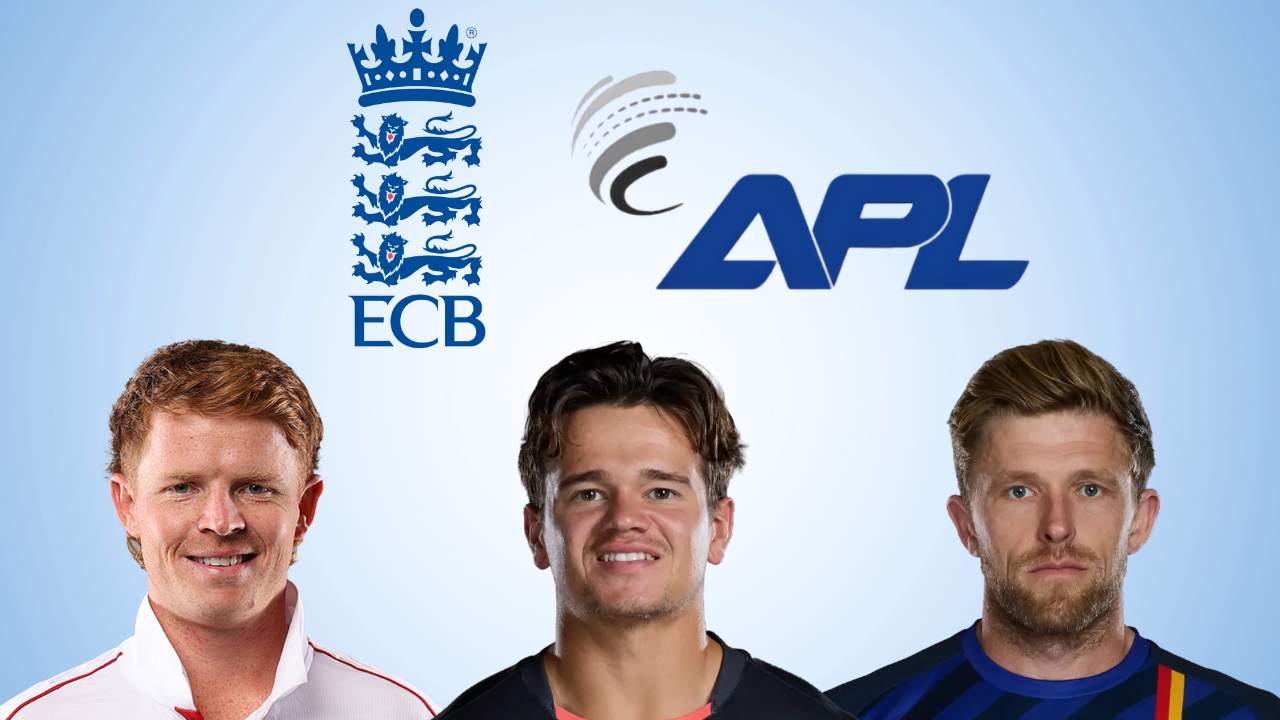
England batter Ollie Pope and fellow English cricketers Will Smeed and David Willey have withdrawn from the inaugural Afghanistan Premier League (APL) T20 draft amid growing scrutiny over the involvement of English players in the competition, according to a report by Cricinfo‘s Matt Roller.
The withdrawals come as the England and Wales Cricket Board (ECB) faces questions over whether it should permit players to participate in an Afghanistan-linked franchise tournament while maintaining its refusal to schedule bilateral cricket against the country because of the Taliban government’s treatment of women and girls.
Pope, who captained England as recently as last summer and has received a new one-year central contract, made his decision before ECB Managing Director of Men’s Cricket Rob Key publicly addressed the controversy on Monday. The draft is scheduled for October 24, with the inaugural tournament due to begin in the United Arab Emirates on December 27.
ECB faces legal and moral questions over player participation
The controversy has placed the ECB’s approach to overseas franchise cricket under scrutiny, particularly because English players require No-Objection Certificates (NOCs) from the governing body to participate in foreign leagues.
The ECB had been planning to issue NOCs for the Afghanistan Premier League despite its longstanding position against bilateral fixtures with Afghanistan. Restrictions under UK restraint-of-trade laws complicate the board’s ability to prevent players from accepting opportunities abroad.
ECB Chairman Richard Thompson had addressed the issue before the latest withdrawals, telling reporters at an event in Lord’s: “That’s a whole other issue, and that hasn’t come to us yet. But when it does, we will have to consider that very carefully.”
The matter subsequently drew comments from Key, who discussed the ECB’s position on the BBC’s Test Match Special podcast. He acknowledged the limitations on the governing body’s authority over players’ overseas commitments, explaining: “Legally it is hard to stop players going over and playing in these competitions.”
Key also addressed the responsibilities of cricketers considering participation in the tournament. He stated: “It becomes a moral judgement and players have to be prepared to take the right moral stance.”
Key went further in outlining his own approach to such an opportunity, adding: “Personally, and it is easy for me to say, I would not go and play. But it is down to the player to make that decision.”
Key’s opposition is rooted in his concerns about the treatment of women in Afghanistan. His comments also highlight the distinction between the ECB’s ability to regulate player participation and the personal decisions cricketers must make when considering overseas contracts.
England’s Afghanistan policy faces renewed scrutiny
The debate extends beyond the APL to England’s wider cricketing relationship with Afghanistan.
Since the Taliban returned to power in 2021, the ECB has refused to arrange bilateral matches against Afghanistan. England has nevertheless continued to face Afghanistan in ICC competitions, including World Cups and the Champions Trophy.
That distinction has attracted criticism from political figures concerned about the restrictions imposed on Afghan women and girls, particularly the absence of opportunities for women’s cricket within the country.
Labour MP Tonia Antoniazzi has been among the most prominent critics. Speaking to BBC Sport in September, she raised concerns about Afghanistan’s women’s team living in exile and questioned whether players were giving sufficient consideration to the circumstances facing women and girls.
Antoniazzi also challenged the ICC’s position on Afghanistan’s participation in international cricket, stating: “I hope the International Cricket Council (ICC) refuses to sanction this event. Continuing to allow Afghanistan full member status makes a mockery of its own membership criteria.”
Her intervention adds another dimension to the debate facing cricket administrators, with the ICC’s responsibilities and the ECB’s decisions over individual player permissions both coming under examination.
Dawid Malan highlights players’ financial and professional dilemma
While Pope, Smeed and Willey have withdrawn, several other English players remain registered for the Afghanistan Premier League draft.
Former England batter Dawid Malan is among those still available, alongside Moeen Ali, James Vince and James Rew.
Malan has defended his willingness to participate, explaining that professional cricketers generally look to the ICC and their respective national boards for guidance on which competitions they can enter.
Speaking on the BBC’s Test Match Special podcast, Malan described the competing considerations facing players: “As a player it is tough because you have what is morally right and what is by the law. I have a daughter and I want her to play sport and get into sport and enjoy it. I fully understand the argument, but at the end of the day I am a cricketer and need to be able to pay my rent and be able to earn a living while I can.”
The former England batter also questioned how players should interpret the different approaches taken to bilateral cricket and ICC tournaments involving Afghanistan.
Malan said: “England don’t play bilateral series against Afghanistan, but they do play them in World Cups – what’s the difference? As players, you sometimes want a board decision to be made that says ‘we don’t think this is right, we are making a stance against it’, then the players will buy into it.”
Malan’s position reflects the professional considerations surrounding franchise participation when competitions receive approval from cricket’s governing authorities. He has indicated that such approval can leave players weighing their moral objections against the need to pursue their careers.
Cricket agent questions consistency of criticism
The controversy has also prompted a response from representatives involved in the franchise cricket market.
Dean Ahmad, an agent who represents former England all-rounder Moeen Ali, has questioned whether the scrutiny directed at cricketers is consistent with the treatment of governments and corporations maintaining relationships with countries accused of human rights abuses.
Writing on X, Ahmad stated: “The Taliban’s treatment of women is indefensible. Yet why are cricketers singled out while governments and corporations maintain ties with states accused of serious human rights abuses. Selective outrage isn’t morality.”
Morality in sport matters, but so does consistency. The Taliban’s treatment of women is indefensible. Yet why are cricketers singled out while governments and corporations maintain ties with states accused of serious human rights abuses. Selective outrage isn’t morality.
— Dean Ahmad (@DeanAhmad_) October 9, 2026
His intervention brings the role of player representatives into a debate involving cricket administrators, politicians and professional players, as the APL attempts to attract overseas talent for its inaugural season.
Afghanistan Premier League faces uncertainty ahead of inaugural season
The Afghanistan Premier League’s preparations remain under scrutiny, with uncertainty surrounding its commercial readiness for the inaugural edition.
With two of the five franchises still unsold at the time of the latest available reporting, the competition’s immediate challenge is to complete its franchise arrangements ahead of its planned launch.