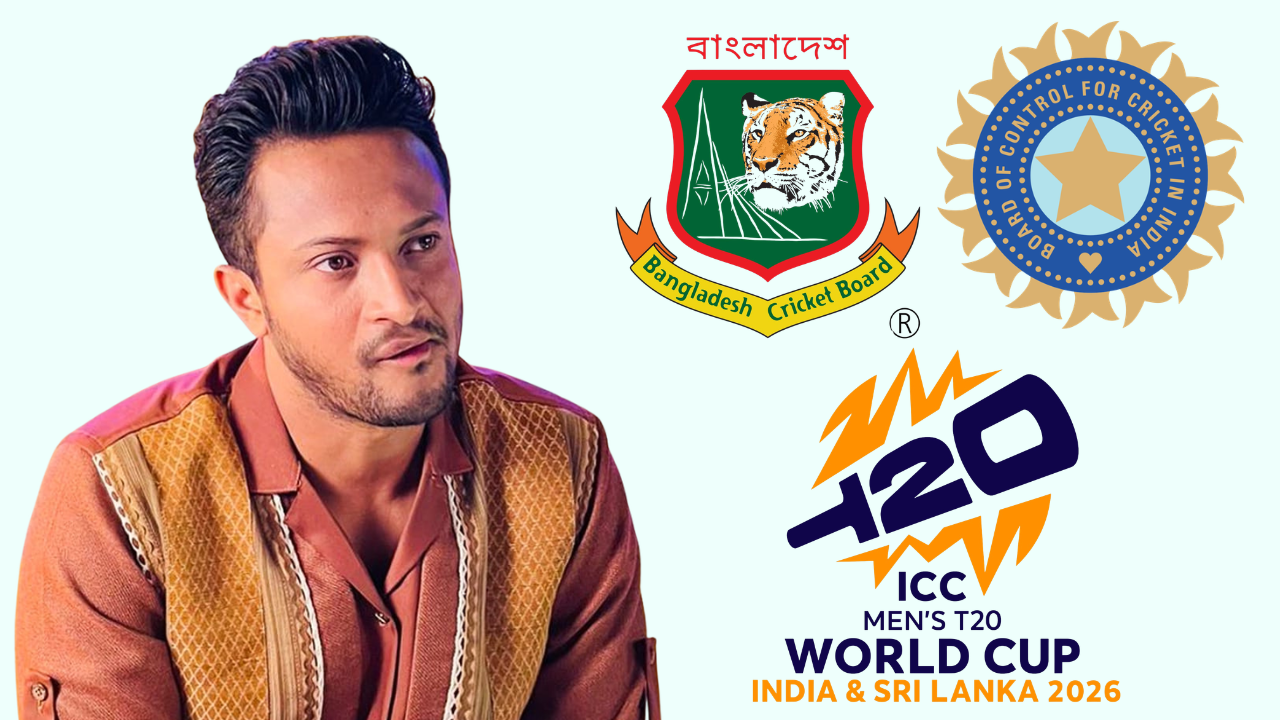
Bangladesh’s ongoing political transition and leadership overhaul within its cricket board could mark a turning point in relations with India, with Shakib Al Hasan indicating that both governance and bilateral ties are set for a reset following a period of strain. Speaking to reporters on the sidelines of the EU T20 Belgium event in Mumbai on Wednesday, the veteran all-rounder pointed to recent developments at both government and board level as key drivers behind a potential shift in cricketing diplomacy.
“I think the situation will improve,” Shakib said, before linking the change directly to developments in Dhaka. “There was an election that happened, so a new government came in. I think they’ll take the right decision in terms of cricket.” He added that further clarity is expected once administrative processes within the Bangladesh Cricket Board are completed, stating, “Also, our cricket board election is supposed to happen sometime soon. Once that happens, I think it will settle down, and they’ll have good communication with, not only India, but with all other boards, and they’ll have fruitful discussions, and they’ll take things forward,” while also pointing to bilateral cricket as a pathway forward. “Efforts should be made to rebuild relations. One or two series will do the job. I’ve heard a series may take place in August or September—if that happens, the ice will melt and relations will normalise.”
Leadership shift at BCB signals long-term direction
The anticipated reset follows significant changes within the Bangladesh Cricket Board, including the removal of the previous administration and the appointment of an interim structure tasked with overseeing fresh elections, as previously reported by cricexec. Former Captain Tamim Iqbal has been placed in a central role during this transition, with responsibilities tied to stabilising governance and shaping the board’s next phase.
Backing his former teammate’s potential long-term role, Shakib said, “He’s there to hold an election, but hopefully, if he becomes the president [permanently], he will have a long-term plan,” before reinforcing his confidence in the direction of leadership. “Bangladesh cricket will certainly benefit from him.” The endorsement comes despite a previously strained relationship between the two senior figures, underscoring a broader alignment around rebuilding the game’s administrative structure.
World Cup withdrawal deepened rift
The deterioration in relations between the Bangladesh Cricket Board and the Board of Control for Cricket in India followed Bangladesh’s withdrawal from the ICC Men’s T20 World Cup, a decision driven by government-level concerns that ultimately led to Scotland replacing the team in the tournament, as reported previously by cricexec. The absence marked the first time since 1999 that Bangladesh did not feature in a World Cup, amplifying both sporting and diplomatic repercussions.
Reflecting on the episode, Shakib said, “A country like Bangladesh not participating was a big miss,” before delivering a stronger assessment of the decision-making process. “I think it was a blunder from the government side that they took the decision not to participate. We are a cricket-loving country and missing a World Cup is a massive loss.” The fallout from that decision contributed to a breakdown in engagement between the two boards, with negotiations over venue changes and participation failing to produce a resolution.
Team evolution continues despite off-field turmoil
While administrative and political issues have dominated headlines, Shakib highlighted positive signs within the national setup, pointing to improved performances and a shift in team dynamics. Bangladesh recently secured a milestone T20I victory over New Zealand, reflecting a broader upward trajectory in results.
“The Bangladesh team are doing really well at the moment. They have just beaten New Zealand and won their first T20I against them. It’s a good team,” he said, before outlining a structural change in approach. “Earlier, the side relied more on individuals, but now it is more team-oriented, which is the best way forward.” The shift toward a collective framework is viewed as a key factor in sustaining competitiveness during a period of external uncertainty.
Path to normalisation underway
With a new government in place, a restructured cricket board, and bilateral fixtures under consideration, there are growing expectations that tensions between Bangladesh and India will ease in the coming months. Planned series between the two sides are seen as a potential catalyst for restoring regular engagement and rebuilding trust at an institutional level.
Shakib struck a measured tone on the broader outlook, saying, “With time, everything heals,” as Bangladesh cricket navigates a transition that could reshape both its internal direction and its standing within the global game.