
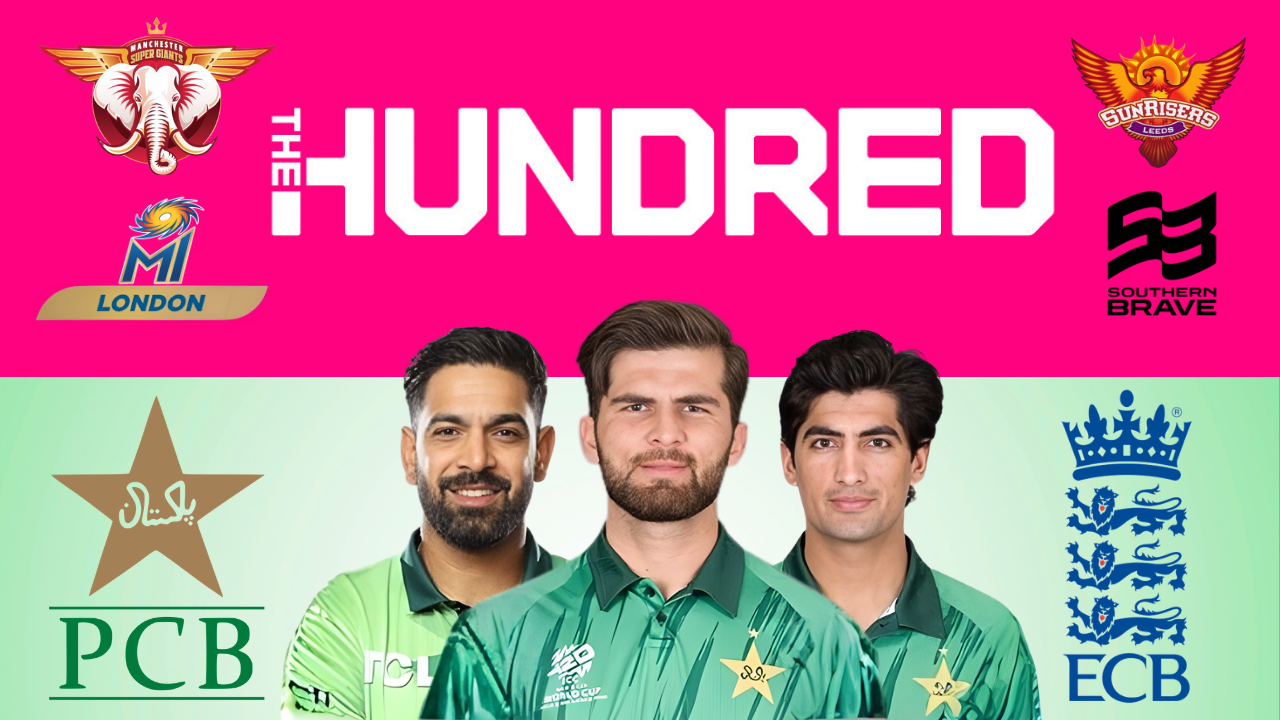
The credibility of The Hundred’s inclusivity framework is set to be tested ahead of its 2026 player auction. According to an exclusive report by Telecom Asia Sport, the Pakistan Cricket Board (PCB) is preparing to formally write to the England and Wales Cricket Board (ECB) over concerns that Pakistani players may be overlooked by franchises with Indian Premier League-linked ownership.
The auction, scheduled for March 11 and 12, has become the focal point of a growing governance debate that extends beyond routine squad selection.
IPL-linked ownership and the emerging controversy
Four franchises — Manchester Super Giants, MI London, Southern Brave and Sunrisers Leeds — have ownership ties to IPL entities. Reports emerging from England suggest that agents representing Pakistani cricketers were informed their players are not being considered by these teams ahead of the draft.
As reported by BBC Sport earlier, franchises with Indian Premier League investment are not expected to bid for Pakistani talent.
For PCB officials, any blanket omission would raise serious questions about merit-based recruitment in a tournament positioned as a global competition. Reflecting that position, Sources told Telecom Asia Sport, “The Pakistan Cricket Board, through Salman Naseer, is due to write to the ECB asking them to ensure Pakistani players are not treated unfairly. Any bias would go against the ECB’s commitment to inclusivity and equal opportunity for Asian players.”
The PCB’s communication is expected to reference the ECB’s own anti-discrimination framework and seek clarity on how those principles will be applied if multiple franchises decline to select Pakistani players.
Auction dynamics versus regulatory oversight
While franchise autonomy in recruitment is a central feature of The Hundred’s commercial model, the ECB retains regulatory authority over compliance with inclusivity standards. That balance is now under scrutiny.
Last year, ECB Chief Executive Richard Gould addressed the governing body’s position on nationality-based discrimination, stating, “I expect players from all nations to be selected for all teams. We haven’t had any need to have any discussions at this point. We have got very clear anti-discrimination policies within cricket in England. If those are not adhered to, our cricket regulator will take action,” Richard Gould said last year.
Those remarks, made before the latest reports surfaced, now frame the regulatory expectations surrounding the upcoming auction.
Proving deliberate exclusion, however, may be complex. Franchises could argue that auction strategy, squad balance and commercial considerations determine selections, rather than nationality. Nevertheless, if all four IPL-linked teams bypass Pakistani players despite significant registrations, scrutiny of governance mechanisms is likely to intensify.
Pakistan talent pool and historical participation
The 2026 draft features substantial Pakistani representation, with dozens of players across men’s and women’s categories registering their availability. Among them are high-profile names such as Shaheen Shah Afridi, Haris Rauf and Naseem Shah.
Pakistani cricketers have previously featured in the competition. Last season, Imad Wasim and Mohammad Amir represented Northern Superchargers, underlining that participation has historically been both viable and competitive.
The broader concern within Pakistan cricket circles is that leagues with strong Indian investment — including SA20 and ILT20 — have previously seen limited Pakistani involvement. That pattern has contributed to the perception of what some describe as an “unwritten rule” in certain privately backed tournaments.
Reaction within England’s cricket community
The discussion has also drawn a response from prominent English cricket figures. Speaking in the pre-match press conference ahead of the Super 8 opener against Sri Lanka, England white-ball captain Harry Brook said, “Pakistan have been a great cricket nation for many years and have some awesome players… It would be a shame not to see some of them in The Hundred.”
Former England captain Michael Vaughan has also urged the ECB to examine the situation closely.
For the PCB, the matter extends beyond individual contracts or auction outcomes. It is positioned as a question of competitive integrity and the global positioning of The Hundred as a merit-driven tournament.
A defining moment for The Hundred’s governance model
With the March 11–12 auction approaching, the ECB faces a sensitive balancing act: protecting franchise autonomy while safeguarding its publicly stated commitment to inclusivity.
Should multiple IPL-linked franchises ultimately decline to select Pakistani players, the issue could escalate from internal correspondence to broader regulatory scrutiny. Conversely, selections based purely on performance metrics would likely defuse the controversy.
Either way, the upcoming draft has evolved into more than a routine recruitment exercise. It now represents a high-profile moment for The Hundred’s governance framework — and for how English cricket navigates the intersection of private investment, global politics and competitive fairness.


