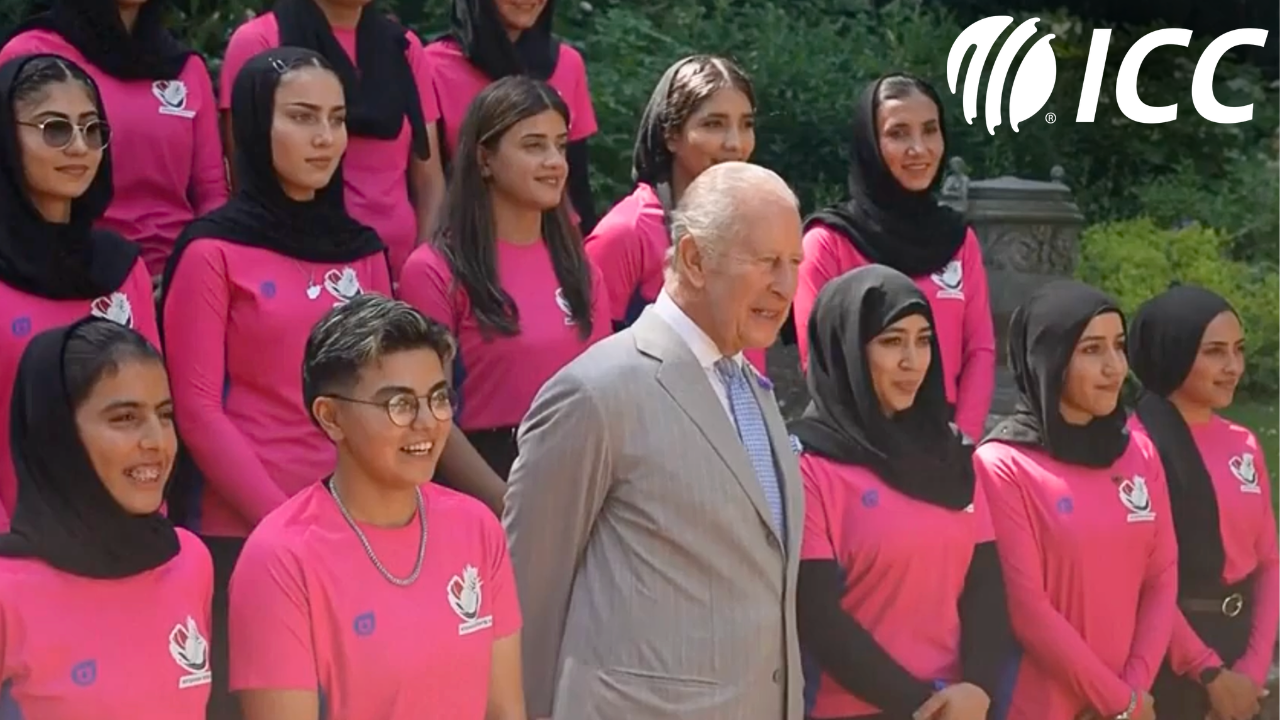
The Afghanistan women’s cricket team has intensified its campaign for official international recognition after meeting King Charles III at Clarence House, using the royal engagement to highlight its ambition to once again represent Afghanistan on the global stage. Forced into exile after the Taliban banned women from playing sport following its return to power in 2021, the players are seeking the same ICC recognition afforded to Afghanistan’s men’s team, which continues to compete internationally while the women’s side remains unable to do so.
A campaign for recognition
The squad, whose members are now living across Australia, Canada and the United Kingdom, has continued its efforts to secure the right to play under Afghanistan’s flag and name while representing women who remain unable to participate in sport in their homeland. The ICC continues to recognise Afghanistan’s men’s team and funds its men’s programme, a position the women’s team has long argued should extend to them as well.
Afghanistan Women’s Cricketer Ekil Latifi said: “We want the ICC to allow us to play under the [Afghanistan] flag and name.”
She added: “Whatever the men do, we want to do the same thing for our country. We’re not just representing ourselves and the team, but also Afghan women back in our country. We’re representing them and all the things they can’t do there. We want to show that women aren’t afraid to do anything they want to.”
Afghanistan Women’s Cricketer Shabnam Ahsan reinforced that position, drawing on the broader principle of equal rights in sport. “It’s so sad because everyone should have the right to study and play cricket like every other country. We deserve recognition as well, we will fight for it, and we will never stop until we get it,” she said.
Royal backing for the exiled team
The engagement took place at Clarence House, where players, coaches and supporters were welcomed after proceedings were moved indoors because of 34C temperatures. Foreign Office Minister Hamish Falconer and the UK’s Special Envoy to Afghanistan, Richard Lindsay, also attended, underlining the wider political significance of the visit beyond cricket.
King Charles III welcomed the cricketers, telling them: “I’m so glad that you can pursue what you want to do.” He had heard accounts of the arduous journeys many players undertook to leave Afghanistan, and told the team he was “so glad you all managed to get to Australia.” As the visit drew to a close, the King added: “I’m so thrilled, I wish you great success and no injuries.”
The players presented the King with a signed team shirt, a decorated cricket bat and a lapel pin featuring the team’s badge, which merges the Afghan and Australian national flowers. Looking at the shirt, he joked it would be “too small for me.” The King also revealed he had played cricket once, but not very well, drawing laughter from the group.
The visit also produced a memorable light-hearted exchange when Latifi asked: “I’m learning some posh words, can you say a posh word to me?” King Charles laughed before replying: “What’s a posh word? I need some advanced notice.” Latifi later suggested: “A posh word like ‘lavatory’.”
Speaking for women back home
Latifi, who left Afghanistan during the 2021 evacuations at the age of 17 and has not seen her family for five years, has spoken consistently about the team’s dual purpose — competing again and remaining a voice for those left behind. “In life, you get one chance. In cricket, if you’re a batter, you might just bat once,” she said.
Ahsan addressed the reality facing women in Afghanistan directly. “Back in Afghanistan, women don’t have the right to play cricket, even to go out, to study or anything,” she said. The team’s presence in England, she added, carries meaning that extends well beyond the boundary. “We’re here to play cricket — but it’s not just cricket, we’re here to fight for them and this has meant a lot for us,” Ahsan said.
Calls for ICC action continue
The ICC continues to fund Afghanistan’s men’s cricket programme while the women’s team remains without official recognition, as women are prohibited from playing sport under the current regime. During their stay in England, the squad is being hosted by the ECB and is scheduled to face Cambridge University Cricket Club on 27 June before another fixture against a UK Armed Forces women’s team.
ECB Deputy Chief Executive Officer Clare Connor told the Press Association: “It’s a complex geopolitical situation. The funding the ICC gives to Afghanistan is only for men’s cricket and under the current regime [women] cannot play sport, so this opportunity is very important because it’s a chance for them to play as a team.” Connor was clear that the situation demands a structured response from the sport’s global leadership. “We do need to find a solution because they are resilient women who deserve the support of the cricket community. It’s about women still in Afghanistan and other displaced Afghan women around the world that these people can be a beacon for,” she added.
Support grows beyond the cricket community
The campaign has also received backing from former Australia cricketer and Pitch Our Future Co-founder Mel Jones, who played a key role in helping members of the team leave Afghanistan after the Taliban returned to power. Jones told the Press Association: “When we have the enormity of something like this behind them it gives them relevance and platform to say we’re here, we still love the game and want the opportunity to have the opportunity the Afghan men have had. We want to create that same fairytale.” She added that the team’s advocacy carries significance far beyond sport. “The other huge part of today is that they still want to be a voice for Afghan women and girls back home, and to say they’re not forgotten,” Jones said.
The meeting with King Charles III offered another prominent platform for the Afghanistan women’s team, but its long-term objective remains unchanged: securing official ICC recognition that would allow the players to compete internationally under their own flag and represent their country once again.