
Australia’s shock group-stage exit at the ICC Men’s T20 World Cup 2026 has triggered fresh concern over their pathway to the Los Angeles 2028 Olympics, according to reports. What was expected to be a routine qualification cycle has suddenly turned into a ranking equation with little margin for error.
Mitchell Marsh’s side bowed out of the tournament co-hosted by India and Sri Lanka after defeats to Zimbabwe and Sri Lanka, with their elimination confirmed when the Ireland vs Zimbabwe match in Pallekele was washed out. Australia managed just one win in three games — against Ireland — and will sign off with a final fixture against Oman on Friday.
Olympic qualification race intensifies after group-stage exit
The immediate fallout from Australia’s early elimination is not limited to World Cup disappointment. It now intersects directly with Olympic qualification.
Cricket will return to the Olympics at Los Angeles 2028 in a six-team T20 format for both men and women. As reported last year by cricexec, the men’s competition is expected to feature just six teams — with the United States likely qualifying automatically as hosts and the remaining spots largely determined by regional rankings at the cut-off date of 8 March, the conclusion of the T20 World Cup 2026.
Under that structure, the top-ranked team from each ICC region — Asia, Africa, the Americas, Europe and Oceania — would secure places, with one additional berth filled through a qualification pathway. The International Olympic Committee is yet to formally ratify the qualification system, but the T20 World Cup rankings are set to play a decisive role once confirmed.
For Australia, that means their current ICC T20I ranking becomes critical.
How ICC rankings could decide Australia’s fate
Australia entered the tournament ranked third in the ICC Men’s T20I standings, one place ahead of New Zealand. While the gap appears narrow on paper, the numbers beneath it are more substantial.
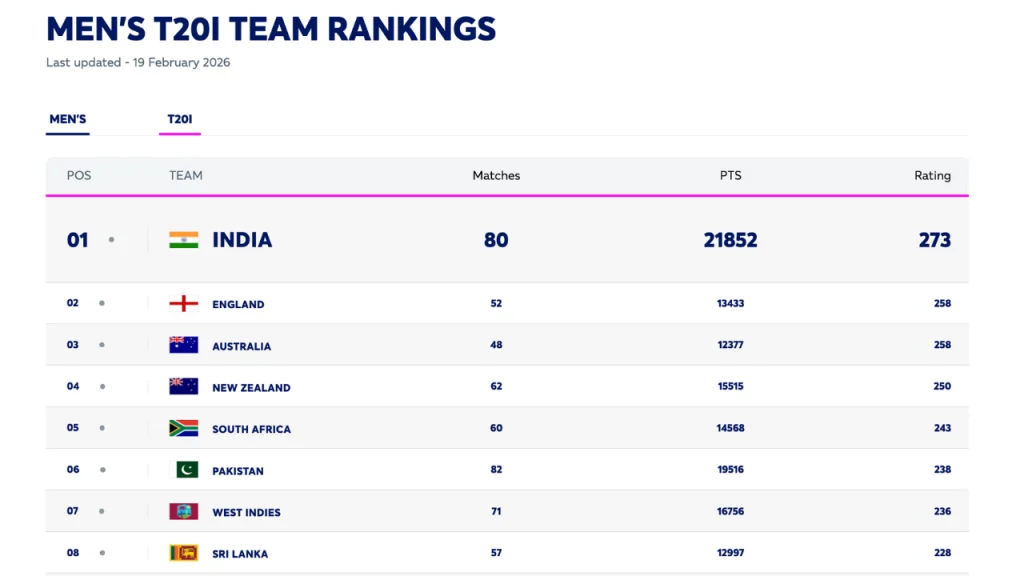
Australia currently hold 258 rating points, compared to New Zealand’s 250 — an eight-point difference despite the single-position separation. The rankings are calculated under a weighted system devised by David Kendix, where total points are divided by matches played, factoring in opposition strength and recency. Matches played in the last two years carry full weight, while older fixtures count for half.
Australia’s rating is derived from 48 matches, while New Zealand’s total comes from 62. Should the Black Caps progress to the final of the ongoing tournament, their tally would increase to 67 matches, compared to Australia’s projected 49 after facing Oman.
Theoretically, New Zealand could overtake Australia and claim the Oceania Olympic spot if they surge deep into the tournament. Reports suggest they would need to increase their overall points tally from 15,515 to 17,152 — a gain of 1,637 points — to move ahead.
However, even a run that includes victories over Pakistan, England and Sri Lanka in the Super Eight and ultimately lifting the title would only generate 1,491 additional points, leaving them 146 short of overtaking Australia.
In other words, while Australia’s qualification path has tightened, the mathematics still favour them — at least for now.
New Zealand’s surge keeps pressure on
New Zealand have already advanced to the Super 8 stage and historically possess a strong record of reaching at least the semi-finals at global tournaments. That progress keeps pressure squarely on Australia’s ranking position.
If New Zealand were to leapfrog their Trans-Tasman rivals before the cut-off date, Australia would lose automatic entry and instead be forced into a qualification tournament — an unexpected scenario for one of cricket’s traditional powerhouses.
Australia’s final group match against Oman carries ranking implications as well. A defeat would reduce their rating from 258 to 256, narrowing the buffer further. A win would strengthen their position.
Despite the setback, Australia remain, for now, on course to secure the Oceania berth — though the margin leaves little room for further slippage.
A tournament that changed the equation
Expectations had been significantly higher for Australia entering the 2026 World Cup. Instead, losses to Zimbabwe and Sri Lanka exposed inconsistencies across the squad and ended their campaign before the knockout stages.
Injuries to key figures such as Pat Cummins and Josh Hazlewood were part of the narrative, but the broader issue was underperformance across the group. The exit has now amplified scrutiny not only on immediate results but on strategic planning ahead of 2028.
Missing direct Olympic qualification would represent a significant reputational blow, particularly given the symbolic importance of cricket’s return to the Games after 128 years.
Olympics 2028 a stated ambition for Smith
For senior players, Los Angeles 2028 is more than a distant target — it is a defined career objective.
“My main goal is to get in the team when the Olympics is rolling around,” Steve Smith said in January after the win over Brisbane Heat. “I’d be keen to do that. That’d be pretty cool. So, keep doing what I’m doing and you never know.”
Smith’s comments underline how seriously the Australian leadership group views Olympic participation.
Should Australia fail to secure direct qualification, they would need to navigate additional qualifying fixtures to reach Los Angeles. The alternative scenario — missing out altogether — would be a dramatic twist for a nation that entered this cycle ranked among the world’s top three T20 sides.
For now, Australia remain in control of their Olympic destiny. But their World Cup exit has ensured that qualification for LA 2028 is no longer a formality — it is a ranking battle that could go down to the final numbers.


