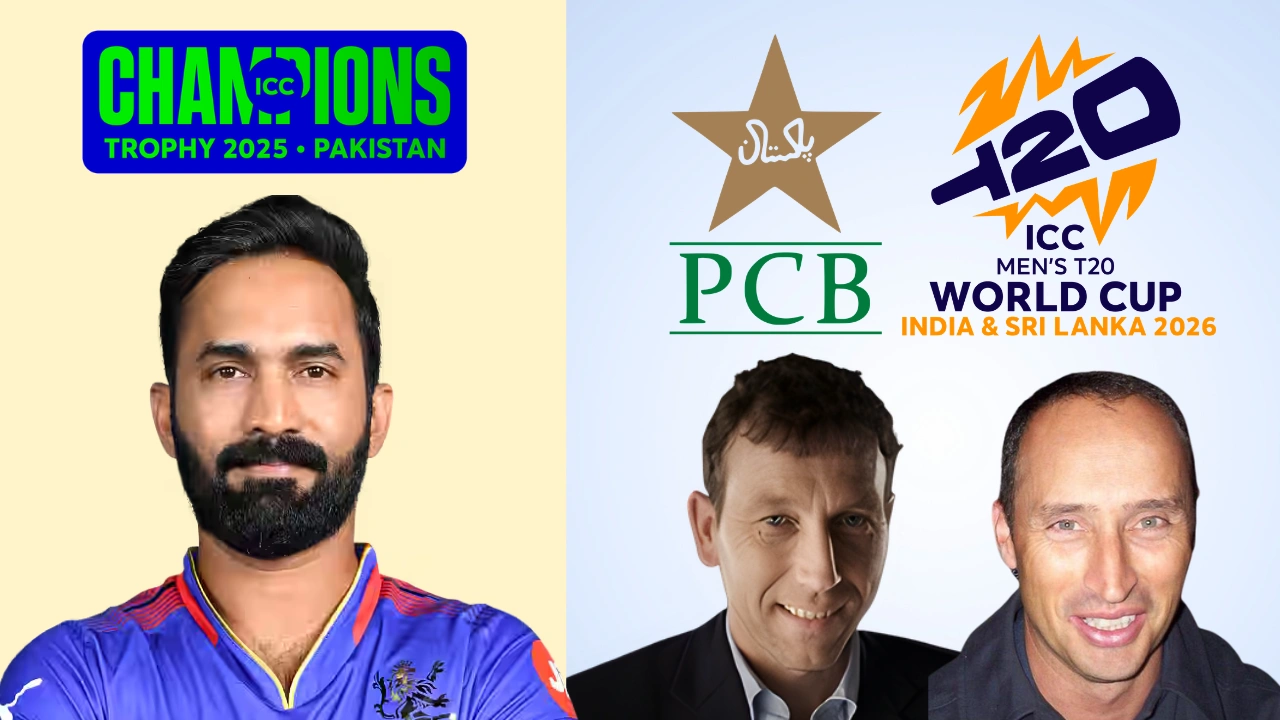
Tournament conditions and venue advantages returned to the spotlight during a discussion involving Dinesh Karthik, Michael Atherton and Nasser Hussain.
Former India wicketkeeper-batter Dinesh Karthik used the discussion to challenge earlier criticism directed at India’s Champions Trophy triumph, pointing to Pakistan’s inability to replicate a similar advantage during the ICC Men’s T20 World Cup 2026 while speaking on the Sky Sports Cricket podcast with Michael Atherton and Nasser Hussain.
Karthik questions Champions Trophy argument
The conversation began when Karthik was asked which teams surprised him by failing to reach the semifinals of the tournament. Reflecting on Sri Lanka’s campaign, he remarked that he expected them to go far “because of the home conditions and because they are a side that needs a bigger cause. But that didn’t work out.”
Continuing his explanation, Karthik noted that “And then I genuinely thought Pakistan purely because they have played consistently in Colombo, stayed in the same hotel, know the pitches. And both you fossils said that’s one of the main reasons why India did so well in the Champions Trophy,” referencing the earlier criticism Atherton and Hussain had made about India’s Champions Trophy campaign.
Expanding on that argument during the podcast discussion, he added that “By that same accord they should have done something in this World Cup but clearly, it works for one team and it doesn’t (for the other). So genuine lack of skill there. I backed Pakistan to say that they will just fight a lot more but they lost most of the games and in the end almost losing to Sri Lanka was mad.”
Pakistan and Sri Lanka fall short in Super Eights
Both Pakistan and Sri Lanka entered the tournament with expectations of challenging for a place in the semifinals but were unable to advance beyond the Super Eights stage.
Sri Lanka struggled during the second round, losing all their matches and ending their campaign without a win at that stage of the tournament.
Pakistan’s Super Eights journey also proved difficult. Their clash against New Zealand was washed out before the side suffered a defeat against England. Although Pakistan finished their campaign with a narrow victory over Sri Lanka, the results were not enough to secure a semifinal berth.
Earlier debate over India’s Champions Trophy campaign
Karthik’s comments referenced criticism that emerged during the ICC Champions Trophy when India played all their matches at the Dubai International Stadium.
At the time, Atherton and Hussain had argued that India benefited from staying at a single venue while other teams had to travel between multiple cities and countries for their matches.
That discussion resurfaced after Pakistan’s campaign unfolded in a somewhat comparable logistical setting during the World Cup, with the team largely operating from Colombo and playing multiple matches there before their Super Eights fixtures in Pallekele.
Salman Ali Agha acknowledged tournament advantage
Before the start of the T20 World Cup, Pakistan captain Salman Ali Agha had addressed similar questions regarding scheduling advantages.
Speaking during a press conference when Pakistan announced their squad for the tournament, he acknowledged that the arrangement could offer logistical benefits but cautioned that performance would still determine results. Agha explained that “It is an advantage, the other teams will be travelling and staying in different hotels, playing at different grounds. We also will be playing different grounds in Colombo but will be staying at the same hotel. But that doesn’t mean that we can win even if we don’t play good cricket,” while discussing the tournament schedule.
He also referenced India’s Champions Trophy success when addressing the subject of venue familiarity and performance.
During the same interaction, Agha emphasised that results ultimately depended on how teams executed on the field, noting that “India played well there, that is why they won. We also have to do the same, only then will we win. But yes, there is definitely an advantage.”