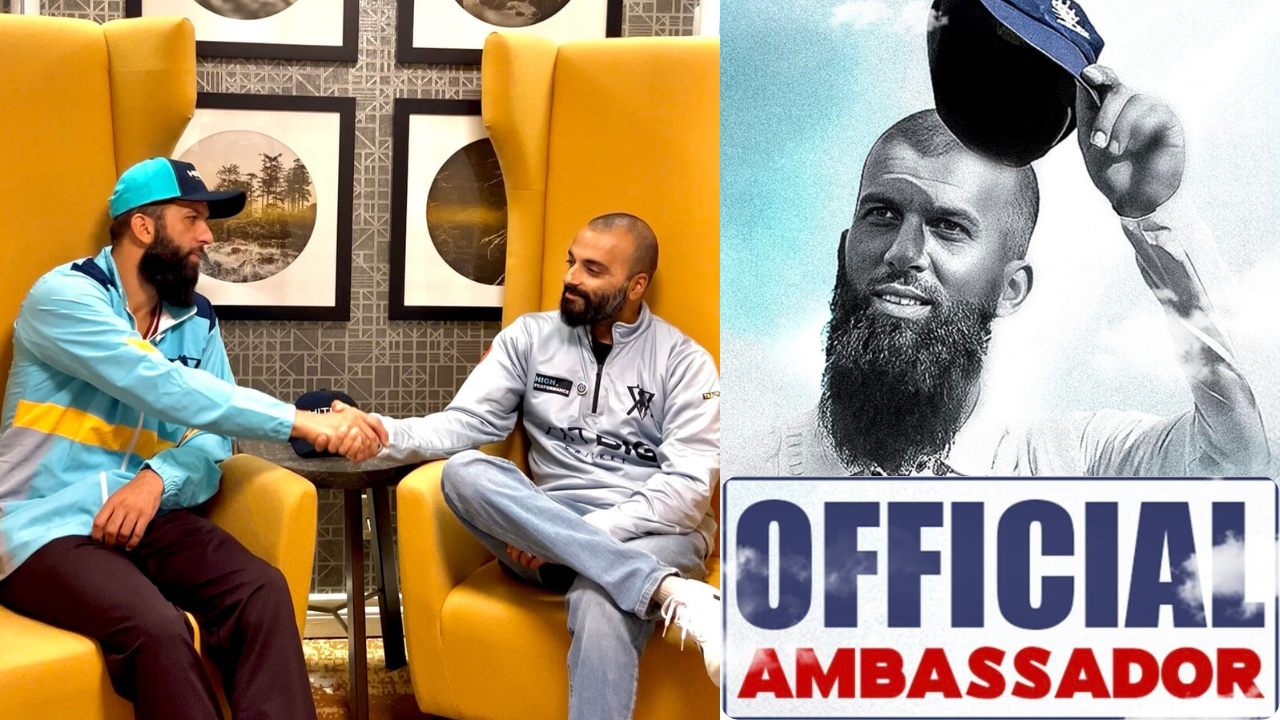
When Moeen Ali arrived in Canada last summer for the Super 60, he wasn’t expecting a trip down memory lane. The England all-rounder had come to Vancouver to play cricket, not to revisit his Birmingham childhood. But as Priyesh Dhoolab showed him around British Columbia’s cricket landscape, something clicked. The makeshift facilities, the territorial battles over indoor spaces, the South Asian communities hungry for opportunity but shut out of the mainstream system—it all felt unsettlingly familiar.
“Priyesh explained to me what cricket is like there, the facilities, and how accessible the game is,” Ali recalls. “It reminded me of when we were younger—when things were quite difficult.”
That conversation has now evolved into something more concrete: a formal partnership that sees Ali become Global Ambassador for Hit Big Cricket, the academy Dhoolab founded after moving to Canada during the pandemic. On paper, it looks like another celebrity endorsement, the kind of big-name attachment that’s become standard currency in the global academy business. In reality, it’s the reunion of childhood friends who share not just history, but a philosophy forged in the unglamorous reality of English cricket’s margins.
The Birmingham blueprint
Dhoolab’s connection to the Ali family runs deep. He grew up playing cricket with Ali’s brother and was coached by Ali’s father, Munir, a figure who looms large in Birmingham cricket folklore. When Dhoolab talks about his coaching philosophy—the obsession with fundamentals, the insistence on quality over expansion, the willingness to turn away business rather than dilute standards—he’s channeling lessons learned in those early days.
“Facilities were limited, and access to them was very difficult—especially for people from South Asian backgrounds,” Ali remembers of his Birmingham youth. “It was a struggle and a fight, but it motivated us. My dad was very passionate and said, ‘We’re going to do this.'”
They did. Ali went on to represent England in all three formats, amassing over 6,000 international runs and 300-plus wickets. But the path there wasn’t paved by academies with pristine facilities and corporate sponsorships. It was built through relentless work in spaces that were far from ideal, guided by coaches who cared more about player development than expanding their business footprint.
That ethos traveled with Dhoolab when he landed in Canada in 2020, carrying next to nothing. “I brought one suitcase, no cricket stuff, because I thought there was going to be no cricket here,” he says. “Little did I know there were a lot of people passionate about cricket—they just hadn’t been exposed to it at that level.”
His qualifications extended beyond childhood coaching in Birmingham. Mentored by legendary coach Gary Kirsten, Dhoolab ended up coaching at top national, provincial and professional levels in Canada, including a stint as Head Coach of the Seattle Thunderbolts in Minor League Cricket in the USA and roles in Canada’s GT20. He developed a sophisticated understanding of North American cricket’s potential and its pitfalls.
One player at a time
What Dhoolab found in Canada was a cricket community rich in enthusiasm but poor in infrastructure, and an academy model that seemed designed to maximize enrollment rather than player outcomes. His response was deliberately contrarian. Instead of opening multiple locations and hiring whoever was available, he focused on individual coaching, working one-on-one with players who had talent but lacked the technical refinement or mental guidance to break through.
Aaron Johnson became his proof of concept. The right-handed batter had the raw ability but needed technical adjustments and, perhaps more importantly, someone who believed in him. “With Aaron, I fixed a few things, did some technical work, but more than that I guided him and talked to him as a friend,” Dhoolab explains. “Eventually he got in and broke records.”
Johnson’s success—he was a regular on Canada’s national team from 2022-2025—gave Dhoolab credibility, and soon other talented players started seeking him out. The pattern repeated: players frustrated by mass-production academies, looking for something different. “Parents and kids come to me from other academies saying there are too many kids and they’re not learning or developing skills,” he notes.
This track record is what makes the partnership with Ali more than ceremonial. When Dhoolab approached him about becoming Global Ambassador, Ali didn’t just see a business opportunity. He saw a coach operating with the same principles that had shaped his own development. “Moeen understands that language,” Dhoolab says. “He comes from an even higher level than that, so it was an easy transition to get him on board.”
The facility problem
The similarities between Birmingham in the 1990s and contemporary Canada go beyond the demographic makeup of the cricket community. Both environments suffer from a fundamental infrastructure problem: cricket exists at the pleasure of more established sports, constantly fighting for space and legitimacy.
In Canada, that means negotiating with baseball facilities that understandably prioritize their primary sport. “Baseball is priority in Canada,” Dhoolab explains. “If they fill up, I can’t coach and I have to cancel sessions—financially, that has an impact.” Even when he can secure space, the facilities themselves tell a story about cricket’s place in the Canadian sporting hierarchy. “When I came here, the first thing I noticed was we don’t have side screens, turf wickets, dressing rooms, scoreboards—there’s nothing. It’s hard to grow cricket like that.”
The facility issue is compounded by territorial dynamics. Indoor cricket centers often run their own academy programs, creating conflicts of interest when independent coaches try to rent space. “Facilities here run their own academies, and once they start, it becomes territorial,” Dhoolab notes. “It’s not easy to just come in and run private sessions.”
For Ali, walking into this landscape triggered immediate recognition. “I see similarities in Canada—a lack of facilities, but so much talent out there,” he observes. The parallel isn’t exact—Canada lacks the deep club cricket infrastructure that eventually elevated players like Ali in England—but the fundamental challenge is the same: how do you develop world-class cricketers when the system seems designed to prevent it?
Quality as strategy
The conventional wisdom in the North American cricket academy business runs something like this: scale fast, open multiple locations, hire as many coaches as possible, maximize enrollment. It’s a model imported from other youth sports, and it has a certain logic if you’re thinking about cricket as primarily a participation sport or a business opportunity.
Dhoolab is thinking about something else entirely. “If I can’t connect with coaches who meet the standard we’re trying to embed, I’m not going to take anyone on for the sake of it,” he insists. It’s a position that likely costs him revenue in the short term, but he’s playing a longer game. “You’re building the next generation of cricketers and leaders. What kind of standard are we leaving behind when we’re gone?”
This isn’t romantic idealism—it’s pragmatism born from experience. Dhoolab has seen what happens when academies prioritize quantity over quality, when the coaching standard is diluted in the name of expansion. Players hit a ceiling, fail to progress, and eventually drop out. The lucky ones find coaches like him; the rest become casualties of a system that took their parents’ money but didn’t develop their talent.
“Quality over quantity for me,” Dhoolab emphasizes. “At the high level, when you’re in front of the global public, it’s very quick to identify where your skill is at.”
Ali’s involvement lends weight to this philosophy. He’s not being asked to show up for photo opportunities or put his name on a certificate. The partnership is structured around his genuine engagement with player development, drawing on his experience at the highest level of the game. “The ultimate job is to grow the game and produce players—county players, international players—and give them something for life,” Ali says.
The associate country advantage
There’s an irony in Canada’s underdeveloped cricket infrastructure: it creates an environment where individual coaches can have outsized impact. In established cricket nations, the pathway is institutionalized, for better and worse. In associate countries, there’s more fluidity, more opportunity for a single academy or coach to shape national team outcomes.
Dhoolab has already demonstrated this. Besides Aaron Johnson, Dhoolab has worked with Dilpreet Bajwa, an all-rounder recently announced as captain of Canada’s national team. “Coach Priyesh has great knowledge and experience of the game,” Bajwa says. “He has helped me not only with my technique but also with my mindset which has given me a lot of confidence. He keeps complicated things simple to understand.” In a small cricket ecosystem, that kind of track record matters enormously. It’s validation not just of his methods, but of the model itself—the idea that focused, high-quality coaching can compete with (and often surpass) larger, more resource-rich programs.
For Ali, Canada represents something else: untapped potential at a moment when the global game needs new markets. “There’s something about Canada,” he reflects. “There are a lot of South Asian people, but also real untouched local talent.” The country’s baseball tradition could actually be an asset, he suggests: “With baseball already being such a hand-eye sport, cricket isn’t that far off.”
The timing feels significant. Cricket is expanding in North America, driven by demographic shifts, the 2024 T20 World Cup matches played in the United States, and the sport’s upcoming inclusion in the 2028 Los Angeles Olympics. In this moment, the coaching infrastructure that gets built—and the standards it upholds—will matter enormously.
“When I was there, I had this feeling the game needs to grow here,” Ali says of his time in Canada. “If we can grow it here, it could be massive.”
Building for succession
Ali’s own story offers a window into what success looks like beyond playing careers. The academy in Birmingham that shaped him—where his father coached and he and his brothers developed—is still producing players. “Even the ones who didn’t become professionals are coaching now,” Ali notes. “It’s a way of life.”
That’s the model Dhoolab is trying to replicate: not just a factory for churning out cricketers in bulk, but an institution that creates coaches, develops leaders, and builds an ecosystem that can sustain itself across generations. It’s why he’s so uncompromising about coaching standards, even when that stance limits growth.
The partnership with Moeen Ali isn’t about accelerating expansion—it’s about validating the approach, bringing credibility to a model that runs counter to prevailing industry logic. In the North American cricket landscape, where big promises and rapid scaling are common, Hit Big Cricket is making a different bet: that in an associate country, quality compounds in ways that quantity never can.