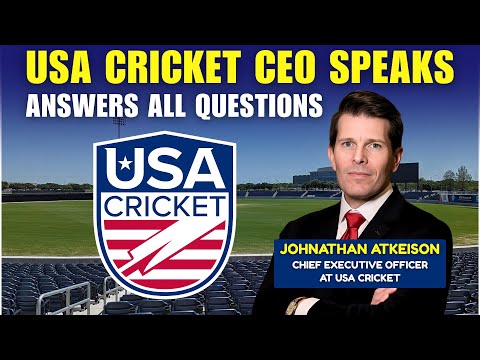
USA Cricket CEO Johnathan Atkeison sat down with cricexec earlier this week for an in-depth interview on one of the most contentious governance debates in the organization’s history.
In a detailed 50-minute conversation, Atkeison walked through the rationale behind a set of constitutional amendments recently passed by USA Cricket’s membership—changes that sparked heated debate within the U.S. cricket community and an ongoing lawsuit against the board.
The interview comes days after USA Cricket confirmed that members had approved the new amendments, which are designed to align the organization with U.S. Olympic & Paralympic Committee (USOPC) governance standards—a critical step in USA Cricket’s bid to obtain official National Governing Body (NGB) status in time for cricket’s debut at the LA 2028 Olympics.
Here are the key takeaways from the interview:
Alignment with Olympic standards — not a power grab
Atkeison made clear that the primary driver behind the amendments was compliance with USOPC requirements, not internal politics.
“What we were doing here was trying to move one big significant section of our bylaws into compliance… We have to get all of that done within this calendar year because they want everyone certified by January 1, 2026,” he explained.
One of the most significant changes is increasing athlete representation on the board from two to four directors—fulfilling the USOPC’s 33% athlete representation rule. A new Athletes Advisory Council (AAC) will also be created to give athletes a stronger voice and the authority to appoint athlete reps across USA Cricket committees.
A key clarification: although some accused USA Cricket leadership of trying to consolidate control, Atkeison said flatly:
“Nothing that changed here changed the terms of the board members that are currently sitting… There was no substance to the accusations that this in any way helped anyone.”
This directly echoes the USA Cricket fact sheet on the amendments, which calls that claim “NOT TRUE.”
Why certain details were moved to appendices
One technical change that drew criticism was the shifting of board director term details from the body of the Constitution into an appendix—a move some feared would allow secret changes.
Atkeison explained this was a “housekeeping” measure designed to streamline the process and avoid requiring member-wide votes each time a director’s term changed due to normal board turnover:
“This is just making sure there’s a clean list that everyone can see… It moved it out of that section where we don’t have to go out for a vote every time… It’s purely formatting.”
Again, USA Cricket labeled this claim “NOT TRUE” in its public document. The director terms remain unchanged and fully visible as part of the governing documents.
The membership list controversy
One of the most sensitive issues was the size and composition of the voting membership. Critics alleged that the voting list was manipulated to disenfranchise certain members.
Atkeison acknowledged that USA Cricket’s membership database had inconsistencies and that the voting pool had shrunk—partly due to constitutionally required membership continuity rules (members had to be active by June 30 of the prior year to vote).
“It’s a complex system… We need to make improvements in that. People need to have more confidence in the way that that’s created,” he admitted.
He said roughly 20,000+ members could have been eligible to vote, but only about 4,200 met the continuity and data requirements this cycle. Notably, after a public peer review process, about 600–700 additional members were granted voting eligibility.
USA Cricket’s “True or Not True” document similarly defended the integrity of the process while acknowledging past challenges, stating: “These issues are separate from the proposed constitutional amendments and are being addressed in parallel by the administrative team.”
Major board turnover ahead in December elections
While much of the recent attention has focused on constitutional reforms, another major governance milestone is fast approaching: a near-complete turnover of USA Cricket’s board in the upcoming December 2025 elections.
Atkeison confirmed that “almost everyone on the board will have turned over” by the end of this year. The elections will include four new Athlete Directors — to be elected via a separate process limited to U.S. international players — and multiple key board seats that will go before the full membership for a vote.
Among the positions expected to turn over: Independent Director Venu Pisike, who currently serves as Chairman of the Board. Director Atul Rai’s seat is also up for election, with additional seats subject to confirmation as the final electoral calendar is set.
These elections will follow a newly refreshed membership eligibility process after June 30, with a peer review period planned to ensure transparency and broader participation. If executed properly, this could lead to a larger and more inclusive voting base than the roughly 4,200 members who participated in the constitutional amendment vote.
For a governance body long mired in division and controversy, the December elections represent a rare opportunity for renewal — and for members to help shape the future leadership of USA Cricket.
What happens next
Now that the amendments have passed, USA Cricket faces a packed to-do list:
- Publish the revised Constitution — within days.
- Run elections for four new Athlete Directors — a complex process limited to international athletes.
- Stand up the Athletes Advisory Council — with full athlete representation on USA Cricket committees.
- Prepare for a major board turnover — nearly all board seats will turn over via elections later this year.
- Continue the push toward NGB recognition — which would open new funding channels, Olympic integration, and enhanced legitimacy.
Atkeison was candid about the scale of the work ahead:
“We are fundamentally a relatively small organization in terms of our receivables… It’s a big challenge to get it all done at the same time.”
But he emphasized the prize at the end of this path: formal entry into the US Olympic family.
“It comes with a lot of privileges… Our athletes get the chance to be Olympians… We should be part of the Games.”
Looking ahead
While the membership has now approved the constitutional reforms, governance disputes and a pending lawsuit continue to loom over USA Cricket. But Atkeison closed the interview with a message of transparency and optimism:
“We’re not trying to hide anything here. These are all pretty routine things… Sunlight’s the best disinfectant.”
With LA 2028 fast approaching—and cricket’s Olympic future on the line—USA Cricket’s governance journey is far from over.
Transcript
Zee: So we’re here today joined by USA Cricket CEO, Atkeison. Jonathan, thank you for joining us at Cricexec.
Johnathan Atkeison: Yeah, of course, Zee, great to be here. Appreciate the opportunity.
Zee: We’re here to talk about the constitutional amendments that the USA Cricket board recently put out to a vote to the full membership. And that also as of today, Monday, were announced to have passed the membership and will be going into effect.
While you have put out materials about what was going on, we thought we’d have you on and give you the opportunity to talk about what this was because there was a lot of talk among the sort of community and press about what this was about. So why don’t we start with this? What was the objective of these constitutional amendments? What’s the context you want to give, right? There were three or four different sections to these.
But what was going on? was the need for these? What was this about?
Johnathan Atkeison: Yeah, absolutely. Maybe I’ll start with a larger context and work into the constitutional amendments themselves. as we’ve been public about, but it’s a detail that’s really important here. USA Cricket, ahead of the LA 28 Olympics, is trying to achieve what’s called NGB status with the USOPC. Sorry, the United States Olympic and Paralympic Committee. So the US Olympic body overall. Now that process is very thorough. The USOPC is a very compliance heavy organization, particularly after some of the issues that they had around the gymnastics and the Larry Nassar case. So there’s a very heavy audit and compliance component to being part of the Olympic movement. And that runs through all points of your business. The way athletes are selected, the way funding is spent, you have to apply for the funding, the way your governance is run, and the way your governance is run is the one that we’re particularly working on here. So the one that people identify the most is that there’s a 33 % requirement for the USA Cricket Board and all committees to be filled by high performance or international athletes. And that is a USOPC requirement that has been put in and changed in the last five years. Every year, you’re audited against audit standards for them though. They go through all your policies, all the boring stuff that nobody really talks about, the financial policies, the whistleblower policy, conflicts, gifts and entertainment, all these things. And every little bit of the policy and your bylaws have to be in compliance with the exact standards of language that they want in them. So what we were doing here in 2025, was trying to move one big significant section of our bylaws into our constitution, sorry, into compliance with that. So USA Cricket had undergone some significant revisions in 2024 to start that process. Now the thing to understand is every year those audit standards change because the US OPC will update what they want as a new audit standard based on reflections of things that have passed, new things that happen within the environment, new laws that may pass or new positions that the Team USA Athletes Commission may take. Now in this instance, specifically, we were trying to do two things. The biggest change that we had to make was to go from having two athlete directors to four athlete directors on the USA Cricket Board to achieve our 33 % threshold. We also have to establish what’s called an Athletes Advisory Council. Now this is basically like a committee for the athletes where they’re elected into it.
Johnathan Atkeison: And it becomes the body that then appoints the athlete representatives onto all of the committees within USA cricket, deals with all the athlete issues, gives them the voice to be able to come to the board. Easiest way to think of it is like a hybrid of a union and a committee together. So we had to get that thing up and established. So the constitutional amendments were made in 2024 to contemplate that being a thing. And then after that, all of the formational documents, the terms of reference, the way in which they’re elected, all of those policies had to be written and then subsequently adopted by the board, which they were earlier, either late 2024 or early 2025. I forget exactly when those were date wise. What we then also had to do was adapt to the fact that these things are ever changing with USOPC. So from the time that they did these adoption of the stuff in 2024, which in reality was contemplated in 2023, there had been a position change by the team USA athletes commission. Now, again, just
Zee: And sorry, when was this position changed? The last position. Got it. Okay.
Johnathan Atkeison: During 2024. Yeah, so again, important to understand there’s a difference between the USOPC and the Team USA Athletes Commission. So the Team USA Athletes Commission is the body of all Olympic athletes from representatives from all sports that come together. They’re self governing and they’re affiliated with the USOPC, but they’re not necessarily in lockstep with the USOPC audit team and governance team, which is separate. So there are some components of what the USOPC has to audit on that are determined by the team USAAC. So the component that changed was the way in which you have two representatives from each NGB that are elected to be the primary and alternate representatives to the team USAAC. Now in the past, what the USOPC had done and stipulated, you know, that 50 % of your athletes needed to be male and 50 % female. That was what we were working towards. And that was how USA Cricket had written it.
One male and one female that would be elected to be the AC reps, one male and one female that will be elected on a staggered term. So these two would start on a four year term. The other ones would be elected on a two year term and adopt a four year term thereafter, but one male, one female. Now what the team USA AC did was change their position to say, actually, you can’t stipulate that they have to be one male and one female. What we want to have happen is it to be an open election by the athletes and whoever gets elected gets elected. So you can’t stipulate.
So we had to make an adjustment in our policies to account for that, which then drove a number of adjustments throughout four, probably the three or four sections that you see inside the constitutional amendments. So that was probably the biggest change. The other change then was to, because as we said, these things change every year, you actually, and the USOPC really pushes NGBs on this.
You don’t want to have all of the formational documents captured in your bylaws or your constitution, because then it’s a big hard process every year to make the little adjustments that they need made as they adjust their auditing standards. So what they suggest is you keep the formation very basic in your constitution. You pull everything out into board approved policies, other than that, that way the board can approve the policy changes of things like voting standards or other stuff internally that happens within the AAC.
Johnathan Atkeison: That don’t have to then go out through the whole constitutional revision process. Very similar when we talk about moving that tracking component of when the director’s terms are into an appendix. It’s just a little bit of a cleanup. And also on that clause, that was meant to sunset, sunsetting meaning it was going to automatically be deleted in 2027 anyway. We just moved it into an appendix with clarity.
But the majority of those changes, actually that encapsulates all of those changes, were designed to get that AAC up and running, to get the documents that had been approved to be the formational documents, and to align what we had to the changes that were mandated in 2024, 2025. So that’s basically what it was. It’s actually pretty straightforward at the end of it. It was things that we had to adjust because we need to run our athlete elections, which means we have to run our AAC elections to be able to get that all done, to be aligned up, to be part of the USOPC. And we have to get all of that done within this calendar year because they want everyone certified by January 1, 2026.
Zee: Got it. So that’s a lot. Yeah.
Johnathan Atkeison: Yeah, it’s a whole lot. Sorry, I should have said like TLDR, if you don’t want to listen to boring governance stuff, just fast forward through this five minutes.
Zee: Yeah, exactly. So if I, can you give me an example, Jonathan? So if you, if we deal, dig into the point about, you know, the, the U S might’ve been the OPC that said move the bulk of these provisions into, appendices or into bylaws as opposed to the constitution in order to avoid having to amend your constitution every time the USOPC changes a requirement. Can you give me other examples, recent and recent history of the kinds of changes that they make all the time that if they weren’t in your constitution or if they were in your constitution would require like a vote of all the members? Like what is the nature of the stuff that you generally are moving from the constitution into bylaws?
Johnathan Atkeison: Yeah, I can give you couple of really good examples. And again, it’s important to note this covers all aspects of your business. So I’ll touch on a couple of different ones in there. There’s a hiring provision, for example, that goes into your hiring policy that some people would have sitting in their bylaws that says any NGB employee cannot hire anyone or cannot suggest anyone for a job that has been convicted of a safe sport offense. US Center for Safe Sport being the body that does.
What people outside of the US would call safeguarding, safeguarding, but child protection, you know, in the US. So that’s a provision that sometimes was sitting in people’s bylaws that moves into an employment related thing. Similarly, there’s some language around antidoping provisions with WADA and USADA. Some of that goes in the bylaws, some of that goes into employment provisions. There have been changes in the way that athlete contract language has led. So if you have things that deal with like name image likeness, a lot of organizations would have had those things in
Zee: Their bylaws, they’ve moved into policy docs or into the agreements themselves. There’s just, there’s so many of these little components that you could have them in one big doc or you move them out to the outside. Conflict of interest is actually probably a really standard one. prior to now, a lot of the conflict of interest policies, gifts and entertainment, things like that, gifts and entertainment being what you can take as a board member or as an organization member from people on the outside, that would have sat in inside the constitution.
And now almost everyone has moved those out into policy docs so that every year if there’s little adjustments that say the threshold has changed because cost of living has changed or we want a new process that says your conflict of interest has to be vetted by this external party, whether it’s a CEO, a committee, whatever, if they change their position on that, that’s in a policy doc as opposed to your constitution and or bylaws.
Zee: Got it. Okay. that makes sense. So let’s, let’s dig into, you know, it seems pretty straightforward. At least this exercise seems like a pretty straightforward exercise. that said there, there was some swirl around this exercise. and there were, you know, allegations, accusations made about what was going on.
And, you know, I want to give you the opportunity to get to the bottom of some of the, or at least respond to some of the things that have been said. Right. So the, probably the, the most prominent or common, um, uh, theory, accusation, whatever you want to call it was that this was, um, a means this whole exercise was a means for existing.
Members of the board to maintain their positions or in transfer positions, maintain power. Right. And I know you put out some literature to your membership responding to some questions, but I’ll give you the opportunity to say it here. Sort of what was, was there any truth to that or accuracy to that?
Johnathan Atkeison: mean nothing that changed here changed the terms of the board members that are currently sitting, whether they’re the athlete directors or the regular directors. The staggering of terms already existed in the constitution for the athlete directors. It’s just realigning that there’s a team AC primary and alternate rep that are on the summer Olympic cycle and the other two, again these are the gender agnostic, the other two which are now stipulated as one male and one female are on the winter cycle.
But that was already in the Constitution. It doesn’t change anything for the two athlete directors that are currently sitting. And then the move of where those tenures were listed into an appendices, it doesn’t change the fact that they’re still in the Constitution. It doesn’t change the tenures. There was no substance to the accusations that this in any way helped anyone.
Zee: So let’s dig in a little further. You know, the list of directors or what it was, staggering of the director term details, right, was moved from the main constitution into the appendix, but that’s not the same as moving it into the bylaws, right? So it was moved from one place to another within the constitution, I guess, because the appendix is part of the constitution, but
Johnathan Atkeison: Director term details, yeah.
Zee: If I have that right, so why was that done? Because that’s not sort of like a clean it up into the bylaws sort of thing.
Johnathan Atkeison: Yeah, so it didn’t take it out of the bylaws. just put it in a different place. Sorry, constitution and bylaws to me are interchangeable terms for most organizations, just to be clear for your listeners. So it doesn’t take it out. All it does is move it out of one of the sections where in order to keep it updated, in the section it was currently sitting in, it had to go out for vote every time to get it updated because it’s under one of the sections of the constitution that requires a membership vote. So as directors change and as those tenures change, you don’t…
Zee: Okay.
Johnathan Atkeison: It’s really, this is housekeeping, right? We’re just changing it to list what the current conditions are. It’s not something that actually needs to go back out and have a membership vote because all of the other sections of the constitution that deal with the way in which the directors are elected and when they’re elected on which cycle, those actually control the elections and the terms. This is just making sure there’s a clean list that everyone can see, which again, is a USOPC required component has to be published on the webpage, has to be up for everybody.
Johnathan Atkeison: But it moved it out of that section where we don’t have to go out for a vote every time to say, okay, well, somebody’s term ended at the beginning of this, at the end of this year, there’s a new term that’s reset that now runs for the four years subsequent to that. And here’s the director’s name. They took the director’s names off too, you know, but it’s individual director term ended on let’s say December 31st, 2025. The new person that’s in there runs from January 1, 2026 through January, December 31, 2029, you know, four year.
So it just keeps you from having to go back out to a vote for something that by and large is just an administrative section.
Zee: So there’s the constitution and bylaws which you’re using interchangeably. What is the place or the destination for some of the changes that you wanted to move? You said that was board policy documents and those items that you’re moving out of the constitution to not have have constitutional amendments each time you change them like the employment provisions we’re talking about. That’s board policy documents, is that what you’re saying?
Johnathan Atkeison: Yeah, so those become board approved policy documents. So there are things that have to go up to the board to get approval.
Zee: Those are available to the public? Are those accessible? Yeah.
Johnathan Atkeison: Yeah, those are published up on the webpage. So all of those are public information. So in this instance, because the athlete election sections were in one of those sections that had to be approved by the membership for changes, the changes to then say these elections have to happen, this thing has to be put together, the athletes commission, this is the way in which these athlete directors are elected on this cycle. All of that was part of one of the sections that requires membership approval.
But then the details that set in underneath that, which are really just the details about how that thing runs, those are put into board approved policy documents, which to be fair, in the future, the AAC will actually be the one that’s modifying those documents themselves and then sending it back up to the board. So the athletes will have control.
Zee: Got it. Can you talk about the, let’s talk about the specific individuals who got added to the board. So there were two board members that were, I want to give you the opportunity. There were two names in, you know, circulated in these documents.
As people who are, I believe, being put on the board. New names, new to cricket. Can you tell us…
Johnathan Atkeison: Sorry, to be clear, you mean the Nominations and Governance Committee, not the board. Yeah.
Zee: Sorry, they’re not, okay, yeah, sorry. I said board, right? Okay, so as part of this sort of initiative, right, there were, yes, there were individuals added to the nominations and governance committee, right, which is chaired by Nisarg Patel. That was already the case. And then Katie Lever and Lisa Noller were appointed as representatives, ICC and independent representatives accordingly. Can you clarify what happened there? Are they, what is the role they are going to be playing? How were they nominated and what, how did their, nomination and appointment, get enacted or not through the vote that just happened? Like was that separately that was announced or was that something that was voted on and effectuated?
Johnathan Atkeison: Yeah, totally separate from any voting. So this was done through two different things. So the nominations and governance committee. It is a committee of the board, but it’s the only committee in our constitution that is separate from the board. So it’s not a committee of the board under the board’s control. It’s an independent committee. That’s meant to have three members. One is an athlete director. Again, 33%, right? We’ve got to have our 33 % representation. That’s Nassar. One is an independent.
And then one is meant to be an ICC representative, which was a nod to everything that we’ve gone through. The ICC has a representative to be kind of an independent observer in that. There were two openings to what she said. There was an independent opening and there was the ICC rep that was open. And what the board asked me to do and what I worked with the ICC to do was actually to go to the USOPC database. So they maintain a database of people that are independents that have experience in a wide range of areas who have said that they want to be involved with Olympic sports and the Olympic sport movement. So I went to that database from the USOPC and sourced a whole slate of candidates, people with heavy compliance background though, I would say. if you look at Lisa and Katie, both of them are attorneys. Both of them come from a pretty heavy compliance background. Lisa is out of Chicago. It’s been federal compliance, prosecution, and now she’s on the other side of it.
Katie is actually in the gaming industry and works in a heavy compliance and regulatory framework. So we wanted to get people that were really solid on those fundamentals because it’s one of the biggest areas that USA Cricket has been criticized for over time, right? Not following the policies of good governance and having enough insulation. So I went and sourced those candidates, did interviews with them, made a suggestion to the board for our candidate, which was Lisa. The board chose to adopt that. I gave the ICC a list of other candidates.
And they selected Katie from amongst that candidate pool to come back on. Now what the NGC does is basically they’re a separate authority that runs the elections for USA cricket. They also look at the appointments that are made to committees and they ensure that those people are compliant. They’ve passed background checks, that they’ve passed their conflict of interest statements, everything that they need to be to actually be on a committee and serve for USA cricket. If they have the right membership requirements, if they’re a membership person, if they’re properly independent, if they’re athletes, et cetera.
Johnathan Atkeison: So the NGC is essentially our kind of regulatory ombudsman for governance matters overall.
Zee: Yeah, I was going to use the term sort of an internal watchdog, right, for for the nominations and elections process. OK, so, you know, moving along, if there was another question that was asked that, you know, that that I heard or that that people were
Johnathan Atkeison: Yeah, that’s fair.
Zee: We’re talking about as, part of sort of these changes, it was about who was voting, right. And the membership list. so the, the voting population or the eligible voting population was a certain number X thousand. and what I’ve heard, or what I’ve heard said is one, that number is down a lot.
Zee: And two, there’s some questions about cutoffs for, for eligibility, right? And, know, this goes to some of the other things that were said, which was if, if someone’s making the allegation that, this was meant to keep someone in power or, or preserve entrenched individuals.
Zee: Then obviously who votes and determining who votes is a part of that. So what went into the determining who’s eligible and what’s been the issue? If there’s any accuracy to that, that there was, you know, four or five times as many members before versus now, what’s the story there?
Johnathan Atkeison: Yeah, it’s a good one to dig into. And again, unless you want to hear the boring nuances of some of the way this works, go ahead and fast forward through this section of it. But leading off on that, I think the biggest thing that we have to acknowledge is we have a relatively small membership base right now, around 22,000 people relative to the entirety of the cricket playing population, which we think is somewhere around 400,000, if not 500,000 in terms of people that are playing league cricket. So organized cricket.
Leather ball, tape ball, tennis ball, you know, inside the US. If we’re looking at the numbers that, you know, crick clubs and crick heroes would report back on that. So part of the problem that we have is we have a relatively small sample size, you know, compared to the overall. And part of what I have to do from a business perspective is find a way to engage all those people. You know, we need to build a better mousetrap to get them under the USA cricket umbrella and to explain to them why there’s a benefit or they should want to be a part of what we’re doing.
That’s my job to build that into the strategy and the business plan moving forward. And once you get to those big numbers, you’re really not worried about a thousand here or there because that comes out in the wash of 400,000. The way the USA Cricket Constitution is written, it contemplates voter eligibility based off the issue
Johnathan Atkeison: It contemplates issues based on what’s historically happened. So there’s a 12-month trailing membership requirement that says at the time that you go to vote, you have to be a member then, and you have to have continuously been a member for 12 months prior to that date, which basically in effect means you’ve got that year and a prior year’s membership. Now, because what we’re doing right now falls on a weird cycle relative to where the elections would normally take place, like in December, it means that because it’s before June 30th, sorry, and in the new 2024 revisions, looking at that continuity based off the concept that people were registering on December 31st of one year and January 1st on another year just to be eligible for elections, they wanted to create a continuity requirement that said, in order for that year to count, you had to be a member by June 30th of the year. That way, you are in fact getting the full 12 months. It’s not just you are a member in one year and a member in the next year, which is a complicated nuance.
Zee: Sorry, John, yeah, I want to make sure I understand the complicated nuance. So in order to vote, and the vote usually happens when, you had to have been a member by June 30 of the previous year. Do I have that right or no?
Johnathan Atkeison: Yeah, so let’s say, let’s go to the future a little bit, because I’ll talk about some of the problems we had with this. So let’s say in 2026, we were going to run an election on January 1st, or let’s say December 31st, 2026, right?
Zee: And the election is usually for new board members for the most part, right?
Johnathan Atkeison: Right. Which always ended the cycle at the like a December 31st, you know, end of the year. That’s when these cycles happen. So you’re running those elections prior to that to get it done. So let’s say 2026 again, we’re going to do one on December 31st, 2026 under the current construct. So you would
Zee: And that’s not hypothetical. That’s actually going to happen. Yeah.
Johnathan Atkeison: Yeah, well, it would be in 2025, but yeah, let’s say 2025. So you would need to be a member in 2025, what’s suggested to the reality, right? 2025. You would need to be a member in 2025, and you would have had to register by June 30th to have 2025 count as part of your membership continuity.
Zee: June 30th 2025 or 2024? Okay.
Johnathan Atkeison: 2025, whoa, sorry, I’ll get to it, 2025. Now, that establishes your membership for 2025. For 2024, which is the 12 months prior thing, you would have had to have been a member in 2024 as well. And 2024 was when they adopted the June 30th deadline. So again, to get that continuity, you would need to have been registered by June 30th, 2024 to have the appropriate trailing continuity, basically your 12 plus months kind of thing. The issue that we had, this year was that when they adopted that June 30th deadline, which was in 2024, right? February, 2024, those were the last revisions. That was thinking the election cycle would be at the end of 2025 because that was when the normal stuff that was taking place. There wasn’t a contemplation of these kind of mid cycle elections because we’re now before the June 30th deadline of 2025, it means in order to establish the right continuity per the constitution,
You’re basing it off, were you a member in 2024 and were you a member in 2023? So it reaches all the way back almost two years prior. And this was all part of the peer review data collection. So in terms of the numbers, if we’ve got 22,000 members and I don’t know the numbers right off the hand to tell you what our annual churn rate is, there’s obviously, there’s going to be a significant overlap of people that are registered in one year, aren’t registered in another year. So that’s the first place that that number starts to come down.
Zee: Got it.
Johnathan Atkeison: Then there’s people that weren’t registered by June 30th in 2024. The year that they knew there was that, you know, that was published as part of the deadline for eligibility to vote. Doesn’t affect membership. It’s just a voting thing. You know, you’re still a member. You still eligible for other stuff for insurance coverage, but you might not be able to vote. That again is going to cleave it down lower. Now look at issues in the data. So we have data that gets uploaded. You know, the clubs or the leagues upload data into the system and that data is incomplete.
Doesn’t have date of birth, doesn’t have an email, doesn’t have something that we need to actually verify who that person is. There’s another group of people that get disqualified. So the peer review process of when we take that list that we think is, okay, these are the people that we think should be on the list, it goes out publicly, then it’s everybody’s opportunity to come back and say, why am I not on the list? Let’s look at the reasons why you may not be on the list. And there’s basically, to put it in a legal term, there’s an opportunity to cure, a cure period.
So if you Zee were registered and you thought, hey, there’s an issue here. And let’s say it was something that your phone number wasn’t in your date of birth. Hey, I should be eligible. I have the right membership dates on here. you didn’t have a date of birth. Well, give me your date of birth. Boom. Now you’re eligible. So that’s what the peer review process is about. that’s, listen, that is cumbersome. It’s cumbersome for the organization to do that because it’s a lot to manage the data. The data has been inconsistent over time. You know, we’ve had membership system change overs.
Like I said, data comes in as bulk uploads. We don’t have control over all of the data integrity all the time. That creates other issues. And then just, it is very complex to track all the dates and get it all out reporting wise. And then people have to look at it ahead of time before the elections to say, am I on the list or am I not on the list? To be able to challenge that. And in every step of that, there are opportunities for this to potentially go wrong.
And I think what you see reflective is, the overall voting pool ended up being it’s around 4,000 people. And I’m not saying anything you couldn’t go out and verify on the peer review.
Zee: Yeah, I’m looking at the list. It’s a 52 page list of 84 people on each page and there’s three extra. So it’s like 42, 80 something or something.
Johnathan Atkeison: Yeah, something, right? So when you look at that, that’s tough. You know, it is a reflection of the process that was run. There were a number of people that were made eligible based on that peer review process or reviews at the board to add additional people to make sure if there were issues with the league when their data was uploaded, when they made payments, et cetera, that the board reviewed to give people the opportunity to vote. But it is, it’s a complex system. And that’s something that over time, you know,
I think our board recognizes and I certainly recognize we need to make improvements in that. People need to have more confidence in the way that that’s created. I understand absolutely the way that it got there because it’s not, and it’s not unjustified. There are reactions like that June 30th thing or the two years. These are reactions to real issues that have happened in the past of USACA or USA Cricket. A bit more with USACA in the old days from what I understand and some now.
So there’s reasons that’s been put in, but we need a system of constant improvement to do post mortems, take that feedback and improve it going forward so we can give people more confidence.
Zee: Right. And before I ask a couple more questions about this, I just want to remind everyone, you started on the job last August, August 2024, right? So you are not even a year into this role. So, but just some specifics about this membership process. So you say, look, if everyone who is a member actually voted, right? Forget the cutoffs of, like then 20…
Johnathan Atkeison: August 2024. Yeah.
Zee: Plus thousand people would have been eligible to vote. Is that correct?
Johnathan Atkeison: Somewhere around there, yeah, because there’s a little bit of like, there’s two different membership types, but I think it’s around 20,000 is the number that I would hear, 2022.
Zee: Got it. And that through these requirements got sort of, I don’t know what the word, I was gonna say whittled down, but I don’t know if that’s a loaded word. So it got whittled down to 4,200. You said the list is supposed to be published for a peer review process where anyone can see, any one of the 20 X thousand people can see.
Johnathan Atkeison: Whittled down? Yeah.
Zee: I’m on it, I’m not on it. I’m on it, I’m not on it. And I can, here’s the, here is the avenue or the path to actually raising concerns and trying to get myself, what, how did that happen for this vote and when?
Johnathan Atkeison: So that started in February or March when we first started publishing the peer review data that went out. And then there was the peer review period that has gone publicly. I’d have to check the exact deadlines. But it was out for 30, 60 days, something like that, 30 days. And I think we continually had that reviewed.
Zee: When you say it went out, how did it first go out? Who first gets it? And like, here’s our initial list.
Johnathan Atkeison: It was out through email, posted to the webpage, and then I believe we put on socials as well that that information was available for people to review.
Zee: Email to all the members. although everyone who’s a member got a
Johnathan Atkeison: All the members. Well, everyone in our email list, which can be members, non-members to some extent, and then some members may opt out. So if they’ve opted out, I can’t contact them, but that’s understandable.
Zee: So there was a press release that went out, May 20 something, that linked to this list.
Zee: May 25th, sorry, I was just checking and confirming, so May 25th, it linked to this and that was a final list. So that initial list you’re saying was sent out or published in a similar way well before that.
Johnathan Atkeison: Well before that, I think that goes back to February or March, then the peer review process happened and there were a number of challenges that were sent into that. We got a report back to the board explaining where the issues were. So we list out the league, some of the challenges or individuals that came in, why they were or were not approved, you know, overall to be added to the list. Some people have just questions about the deadlines. Some people have questions about the data. Some of the issues that we ran into were league could make payment.
On X date, but they upload their data on Y date and that may straddle across June 30th. You know, they may have made payment for their members on February. And to be fair to the members point of view, they’re paying to be in their league. They don’t know when the data gets uploaded and that’s not in their control. So that was something that was contemplated as well to make allowances for that. Now in the future, we need to clean that process up. So there’s, you know, less need for exceptions on that, but all of that’s happened over the ensuing months. All of those things went in front of the board to be reviewed and or approved. And then the final list was linked out, as you said, right before we went through the voters.
Zee: Can you sort of quantify that once you publish the first list for peer review? Approximately how many individuals or organizations did you hear from?
Johnathan Atkeison: I think we ended up granting eligibility to an additional 650. Don’t quote me on that. can go back and look at it. It’s something under a thousand, but it’s over 500. Something between six and seven hundred additional people were granted.
Zee: But for example, for the vote that is going to take place, say, December 31st of this year, right, for how many board seats get elected this December?
Johnathan Atkeison: Almost everything is turning over. So we’ll have the four new athlete directors this time and then VNU’s position I believe is up, Atul’s position I believe is up. I’d have to go back and look at it. I should have done that before I got on here. But we have almost a complete board turnover is the answer at the end of this year. By through this whole process almost everyone on the board will have turned
Zee: And so that election is going to take, like the voting is going to happen on or by December, the end of the year, right? Probably a little bit before.
Johnathan Atkeison: Yeah, and there’ll be a whole new peer review process for that because that will be after June 30th, 2025. So we’ll need to go through a whole new vetting process.
Zee: So everyone who is a member as of the end of this month, end of June 2025, in theory, with whatever caveats we need to add, will be eligible to vote in the December election.
Johnathan Atkeison: As long as they had been a member in 2024 by June 30th. Yes.
Zee: Correct. Right. So eligible by now with the one year look back. And do you know, do you add not to put you on the spot because I didn’t sort of like, you didn’t know I was going to ask this, but like how many people is that? So there’s 20,000 something members right now. How many of them would be, how many of them like back, you know, would, would meet that look back 20, 24 requirement. If you don’t know it off the top of your head.
Johnathan Atkeison: Yeah, I don’t know yet, yeah, because we’ve got to wait until June 30th to see how many people register for this cricket season, which would then affect it back. So we’ve still got a little bit more time before we start pulling that data. But I’ll tell you, as of July 1st, our staff is starting to work on that because this is, it’s a bear to get all of that together.
Zee: Got it.
Zee: Yeah. But safe to say more than the 4,200 because you’re dealing with two look back periods as opposed to like just one. Okay. Now on this issue, know, guess, you’ve answered a lot, right? This is a lot for a lot of people to digest, not just me. What
Johnathan Atkeison: Yeah, definitely. Mm-hmm. Correct.
Johnathan Atkeison: Let’s hope it’s a lot. I don’t know how many people want to listen to half an hour of me talk about governance.
Zee: Yeah. But this is important, right? Because that’s what a lot of these questions are. And I think, I think there’s a lot of people don’t really understand everything that’s going on and they’re just reading things second and third hand, right? And rightly or wrongly drawing conclusions. And we’re all big about people just hearing from the source and looking at the documents, right? One thing that was raised, including by me, was the press release on the 25th talked about a town hall, right? A virtual town hall to present the amendments and answer questions from members, right? I am, I should be very clear, I am not a member. but it seemed like the town hall was open to members and non-members alike, unless I have that wrong.
Zee: And it said details to be shared via social media. And I don’t think we ever saw it on social media. Did that town hall happen? How did the word actually go out about that? Who attended and what was covered?
Johnathan Atkeison: Yeah, it did happen and I do think so we issued an email out about that to that same email membership list We were talking about and I do think we missed it on socials, know that I think organizationally I’ll own that one and take it on the chin We were down in Florida with the CWC going on and it just didn’t happen that it went out on social So I’ll hold my hand up. That’s our fault. There’s no malfeasance behind that It was just a mess, you know from my perspective that all it did happen that night we had about 70 people
65, 70 people on that call. I went through very similar to what we’re doing right now through the points and answered as many questions as came in in the chat about the constitutional amendment process, you know, similar questions to this about the elections, about the peer review, about the impact of some of these things and laid them out just like we’re talking right now. Took them as long as we had them. And I think we went for probably 30, 40 minutes and that call was wrapped up, but it did happen.
We definitely could have done a better job of opening that up. And again, this is not a thing that we’re trying to hide. I’m here talking to you as a member of the press. I’m happy to talk to people about it because from a governance perspective, again, and I come from a journalism background, Sunlight’s the best disinfectant for everything. We want to be open and transparent about all of these things. And there’s nothing to hide. These are all pretty routine things that are going through here. So there’s no reason for us to have any concern about talking about it, whether it’s to our members.
And we are a membership organization. They have every right to ask questions about that or to the press. We want to make sure that that message hits out there.
Zee: Was there anything discussed in that town hall meeting that wasn’t in the documents or the communications around this in one way or the other? Like, was there anything new that people wouldn’t have had access to had they not participated?
Johnathan Atkeison: No, I don’t think so. I mean, really, we covered pretty much everything in that explainer doc and then that subsequent document that you’re talking about that was sent to voters to talk about some of these issues that have been raised. I don’t think there was anything, there were other questions that we got about, know, let’s talk about college cricket. Let’s talk about, you know, the way we’re going with the national teams. Let’s talk about things that are going on with the hub level, which is definitely really valuable feedback to get. It wasn’t the purpose of that meeting. We’ll address that in different town halls but nothing that we haven’t covered in terms of governance.
Zee: Okay, again, just so everyone understands kind of the roles and the players here, you are the CEO of USA Cricket. Maybe I should have started with this. you are, yeah, what is your role on the board itself or with respect to the board? You report to the board. Are you on the board? Do you vote on the board? Or you do attend board meetings? Like, how does a CEO fit in?
Johnathan Atkeison: You just cut it and put it back there at the beginning. It’s fine.
Johnathan Atkeison: Yeah, well, it’s a good question too. And for everyone’s background in different organizations, the CEO can have different roles on the board. So publicly traded corporations, often the CEO is the CEO and the president, which is basically the chair of the board. In some nonprofits, the CEO can be a voting member of the board. And in some, like our setup, I am not on the board in any capacity. I am a staff member that reports to the board.
Now I am consistently on the board calls because I am the contact point back and forth between the organization, the staff and the board itself, but I am not a voting member of that. I just give input or drive strategy and work with the board to build those things out and build that operational details.
Zee: Got it. And you were hired by the board.
Johnathan Atkeison: I was hired by the board, yes.
Zee: And is it public how long your term is? Or like your tenure is?
Johnathan Atkeison: I don’t think it is. mean, I don’t mind saying I’m through the Olympics at a minimum. like to stay longer, really enjoying cricket. Honestly, I love it. I think there’s a lot of work to get done over here. And I am committed to the future of this organization overall. Listen, it’s hard. It’s challenging every day. There’s no question about that, but I really enjoy what I’m
Zee: So now, know, again, we’ve talked through a lot of this and I appreciate your time. Let’s just wrap with talking about what happens next. Now these, these amendments have passed, right? Again, you announced that today. Today being Monday, June 9th. What happens? these, you know, the membership has
Zee: Formally voted on and approved these amendments. What happens next? Like where does USA cricket go from here? What is, what happens next with these amendments and what happens next on the path to, USOPC, you know, approval.
Johnathan Atkeison: Great question. So there’s a couple of things that have to happen. One, the Constitution document will be amended and published. That should happen in the next day or two. We’ve gotten that back from the Constitutional Review Workgroup, which again is a working group that was established by the board to look at the constitutional revisions that needed to be done, make the suggestions to the board, which then the board votes to adopt or not adopt, some of which they can adopt and change by their own, some of which they can choose to adopt and then put forth to the membership for a vote. So we’ll get that done.
The next thing is the NGC actually has to get working, which they already are, on the elections for the athlete directors. So there’s a staged process of three elections that will happen. Now these, again, these are not membership elections. These are only voted on by the actual athletes that have represented the United States, male or female, in international senior competition. And that’s the way the USOPC sets it out. You there’s an athlete standard, and those athletes are the ones that get to vote on the athlete reps.
They’ll first elect two directors who will also be the team USAAC reps. They’ll then open up what are the AAC election positions. Two of those will likely also be USA Cricket board members, the other two athlete directors that will be voted on on that. They’ll fill out those things. So that will be more of an internal process that will be run to do that. We’ll get those running.
That will happen hopefully quite quickly. You know, we’re targeting having it all done by July because again, we need to get these things up and running to be able to have a chance with the USOPC to be compliant, to get everything done. You know, they are on a truncated timeline of wanting to get everything done, truncated to a degree by January 1st, 2026. And listen, this is, it’s hard. You know, when you start this, there’s public notice periods, there’s opportunities for review, hearings, et cetera.
It’s a very bureaucratic process that you go through. And it’s very rigorous because they’ve had a number of challenges publicly, you know, surfing, skateboarding. A couple of others have had issues that have come in in the last few games, relatively young NGBs. And it’s, you know, this is a difficult process. I come from this background with my experience with USA rugby, having run it. I’ll tell you, you feel like you’re getting audited all the time because you get an annual audit, a quadrennial wallet comes from the US OPC. It comes from the center for safe sport.
Johnathan Atkeison: In this instance, we have them from the ICC as well. Plus you got your financial audit and it becomes a huge part of the organization. You have to have a compliance person managing that consistently to go through. But next steps, constitution amended, international athletes, representatives elected to the board, AAC up and running. They’ll then seat all of the athletes onto the USA cricket committees. So they’ll go through a process of redoing that. What the members will see is we’ll move through the rest of the election processes that we have to run.
We do currently still have an independent board director position that is open pending some things that are going on in the background there. The NGC, if that process goes forward, will be running that process as well. So that would be a replacement position. Then towards the end of the year, you would see another peer review process for membership data and you’ll see the elections start to run for those individual league and club director positions as they.
And by the way, if you ever think you want a career in sports, let me tell you, you don’t think that you’re going to be spending 40 minutes, 45 minutes talking about the nuances of governance.
Zee: Yeah, with me of all people. Yeah, was going to say somewhere in there, you, you, Jonathan, need to find time to grow the sport in America.
Johnathan Atkeison: But it’s really important.
Johnathan Atkeison: Yes, that’s the hard part, right? We’re talking about a huge remit. We’ve got national teams that are basically professional organizations. We’re working at the local level to do grassroots cricket. I’ve got compliance. We’ve got everything running a business. I got to buy insurance, all the normal stuff that happens. You we got labor. We have to talk to the players all the time, which is fantastic. They’re our stakeholders, but it’s a huge job to get it done. And we are fundamentally a relatively small organization in terms of our receivables. You can look at our 990s and see how we compare, you know, to your corner shop down the road. We’re relatively limited. So it’s a big challenge to get it all done at the same time.
Zee: And if you, you know, back to this, this, this imperative or this task of, of getting, you know, USOPC compliant, what’s the prize at the end of it? So if you do all this, then what, what gets that, what do you get to do after that? Like what’s the role of it? You know, what, what do you win?
Johnathan Atkeison: The USOPC, don’t get me wrong, it’s hard to get in there, but it’s a club that you want to be a part of. You you become part of the American Olympic family and that comes with rights. It comes with a lot of obligations of what you need to do to be a part of that fraternity of organizations, but it comes with a lot of privileges as well. You know, you’re accepted as part of the Olympic movement overall.
There is significant funding that can be accessed through the USOPC specifically to support high performance and national team operations, which is great. Our athletes then get the chance to be Pan American Games participants. They get the chance to be Olympians. And I think from an American perspective, it’s very difficult to argue with the allure of a gold medal. We all grow up seeing that every four years and seeing our Olympic heroes go out there. And from an Olympic perspective, having the backing of the United States Olympic and Paralympic Committee is about the same as from a cricket perspective, having the backing of the BCCI, right? They are a huge organization. They’re integral to the Olympic movement overall. And it’s also a standard of American excellence. You know, they push out what they would call podium behavior. They want to target gold medals. They want to target high performance and they want to target excellence. And we want to be a part of that.
Zee: And, you know, last question, obviously 28 Olympics, Los Angeles, 2032 Olympics in Brisbane. Right. So I kind of like cricket’s chances of staying in the 2032 Olympics, although it’s not a done deal. But the Olympics are including cricket in 2028 as sort of a, it’s not a permanent decision, right? It’s, it’s,
Johnathan Atkeison: Correct.
Zee: And so I forget what the latest terminology is for that status. It’s not an exhibition sport, right? It’s a metal sport, but it would be a, what’s the word, what provisional? Like I forget what.
Johnathan Atkeison: Yeah, so it’s basically there are a certain number of sports that are medal bearing, but there are only sports that are appointed by the host committee. So the LA 28, right. So breakdancing is probably the most famous one from Paris, right? Everybody enjoyed watching that or at least parts of that or the memes that came out of that. So there were medals given out, but breakdancing didn’t stay in the games overall. And it’s complicated. The Olympic games already has a huge footprint.
Zee: to host for that one.
Johnathan Atkeison: And there was an agreement in Paris to limit the number of participants that are involved in an overall games and to try and limit the actual requirement for cities to be able to host it from an infrastructure perspective, because it’s a massive undertaking. So when cricket went in, cricket went in with six teams. There’s six men’s teams, six women’s teams, which means that field is as competitive as anything in cricket, you know, to get into it. Everybody will want to be a part of it. Part of the restriction that we’ll have here, and it’s been announced that, you know, the Pomona
County Fairgrounds in Los Angeles, Pomona Fairplanks will be the site, is we’re working out of one facility. So all 12 of those teams, the entirety of that tournament will be held in one ground. Six, eight strips, know, wickets in the middle. That’s going to be really tough. So it limits the opportunity for people to be involved. When you go to a Brisbane and then potentially, if you believe the Olympic scuttlebutt, maybe India after those Brisbane games, you’re going to have more cricketing infrastructure and you’re potentially definitely with Brisbane.
You’re going into a country that has cricket as kind of its sporting fabric. It’s one of the top three sports in Australia. If it goes to India, obviously we all know it is absolutely the number one sport. So cricket is really well positioned if it can deliver great games and deliver on the promise of what cricket can bring to the Olympic family in terms of an international profile. We’re the second largest and most popular sport in the world. We should be part of the games. Everybody wants to be part of that. If it can deliver an LA 28, I think it’ll cement its position moving forward as part of the consistent game sport package.
Zee: And, what you’re saying is say, you know, in 2036, it’s not awarded to India, say it goes to Istanbul or one of the other potential candidates in the running. if, if cricket status in Brisbane, if it gets to that point is because the host country chose to include it. and that goes away, right?
Zee: and cricket doesn’t become a permanent sport, right? Like swimming or track and field. There are still, but you can still continue. The USA Cricket entity organization can still be a part of the USOPC and still get benefits in other competitions or does that, do they just say, sorry, you can’t be part of the club anymore?
Johnathan Atkeison: Yeah, no, there’s some sports that are Pan Am game sports only. Squash is actually a really good example, I think, where they had been a Pan Am’s participant. They had previously been an Olympic participant. They’ve been an on and off over the years in the sport program. I think they’re back in in LA 28, along with baseball and softball, who had both been in the program for years, who are out and are now back in because they’re in LA. So you can still be part of the NGB family within the US OPC.
Now, I will absolutely say that the USOPC, they have a large budget, but it is a limited budget. So they allocate their finances towards where they think there are metal opportunities. So it does change that a little bit, but it doesn’t mean you get dropped out of the sport.
Zee: Amazing. All right, Jonathan, you have shed a lot of light and shared a lot of your time and then kind of to explain a lot of what’s been going on. Thank you for joining us. And I hope the viewers found it as helpful as I have, right? Because there’s questions and it’s easy, you know, like anything in government, right?
Zee: You can say and you can write a lot of things about massive bills that are going through Congress that have like hundreds of pages. But it’s different to dig into the nuances of exactly what’s going on.
Johnathan Atkeison: Yeah, absolutely. You know, and it’s always great to have an opportunity to come out and talk about it publicly. it is, again, you never think that the governance and sport performance governance, you know, within the national governing bodies is going to be this weird particular skill set that you develop. But it is, it’s very complex and it’s nuanced. And I know, like we talked about, if you try and write an article about this, you’re going to write a 24 page PDF that nobody’s ever going to read.
So I’m always happy to chat about it and I really appreciate the opportunity to do so.
Zee: Great. And we’ll have you on again soon, hopefully to talk about things more related to, you know, growing the sport in America.
Johnathan Atkeison: Yeah, next time we can pick up on that, right? We’ll talk about what we’re gonna do to grow the game here, how we’re gonna get our national teams performing. And listen, we’ve been public about our aspiration to be a full member of the ICC, so we can talk about how we’re gonna get there.
Zee: Awesome. Thank you, Jonathan.
Johnathan Atkeison: Thank you,