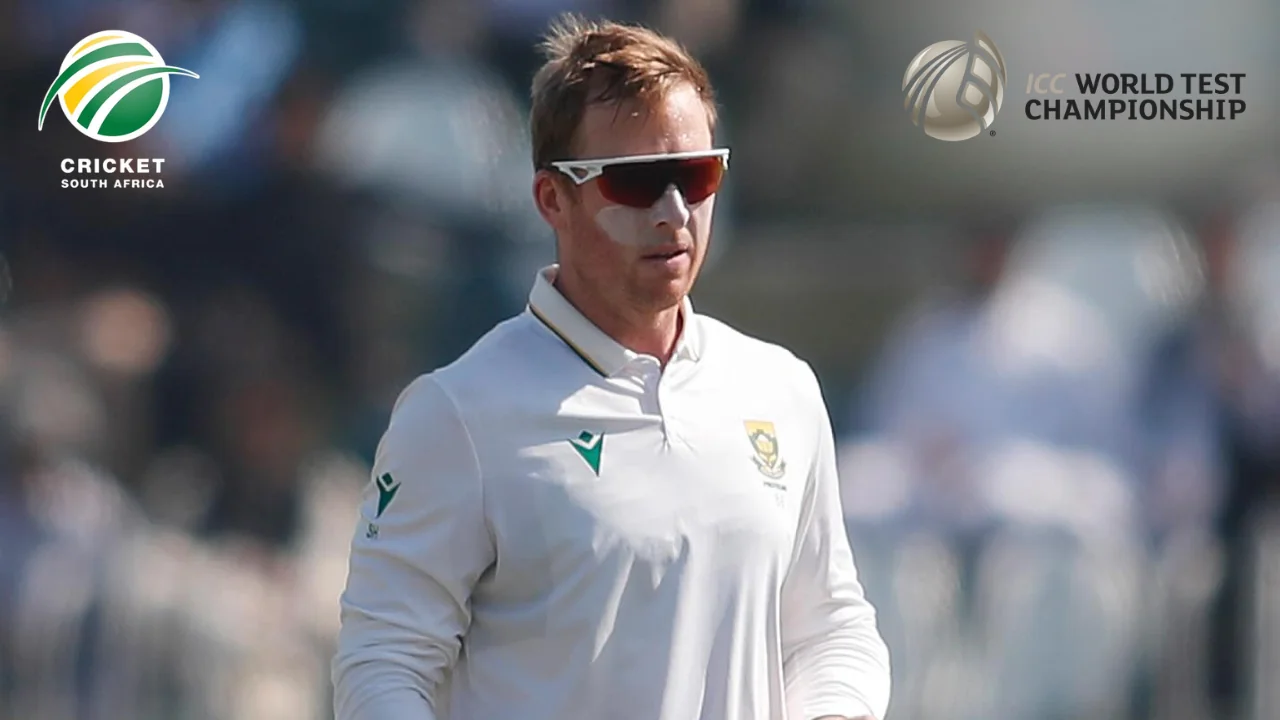
South Africa spinner Simon Harmer has called for a more equitable distribution of Test cricket, arguing that the World Test Champions must continue proving themselves on the field to secure the opportunities routinely afforded to the sport’s biggest teams.
His comments follow South Africa’s 2–1 home series victory over Australia, in which Harmer claimed 10 wickets in the deciding Cape Town Test, including figures of 6/17 on the final day at Newlands.
Speaking on _the Scoop_, Harmer made clear that South Africa’s limited opportunities have strengthened the team’s determination. “It lights the fire even more.”
South Africa face a significant Test scheduling gap
The disparity is evident in the ongoing 2025–27 World Test Championship (WTC) cycle.
South Africa were allocated 14 Tests across the cycle, comprising eight at home and six away, and have already played seven. Australia have completed 13 of their 22 Tests, England 16 of 21 and India 11 of 18.
Across the full cycle, that gives South Africa eight fewer Tests than Australia, seven fewer than England and four fewer than India.
South Africa’s six WTC series comprise two three-match contests, against Australia and England, and four two-match series against Bangladesh, Pakistan, India and Sri Lanka. Having completed their series against Australia, Pakistan and India, they still have seven Tests remaining: two against Bangladesh, three against England and two against Sri Lanka.
Harmer believes South Africa’s recent performances warrant a more substantial Test programme. “I do think that slowly but surely we are showing the world that we should be allowed to play more cricket. I can’t remember personally the last time that South Africa had eight home Tests in a summer and ten Tests over a South African summer period. And like that shouldn’t be sort of extraordinary, that should be the norm.”
South Africa have not played a four-Test series since hosting England in 2019–20. Their subsequent bilateral Test commitments have largely consisted of two-match series, limiting the number of opportunities available to the team.
Why playing India matters financially
The scheduling debate also has a significant commercial dimension, particularly when it comes to fixtures against India.
England and Australia each have five-Test series against India in the current WTC cycle, while South Africa’s series against India consisted of just two Tests.
“It’s no secret that playing against India is basically where a lot of the governing bodies sort of finance themselves for the four-year period of their budgets. And England and Australia get to play against them in five Test match series, plus the ODIs and the T20s that go with it. We get to play two Tests against them.”
The commercial importance of Indian tours is reflected in Cricket South Africa’s financial results. According to Cricinfo, CSA recorded an R815 million (approx. USD50 million) profit in 2023–24, a season that included a home series against India featuring two Tests, three ODIs and three T20Is. Broadcast revenue was a major contributor to that result, alongside other income streams.
In 2024–25, when India’s four-match T20I visit was CSA’s only profitable incoming tour, the organisation recorded another profit, although its overall earnings were lower. The figures illustrate the value of hosting India without establishing how much of CSA’s total profit came from those fixtures alone.
Success has not eliminated the scheduling disparity
South Africa’s case for additional Test cricket comes after a sustained run of results, including their triumph in the 2023–25 World Test Championship and their recent series victory over Australia in the current cycle.
The team have lost only one Test series since January 2024, against New Zealand, when South Africa fielded a significantly weakened squad because of a scheduling clash with the SA20.
Their route to the 2023–25 WTC final nevertheless attracted scrutiny over the opponents they faced, an issue Harmer believes can only be answered through further success.
“You know, like everybody had something to say about how the team got to the World Test Championship final last year, and how we didn’t play against these people and we didn’t play against that team. We’re just gonna have to bang the door down and show the world that we are the best team, but you’re only gonna do that by winning series and winning trophies.”
For Harmer, the stakes extend beyond the current squad. He wants South Africa’s achievements to translate into greater opportunities for those who follow.
“And I hope that the next generation of South African cricketers benefit from what the team has achieved over the last 18 to 24 months. And it is a responsibility on this group to make sure that we understand what we are slowly achieving in world cricket.”
With seven Tests remaining in the current WTC cycle, South Africa will continue their title defence on a schedule that provides considerably fewer opportunities than those available to Australia, England and India.