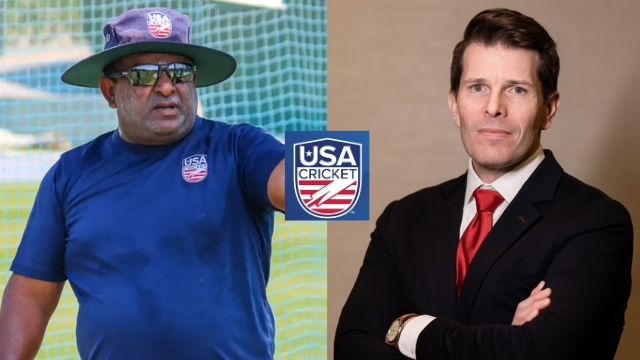
We sat down for an exclusive interview with USA Cricket Johnathan Atkeison and newly announced Men’s Head Coach Pubudu Dassanayake
In an exclusive conversation with cricexec, USA Cricket‘s newly reappointed head coach Pubudu Dassanayake and CEO Johnathan Atkeison laid out a bold vision for the future of American cricket. With a packed calendar and historic opportunities on the horizon, the pair offered rare insight into USA Cricket’s strategic direction, development ambitions, and how Dassanayake‘s return could serve as a launchpad for bigger things to come.
A familiar face, a new mission
Dassanayake, who led the USA Men’s National Team from 2016 to 2019, is back for a second stint. His reappointment comes at a pivotal time for the sport in the United States. With Major League Cricket entering its third season, USA already qualified for the 2026 ICC Men’s T20 World Cup, and the 2028 Los Angeles Olympics looming, cricket in America is brimming with potential. But potential alone isn’t enough.
“I’m really excited to come back,” Dassanayake told cricexec. “I was part of building that team from scratch. Now I’m coming back and I’m excited to see how I can take them into the next level. It’s a totally different setup, very organized, and there’s a huge player group in the country.”
Long-term vision: T20 World Cup, Olympics, ODI World Cup
USA Cricket’s leadership made clear this appointment isn’t just about short-term results.
“We have our eyes firmly on not only the 2026 T20 World Cup, but the 2027 ODI World Cup and the LA Olympics in 2028,” said CEO Johnathan Atkeison. “What we really wanted was long-term stability. And we believe we have found a coach who’s capable of leading us forward successfully in all of those avenues.”
Dassanayake confirmed that his contract extends through the 2028 Olympics, reflecting the board’s commitment to continuity. This is not a one-series appointment.
A dramatically changed landscape
One of the biggest changes since Dassanayake’s first tenure is the arrival of Major League Cricket (MLC).
“When you look at the earlier domestic cricket, they still had good leagues around, but it’s totally different levels,” Dassanayake explained. “With MLC, they’ve brought all the top players into one stage. Even Minor League Cricket has become a huge feeder system. The player base has really increased, and the quality of cricket has improved significantly.”
This means Dassanayake is now dealing with a much deeper and more competitive pool. The challenge? Picking the best 11 from a growing list of high-caliber players.
“I just want to see always the best 11 players on the field,” he said. “There has to be competition within the squad where you perform and you get better. That internal competition is healthy, and it’s what drives national success.”
Selection strategy: A three-layered pipeline
Dassanayake described the player ecosystem in three categories: veterans who have been in the national setup for several years, MLC-based talent who are relatively new to the international fold, and a group of young cricketers rising through the USA Cricket junior pathways.
“Some of the juniors who came through the system have already stepped up and are performing,” he said. “That’s because they had the opportunity to play in top leagues. That internal growth is what gives us the depth and resilience we need to compete internationally.”
Fast-track ambitions
In his first stint, Dassanayake helped guide the U.S. from ICC Division 4 to ODI status. He believes another fast-track leap is possible, this time from a high-performing associate side to a full-fledged global contender.
“We had a bit of a fast track in 2016 to 2019. I think right now also we can be in a setup where we can fast-track into the first table again,” he said. “But this time, we have to do it with a stronger base and a bigger vision.”
Immediate goals: Top of League 2
Dassanayake’s near-term focus is clear: win the ICC Cricket World Cup League 2.
“Of course, someone can say that if you’re in the top four, you qualify for the next round. But I feel it’s very important to win League 2 outright,” he stressed. “Being the top team is how we get out of this associate level.”
To that end, Dassanayake emphasized not just short-term squad strength, but long-term player development.
“We need to have that feeder system ready. We already have the players in the country. It’s just about putting them on the right track,” he said. “We also need to fix our junior pathways so that by the time these players hit the senior level, they’re ready to win games for the country.”
An integrated high-performance system
Atkeison confirmed that USA Cricket is close to hiring a new High Performance Director, a role that will work in tandem with Dassanayake.
“We’re down to a small number of final candidates,” he said. “This person will sit at the top of our high-performance structure, focusing not on coaching itself but on how we build systems and processes across senior teams, development programs, and grassroots pipelines.”
The hire is expected to be finalized within two months.
A broader goal: Full member status
Atkeison didn’t shy away from the long-term dream.
“Ultimately, we want to be in a position to achieve full member status,” he said. “That means not just fielding competitive national teams, but meeting the standards of governance, infrastructure, and performance.”
So, does that mean Test cricket?
“It’s built into our long-range planning,” he said. “But in the short term, our focus is on the T20 and ODI formats.”
Dassanayake agreed.
“We still have players in the country who have played first-class cricket. If we can build the right domestic structure, we can get there. But for now, it’s about laying the foundation.”
Why Dassanayake, again?
Despite being a known figure, Dassanayake didn’t get the job through backchannels. He went through a full global search.
“We had applicants from all over the world, including some big names,” said Atkeison. “But Pubudu stood out. His knowledge of the associate world is unrivaled. He can hit the ground running. We have a lot to do and little time.”
Player relationships and culture
Dassanayake emphasized the cultural progress the team made under his previous leadership—something he hopes to rekindle.
“We built an American sports culture into the team, where everyone respects each other, no matter where they come from. We had a great culture, and I want to build on that,” he said.
Having coached several American players in franchise competitions even after stepping down in 2019, he brings familiarity along with fresh vision.
“Our core group is well known and familiar. I’m very confident we can achieve a lot together.”
The work begins now
Dassanayake has already taken the reins for the ongoing ODI tri-series against Canada and Oman. And this time, his eyes are not just on wins, but on building a sustainable pipeline, a winning culture, and a legacy.
“It’s a good time for USA Cricket,” he said.
If the ambitions of USA Cricket match the execution of its leadership, it could be a historic time as well.