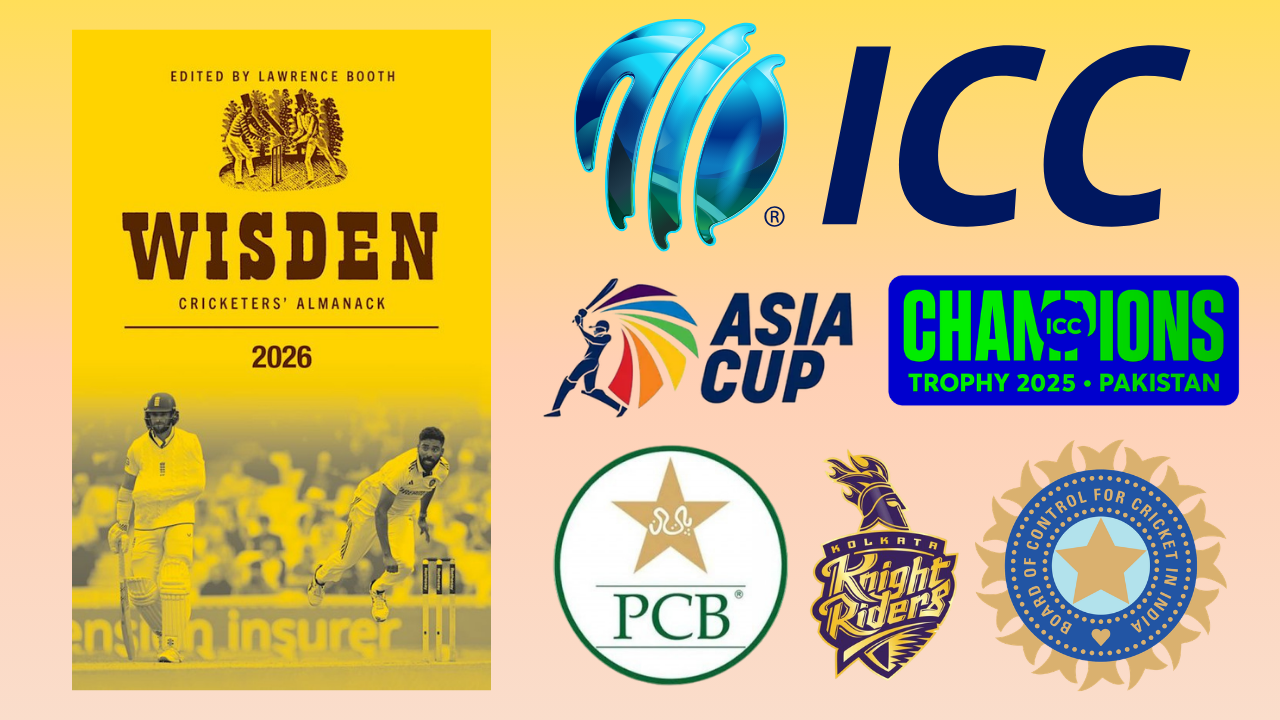
A sharp critique of cricket’s modern power structure has emerged from the latest edition of the Wisden Cricketers’ Almanack, where Lawrence Booth examines how influence, governance, and external forces are increasingly shaping the direction of the sport. His assessment frames a system under pressure, where decisions at the top level are no longer viewed in isolation, but as part of a broader shift affecting competitions, administration, and international relations within the game.
An evolving power structure under scrutiny
Booth’s central argument builds around the growing perception that global cricket governance is no longer operating on neutral ground, with influence concentrated in ways that carry wider consequences. “The sport’s governance grows ever more Orwellian, pretending that Indian exceptionalism comes without consequence, and blaming those lower down the food chain for lashing out. Predictably, almost no prominent voices in the Indian game addressed the root cause of the carnage: the politicisation of a sport that, whatever Naqvi may say, has never been untouched by the real world, yet never more poisoned by it either,” Lawrence Booth wrote in the 163rd edition of Wisden Almanack.
That broader concern is tied to contradictions within cricket’s leadership, where public messaging and institutional realities often appear misaligned. “Was there a clearer indictment of the game’s governance in 2025 than Pakistan Cricket Board Chairman Mohsin Naqvi’s assertion that ‘politics and sport can’t go together’? Presumably he had forgotten he was also his country’s Interior Minister,” he wrote.
He further pointed to long-standing structural alignments shaping the game’s direction. “It was obvious long before this latest grandstanding that the BCCI were the sporting adjunct of India’s ruling BJP,” he added.
Asia Cup tensions highlight deeper issues
The 2025 Asia Cup serves as a prominent example in Booth’s analysis, reflecting how cricketing events can become entangled with broader narratives beyond the field. “If India were so appalled by Pakistan, they should simply have refused to play them. Instead, they opted for humiliation. But it was all performative: before the public snub, the captains had shaken hands in private. And when the two nations’ Under-21 hockey teams met soon after in Malaysia, the game ended with hugs and high-fives. Cricket has become an important piece on the BJP’s geopolitical chessboard, and the Asia Cup descended into tit-for-tat farce, with players on both sides making tasteless gestures about fighter planes, and India refusing to take the stage to receive the trophy from Naqvi (whose busy portfolio includes the presidency of the Asian Cricket Council). At the time of writing, the trophy is thought to be under lock and key in the UAE, a neat symbol of international cricket’s dysfunction,” he wrote.
The rhetoric surrounding the tournament extended beyond the field, reinforcing the link between sporting outcomes and political messaging. “And the idea that cricket was now a legitimate proxy for more lethal activity was hammered home on X by India’s Prime Minister, Narendra Modi, after his country beat Pakistan in the final: ‘Operation Sindoor on the games field. Outcome is the same – India wins!’ The real-world Operation Sindoor had left dozens dead, on both sides of the border. Now it was being equated with a game of T20. Suryakumar lapped it up, suggesting ‘it feels good when the country’s leader himself bats on the front foot – it felt like he took the strike and scored runs.’” he noted.
Global decisions and franchise cricket under lens
Beyond bilateral contests, Booth highlighted inconsistencies in how similar situations are handled across the international calendar. “Faced with a similar situation in 2025, when India refused to visit Pakistan for the Champions Trophy, and insisted on playing all their games in Dubai, the ICC had bent over backwards to accommodate them. But Bangladesh were kicked out of the tournament – despite their request to move games to co-hosts Sri Lanka. Indian apologists were quick to deny the equivalence, arguing that the BCCI had given the ICC more notice than the Bangladesh board, as if that deserved a pat on the back,” he wrote.
Within the franchise ecosystem, those dynamics are also reflected in player-related decisions that carry wider implications. Bangladesh pacer Mustafizur Rahman was signed by Kolkata Knight Riders for INR 9.2 crore (approx. US$985k) before being released, a move Booth linked to external tensions. “It was retaliation for the murder of Hindu men in Bangladesh, and a shot across the bows of KKR’s Bollywood owner Shah Rukh Khan – a Muslim, and a regular target of Hindu nationalists,” he wrote.
The episode feeds into a broader conclusion about the direction of the sport. “The fate of Mustafizur confirmed cricket’s descent into the hands of its political masters, just as Suryakumar embodied its acquiescence,” he added.
A defining moment for cricket’s future direction
Taken together, the observations outlined in Wisden’s latest edition present a picture of a sport navigating a complex intersection of governance, influence, and external pressure. Booth’s assessment positions the current landscape as a critical moment for cricket, where the balance between administration and wider political forces continues to evolve and at the moment seems to skew toward the political.