The Hundred’s March auction was always going to be closely watched. But for many across the global cricket industry, it has now become something larger: a governance stress test.
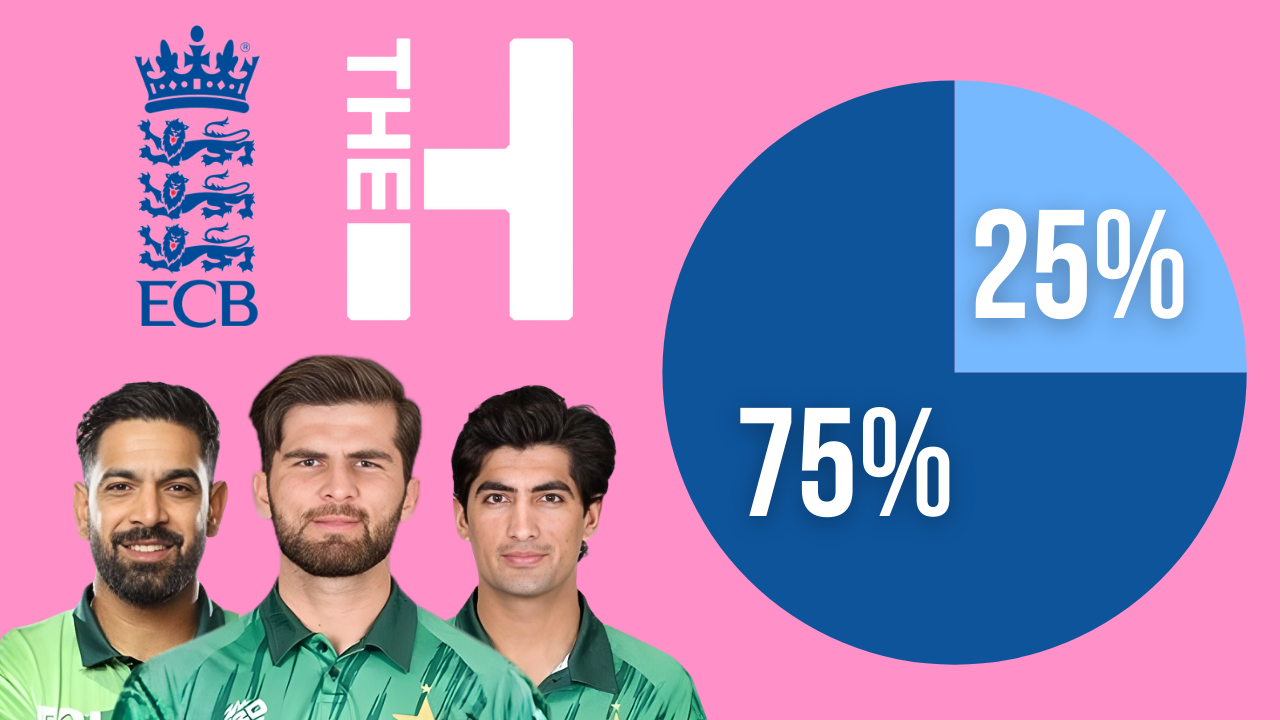
A cricexec poll of senior global cricket executives found that 75% believe the England and Wales Cricket Board (ECB) should investigate if no Pakistani players are signed by IPL-owned Hundred teams, with 25% opposed.
The question was deliberately framed around a conditional outcome: If no Pakistani players are signed by IPL-owned Hundred teams, should the ECB investigate?
With the men’s and women’s auctions scheduled for March 11 and 12 in London, industry sentiment suggests that selection patterns — not pre-auction rhetoric — will determine whether the debate escalates from speculation to regulatory scrutiny.
From auction mechanics to governance flashpoint
Reports from BBC Sport and Telegraph Sport a couple of weeks back indicated that four franchises with IPL-linked ownership — MI London, Manchester Super Giants, Southern Brave and Sunrisers Leeds — were unlikely to consider Pakistani players.
In messages seen by BBC Sport, a senior ECB official reportedly indicated to an agent that interest in his Pakistan-based clients would be limited to sides not linked to IPL ownership.
Another agent described the situation as “an unwritten rule” across T20 leagues with Indian investment.
“It’s a given, they have been doing the same all around the world. Now that they are in the Hundred, I don’t see any different,” one agent told Telegraph Sport.
“I’ve personally reached out to franchises in ILT, MLC, SA20 and now the Hundred. They would love to have Pakistanis but due to political pressure back in India, they will never risk going against the government. They will never admit in writing.”
That global pattern is part of what appears to be influencing executive sentiment in the cricexec poll. IPL-owned franchises in SA20, all six in the league, have not signed a Pakistani player since launch in 2023. In the ILT20, Indian-owned teams have consistently not selected Pakistan players, despite recruiting from more than 15 other nationalities.
The question now is whether The Hundred — governed under ECB jurisdiction and UK law — becomes the next test case.
ECB’s line in the sand
Following these reports, the ECB moved quickly to assert its regulatory authority. In a joint statement with all eight franchises, the governing body declared: “Players must not be excluded on the grounds of their nationality.”
The statement reiterated that: “All eight teams commit to selection being based solely on cricketing performance, availability, and the needs of each team.”
It also emphasised that The Hundred “continues to be a competition that is inclusive, welcoming and open to all.”
Earlier, ECB chief executive Richard Gould had stated: “I expect players from all nations to be selected for all teams… If those are not adhered to, our cricket regulator will take action.”
But critics argue that statements alone are insufficient.
Former England captain Michael Vaughan was unequivocal: “The ECB need to act fast on this .. they own the league and this should not be allowed to happen .. the most inclusive sport in the country is not one that allows this to happen ..”
In his Telegraph column, Vaughan added: “If no Pakistan players are signed by the Indian-owned franchises then we have our answer. I would then like to hear a proper explanation from a senior ECB figure.”
He warned that the outcome would reveal where power truly resides: “If this informal ban on Pakistan players happens then we know who really runs the competition and it is not the governing body.”
That framing — governance versus ownership influence — is central to the 75% of executives calling for investigation in the cricexec poll.
Players and public voices raise the stakes
The controversy has extended beyond administrators.
England white-ball captain Harry Brook said it would be “a shame” not to see Pakistani players involved, noting: “There are some amazing cricketers and, yeah, they bring some great crowds as well.”
Former England International Moeen Ali, whose family is of Pakistani origin, was more direct: “It just shouldn’t happen… I’m sure the ECB will definitely keep an eye out.”
He also warned of a broader pattern: “These kind of things have been happening for ages now. It’s time for a solution, because it’s not fair – it’s obviously discriminating against certain type of people… It’s horrible.”
Azhar Mahmood, citing his own experience in franchise cricket, connected the issue to structural realities: “Everything is connected to the ecosystem of the IPL… The same thing goes for the players as well.”
Former England captain Michael Atherton framed the matter in legal and reputational terms, writing that it carried “legal, regulatory and reputational” risk and that “no one in England would countenance supporting a tournament that excludes players from Pakistan.”
Even government voices entered the conversation. A Department for Culture, Media and Sport spokesperson told BBC Sport: “It is important that the tournament remains free from discrimination and nationality should not be a deciding factor in the selection of players.”
The spokesperson for the Mayor of London’s office also told BBC Sport that excluding players “for no other reason than their nationality would be unacceptable.”
Against that backdrop, the PCB is reportedly preparing formal communication to the ECB, underscoring the international dimension.
Autonomy versus accountability
It is important to note: no franchise has formally announced a ban. No auction has yet taken place.
James Sheridan, deputy chair of Manchester Super Giants, rejected suggestions of targeted exclusion: “The only conversations we’ve had is to pick the two best squads to give us the best possible chance of winning the two competitions,” he told BBC Sport.
Pakistani batter Sahibzada Farhan, one of 67 players from his country registered for the auction, struck a pragmatic tone, speaking to reporters before Pakistan’s World Cup Super 8s match against England: “This is not in our hands who picks us or who doesn’t… The Hundred is one of the best leagues. So I hope for the best.”
That ambiguity complicates enforcement. As Moeen Ali acknowledged: “The difficulty is that you can’t really prove anything if they don’t get picked,” he told Telegraph Sport.
Franchises operate within salary caps, squad balance constraints and subjective sporting judgment. But if a clear pattern emerges — particularly across all four IPL-linked teams — executives feel that regulatory review is in order.
The cricexec poll result reflects that threshold logic. It does not pre-judge wrongdoing. It signals that the absence of Pakistani signings, if concentrated among IPL-owned teams, would cross a line for many industry leaders.
Investment, influence and precedent
The debate comes just months after The Hundred secured over £500 million in private investment and was valued at approximately £975 million.
IPL-linked capital now sits inside four of the eight franchises. That commercial reality is unlikely to change.
What remains in question is how that capital interacts with English regulatory frameworks.
As Vaughan put it: “Fundamentally, if India can play Pakistan in a World Cup match then surely Indian owners can pick Pakistan players in a foreign league.”
And as Atherton warned, if nationality-based exclusion were to materialise, it would represent “a fundamental threat for the competition.”
For the ECB, the coming days will be about more than squad lists. They are about whether governance structures can assert themselves in a landscape shaped increasingly by global franchise ecosystems.