
The audacity of the moment
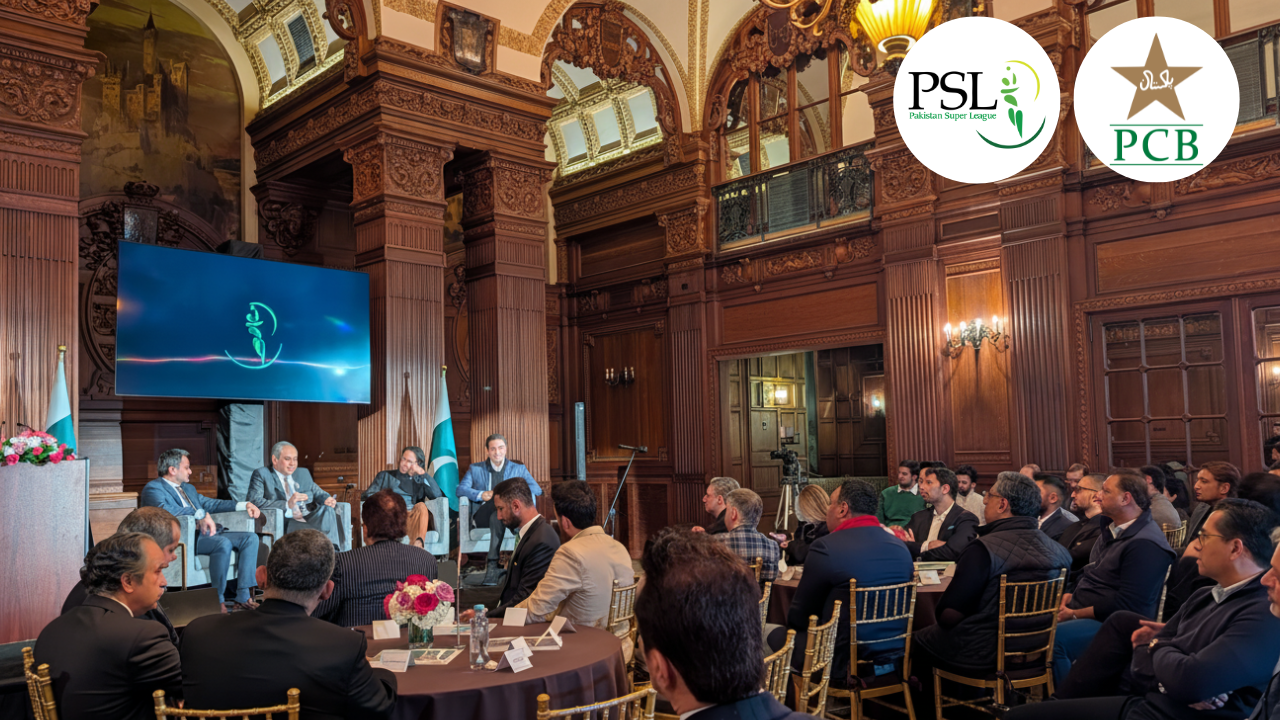
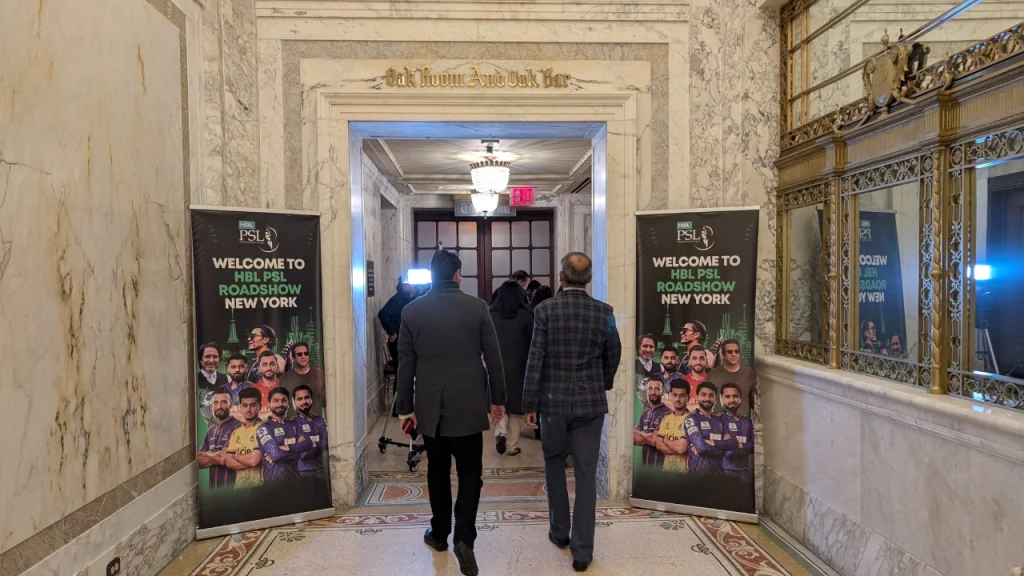
The Plaza Hotel sits on Fifth Avenue like a monument to American ambition, its facade overlooking Central Park’s southeast corner with the kind of quiet authority that money whispers rather than shouts. Inside the Oak Room on a December evening, beneath chandeliers that have witnessed a century of deals, another audacious pitch was unfolding—this one carrying the hopes of a league ten years in the making and a nation that bleeds green.
The Pakistan Super League had come to New York.
This wasn’t the league’s first international investor roadshow—six days earlier, PCB officials had made their case at Lord’s Cricket Ground in London, drawing significant interest from European capital. But New York represented something different. This was a direct appeal to the Pakistani-American business elite, the private equity partners and hedge fund managers who had built fortunes in the world’s financial capital while maintaining deep emotional ties to the game that defined their childhoods. The city’s Pakistani diaspora, along with a broader South Asian investor base drawn from finance, technology, and real estate, filled the Oak Room.
The event was deliberately intimate, capped at under 100 attendees including all PCB executives and stakeholders. The goal wasn’t spectacle but substance—a curated environment where serious investors could hear directly from the architects of PSL’s expansion. Given the tight turnaround after the London roadshow, the production quality was impressive. But the real draw was always going to be the content, the vision, and the numbers behind Pakistan cricket’s most successful commercial property.
A decade of resilience, a future of ambition
Salman Naseer, the league’s CEO and longtime PCB executive, took the stage to frame the PSL’s journey. His remarks opened with a self-aware nod to New York’s reputation: “They say, ‘If you make it here, you can make it anywhere.’ Such is the high pressure. Let me tell you something you already know about Pakistan cricket and pressure. Blood pressure.” The room chuckled knowingly. “It gets your heart racing, blood pumping. Almost makes Wall Street like a walk in the park.”
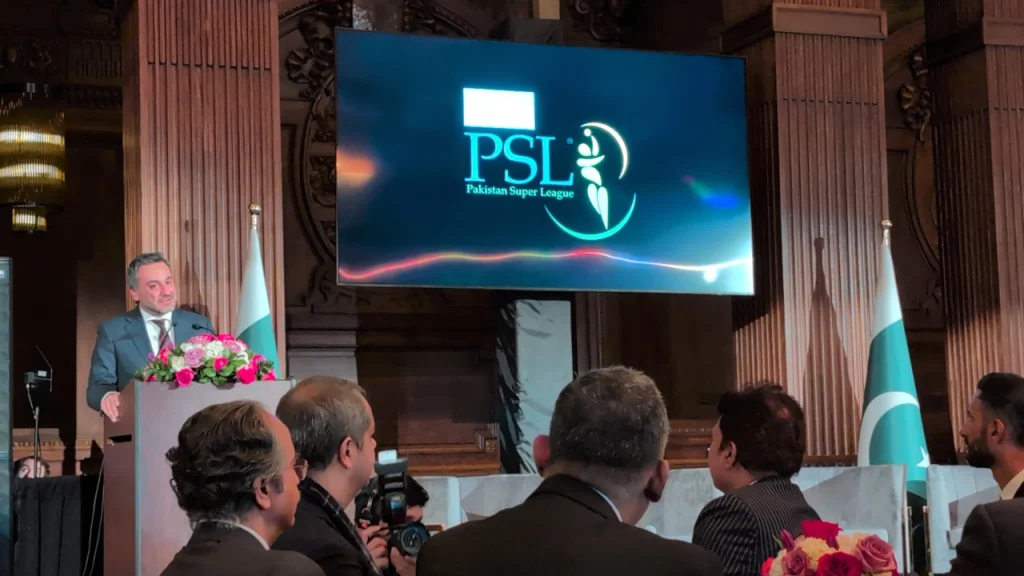
The levity set the tone, but Naseer quickly pivoted to substance. He walked the audience through PSL’s origin story—launched in 2016 with just five teams when international cricket had been suspended in Pakistan. Naysayers predicted failure. Instead, according to Naseer, those original five franchise owners displayed faith in a product that would eventually redefine Pakistan’s cricketing landscape.
“We stood tall, we delivered,” Naseer said, crediting not just the PCB team but the millions of fans who invested their passion. What followed was a decade-long masterclass in crisis management and institutional resilience. The league faced challenge after challenge that Naseer retold: bringing matches back to Pakistan from the UAE, navigating COVID-19 protocols that forced a mid-season postponement and eventually a biosecure bubble in Karachi with hotel staff testing overwhelmingly positive, and even managing through the brief India-Pakistan war earlier this year that temporarily halted the tournament (as well as the IPL). In one memorable anecdote, Naseer recalled receiving a ceasefire call while driving back to Lahore from Islamabad. The players had already been transported to Dubai to continue the tournament there. But within minutes, PCB Chairman Naqvi was on the line with Naseer with three words: “Bring them back.” Within seven days, the PSL was running again.
“This is the commitment,” Naseer said. “But we’re in New York, you guys like numbers, let’s talk some numbers.”
The commercial growth, Naseer argued, has been striking. Operating under a centralized governance model where the PCB sells all commercial assets and distributes 95% of income equally among franchises, the league has seen its franchises revenue grow by over 300%. Title sponsorship revenue has surged 505%. Global broadcast rights outside Pakistan have increased 311%, while Pakistani broadcast and streaming rights have skyrocketed by 3,168%.
Naseer made his final pitch with characteristic directness. “In other leagues, you buy a franchise, you get a team. In HBL PSL, you buy a franchise and you become one of the most talked about people in 250 million. You get memes about yourselves, social media debates about you, but more importantly their prayers also. This is perhaps the greatest reality TV show, the HBL PSL, and you get to be a part of it.”
Mohsin Naqvi announces ambitions and incentives
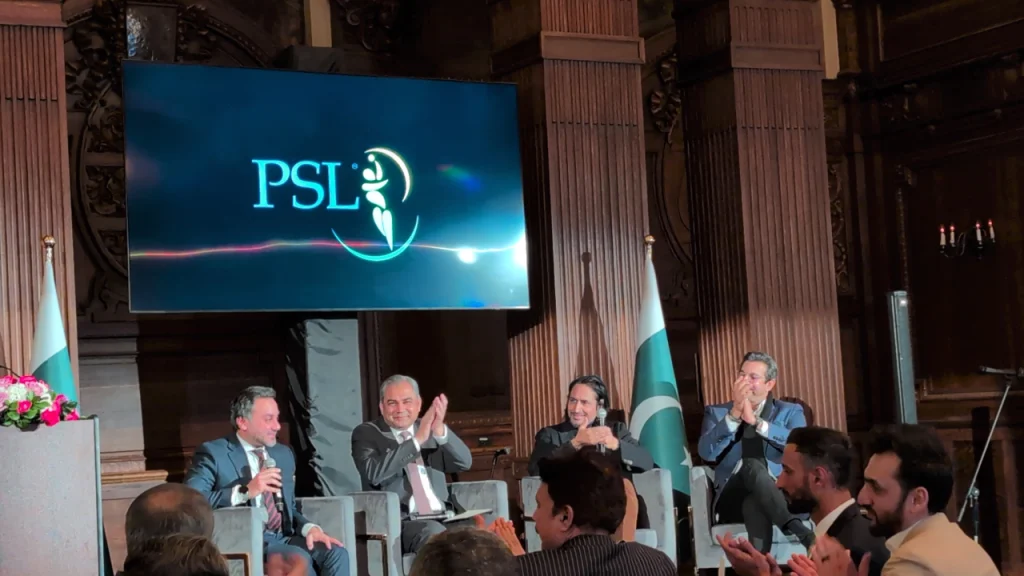
The evening’s main event was the panel featuring PCB Chairman Mohsin Naqvi, former PCB Chairman and Pakistan cricket legend Ramiz Raja, and Wasim Akram, moderated by Salman Naseer – who joked about the pressure of moderating his boss, former boss and “cricket boss” Akram.
Naqvi, who also serves as Pakistan’s Interior Minister, was unambiguous about his ambition for the league. “It’s very clear. Just in one sentence, I would say, we need to make this league world number one league,” Naqvi stated. “And for that, we have to do a lot of work.”
Then, turning to Naseer, he quipped: “Meaning you have to do a lot of work.”
That work, he explained, includes substantial new incentives for investors. The PSL 11 champion will receive $500,000, runners-up $300,000, and crucially, $200,000 will go to the franchise investing most heavily in player development. “This is apart from prize money,” Naqvi clarified. “This is extra.”
The auction for the two expansion teams itself will be held January 8 in Islamabad via open bidding, with the submission deadline for franchise proposals extended to December 22 to accommodate surging interest from Europe, North America, and the Middle East. Naqvi emphasized transparency: “This whole process is going to be open bid.” The PCB is also allowing flexibility in franchise naming for overseas investors, recognizing that diaspora-connected ownership groups may want to inject their own identity beyond simply the chosen Pakistani city’s name.
Tournament dates were another major reveal. PSL 11 will run from March 26 to May 3, 2026, placing it in direct overlap with the Indian Premier League for the second consecutive year due to ICC Men’s T20 World Cup scheduling. It’s a bold statement of confidence—PSL is no longer trying to avoid the IPL window, but competing directly for talent and attention.
Naqvi also unveiled the PCB’s plans for a dedicated OTT platform launching in Pakistan within weeks. “Money will flow to the investors,” he explained, framing the platform as a critical new revenue stream that would enhance franchise valuations. The chairman emphasized how marquee international players—David Warner, Moeen Ali, Faf du Plessis—are increasingly choosing PSL even when it overlaps with the IPL, a testament to the league’s rising stature.
Beyond commercial incentives, Naqvi outlined major infrastructure investments that signal long-term commitment. The PCB is undertaking a comprehensive redevelopment of Gaddafi Stadium in Lahore, with new lighting designed to capture the drama of fan emotions—a detail Ramiz Raja praised for its broadcast appeal. Muzaffarabad Cricket Stadium will be developed to host both PSL matches and international fixtures, extending the league’s footprint into Azad Jammu and Kashmir. Faisalabad and Hyderabad stadiums are also slated for renovation, with a domestic roadshow planned for December 20 to engage Pakistani investors directly.
The case from cricket’s icons
Ramiz Raja, who served as PCB Chairman through some of PSL’s most turbulent editions, reinforced the league’s cricketing value proposition. “I think it is everything. It’s a great model,” Raja said. “What you get through PSL is a platform where your temperament is tested completely. And it’s a great way of introducing yourself not only to Pakistan but to the entire world because the coverage goes to Australia, England, everywhere.”
He highlighted PSL’s role as a finishing school for young cricketers, a place where raw talent meets high-pressure situations and international stars. The league’s commercial viability, Raja argued, flows directly from its cricketing authenticity. “The fact is that it works commercially. It works from cricketing aspect. It works from fan aspect.” He also noted that international players increasingly recognize PSL as “the best bowling league in the world,” a reputation built on Pakistan’s historic strength in producing fast bowlers and spin artists.
Wasim Akram, involved with PSL franchises since the league’s inception, spoke to the palpable enthusiasm he’s encountering from potential investors. “First year, everybody was skeptical,” Akram recalled. “They were only five owners who didn’t have bids, so whatever the price was, we had to sell the teams. But when we started the first game we played in Dubai, we never looked back.” The league’s return to Pakistan created something even more powerful—regional rivalries and civic pride that transcend cricket. “You’ve got your own identity. This is my team, I’m supporting them all the way.”
Akram also addressed international player demand. “There’s a lot of investor interest I’m hearing about,” he said, noting that PSL’s reputation for quality cricket and competitive pay is attracting established stars alongside emerging talent.
The player perspective: PSL as career accelerator
The roadshow featured two player panels moderated by Wasim Akram, offering investors a direct window into how PSL shapes careers. Test Captain Shan Masood, T20 Captain Salman Ali Agha, and rising stars Saud Shakeel, Saim Ayub, Abrar Ahmed, and Faheem Ashraf all spoke to PSL’s developmental impact.
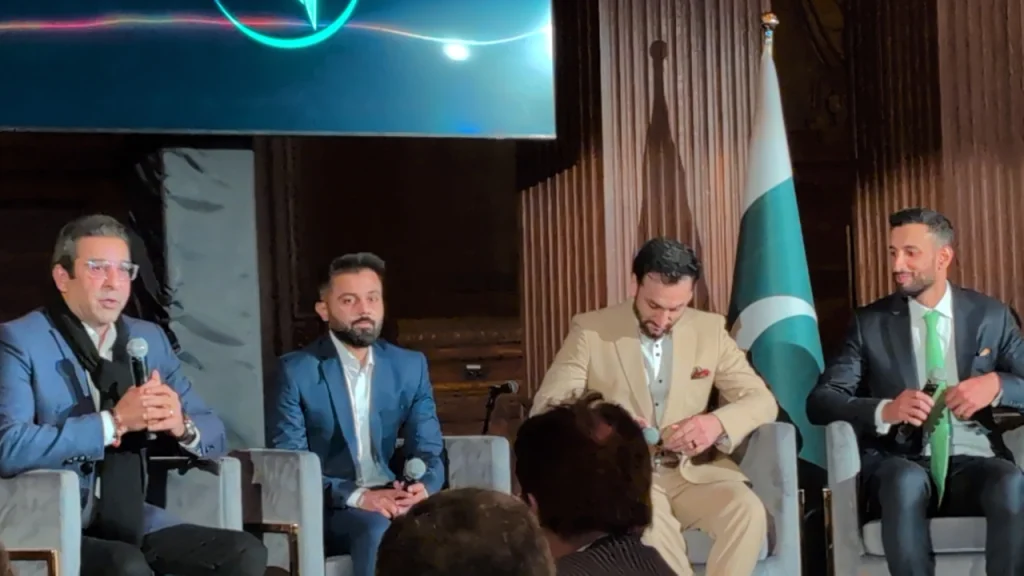
For many, PSL provides the first sustained exposure to international-quality cricket. Salman Ali Agha noted how playing under pressure against foreign stars prepares players for the rigors of international competition: “When you deal with that pressure in PSL, you come to international cricket already tested.” Saud Shakeel recounted how a conversation with David Warner during PSL shifted his entire approach to T20 batting, transforming him from a Test specialist into a multi-format threat.
Saim Ayub, who recently claimed the number one spot in ICC T20I all-rounder rankings, credited PSL with giving him a platform to experiment and grow. After being groomed by Peshawar Zalmi and eventually performing well enough to earn international selection, Ayub’s story exemplifies the league’s talent pathway. Even established players like Faheem Ashraf emphasized how PSL’s intensity—playing in packed stadiums with constant scrutiny—hones the mental resilience required at the highest levels.
Why investors are watching
Speaking with cricexec after the formal presentations, several potential investors confirmed they are assembling bids for the January 8 auction. Their interest is grounded in multiple factors: Pakistan’s massive population base (the world’s fifth-largest, projected to become third-largest within two decades), the sport’s cultural dominance in the country, and PSL’s demonstrated commercial growth trajectory despite operating in challenging geopolitical and economic conditions.
One finance executive, speaking on background, noted the demographic appeal: “Two hundred fifty million people, two-thirds under 30, and cricket is the only sport that truly matters. The engagement metrics are insane.” The OTT platform announcement particularly caught investor attention, as digital monetization represents untapped upside in a mobile-first market where smartphone penetration is rapidly expanding.
The PCB’s willingness to offer significant incentives for development spending also resonated. And investors were also wise to possibly the strongest signal yet about value: five of the six original investors renewed their franchise agreements, and the sixth (Multan Sultans’ Ali Tareen) was reportedly not offered a renewal by the PSL after his open conflict with the league. For potential new investors that spoke to cricexec, the near-unanimous re-upping by existing investors means the underlying value must be there.
A celebration of cricket and culture
The roadshow concluded with a performance by Ali Zafar, the Pakistani musician and actor whose involvement underscored PSL’s appeal beyond pure sports investment. The blend of cricket, business, and entertainment reflected the PCB’s attempt to demonstrate that PSL is as much a cultural product as a sporting one. For the Pakistani diaspora in attendance, the evening offered something more personal—a chance to invest not just in a franchise, but in a piece of national pride.
Pakistan Ambassador to the United States Rizwan Saeed Sheikh opened the event with remarks that positioned PSL within a broader narrative of Pakistan as an investment destination. Highlighting the country’s strategic geographic positioning between China and the GCC, its cost-competitive IT sector, and its young, rapidly growing population, Sheikh framed cricket as a gateway to understanding Pakistan’s commercial potential. When he quipped that Pakistan’s population growth rate is its “most reliable statistic,” the room erupted in knowing laughter.
The road ahead
As attendees filtered out of the Oak Room into the December cold of Fifth Avenue, the stakes were clear. The PCB has transformed PSL from a crisis-born experiment into Pakistan’s most valuable sporting property. The league has survived terrorism, pandemic, and conflict. It has built passionate regional rivalries and produced a generation of international stars. Now it faces perhaps its most consequential test: expansion.
Adding two franchises will fundamentally reshape PSL’s competitive and commercial dynamics. Done right, it could accelerate the league’s trajectory toward true global stature, drawing more international talent, deepening regional engagement, and multiplying revenue streams. Done poorly, it could dilute the product and burden the league with underperforming franchises.
The New York roadshow was designed to mitigate that risk by attracting serious, patient capital rather than quick-flip speculators. The PCB’s pitch emphasized sustainability, transparency, and long-term value creation.
Whether that pitch translates into the kind of ownership groups PSL needs will become clear on January 8 in Islamabad. What’s already clear is that the league has come a long way from its five-team origins in Dubai. From the Plaza Hotel’s Oak Room to the power corridors of Islamabad, from Lord’s to Lahore, PSL is no longer fighting for survival. It’s competing for supremacy.
As Naseer put it in his closing remarks: “The narrative around Pakistan cricket has changed. We are not surviving. We are thriving. This train called the HBL-PSL is leaving. And unlike the subway I took this morning, it’s running exactly on time.”


