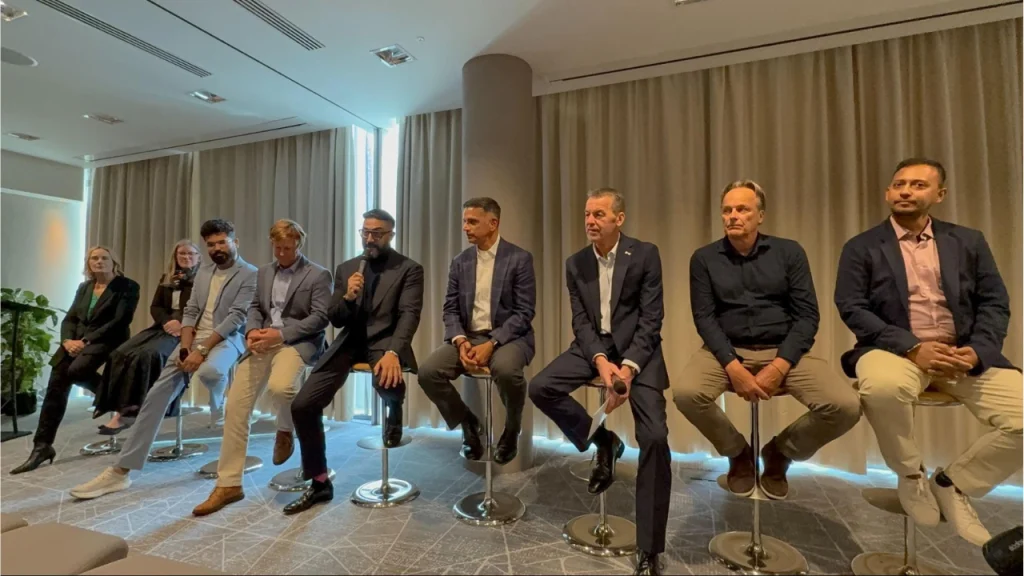
At a press conference in Dublin on Monday, with senior figures from Cricket Ireland, Cricket Scotland and the Royal Dutch Cricket Association seated on the same stage, the European T20 Premier League fully answered the question that has intrigued cricket watchers since the league started its public push: who would own the teams. Rahul Dravid, one of the most decorated names in Indian cricket, was announced as the owner of the Dublin franchise. The team will play as the Dublin Guardians. And with that announcement, the ETPL’s six-team ownership picture — Dublin, Belfast, Edinburgh, Glasgow, Amsterdam and Rotterdam — is complete.
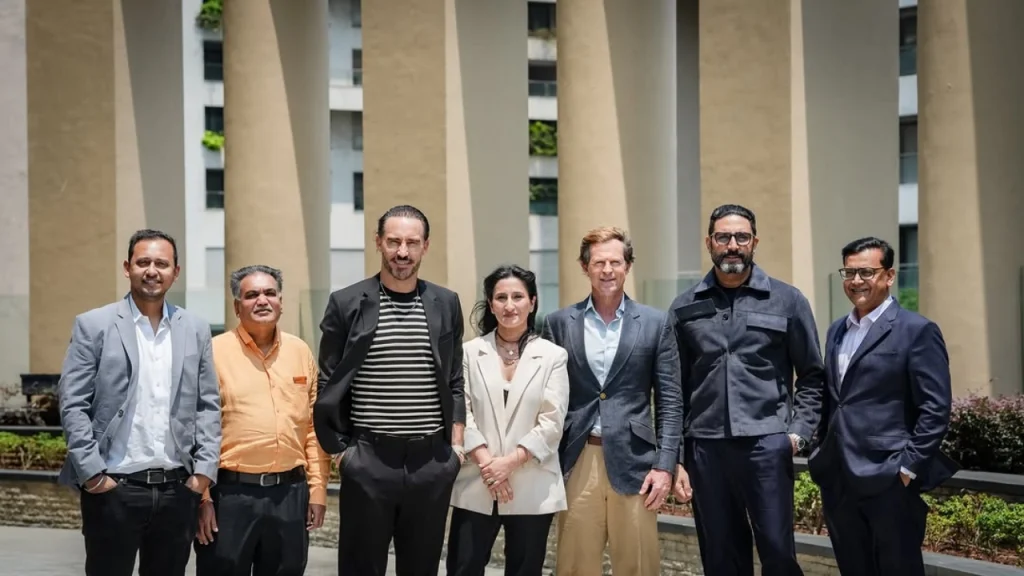
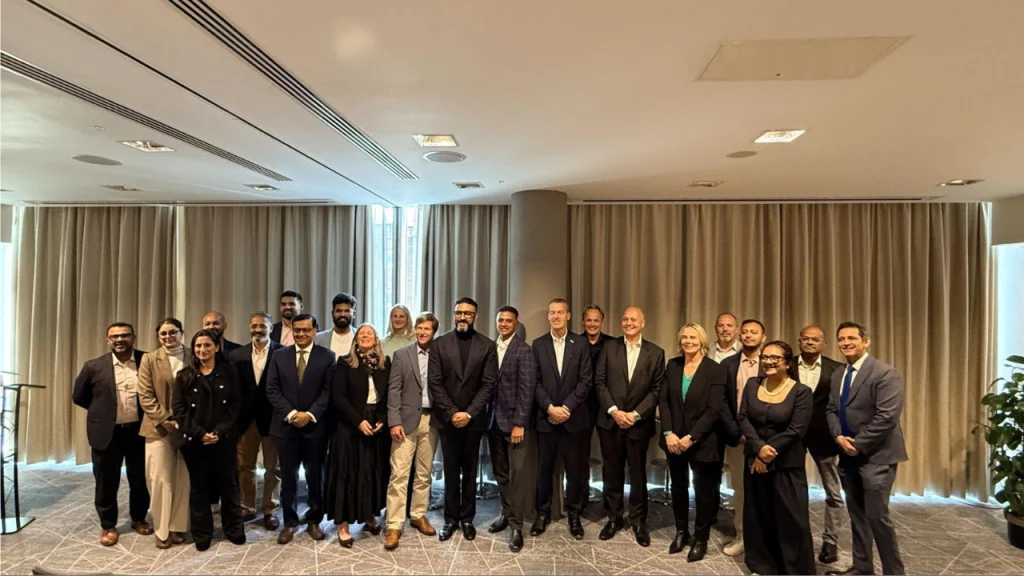
The event drew the full cast of co-founders and partners: Abhishek Bachchan, the league’s most visible co-founder, alongside Rules Global partners Saurav Banerjee, Priyanka Kaul and Dhiraj Malhotra; Brian MacNeice, who chairs both Cricket Ireland and the ETPL Board; and CEOs and senior leaders from the three founding boards — Sarah Keane (CEO, Cricket Ireland), Trudy Lindblade (CEO, Cricket Scotland), and Roland Lefebvre (High Performance Manager, KNCB). Owners from the two other newly-announced franchises from league were also present, including Jonty Rhodes (Co-Owners) and Madhukar Shree (Managing Partner) of Team Rotterdam, and Vipul Agrawal, the Mugafi Group founder behind the Glasgow Mugafians.
A name with intent
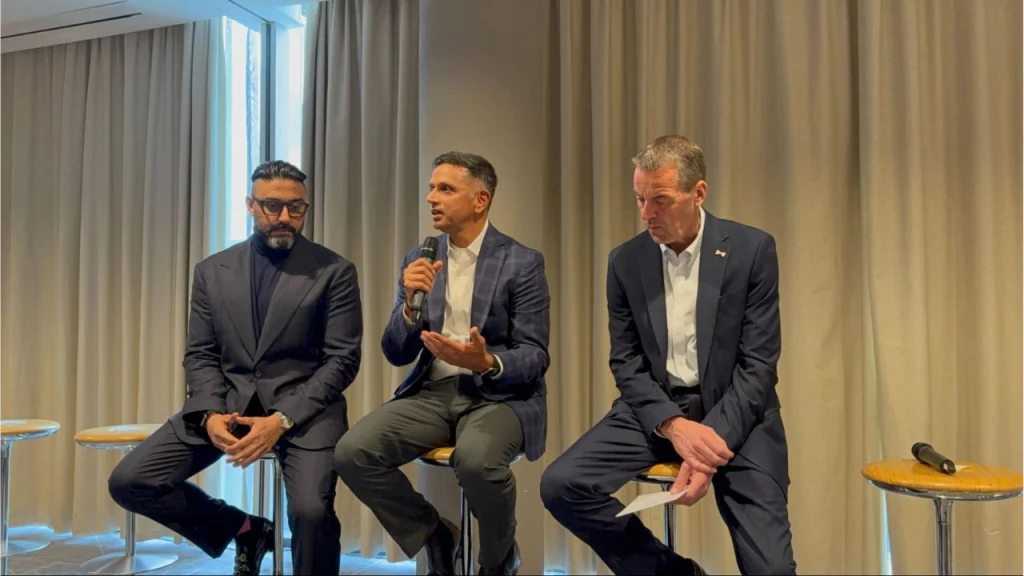
Asked about the inspiration for the Dublin Guardians name, Dravid first deflected with a smile — there were jokes about “lots of wall” — before giving an answer that returned the conversation to its institutional center. “We’d like to be guardians of Irish cricket and actually cricket in the continent, and look to develop and grow young talent from here,” he said. “If I think about what success would be, it would be to see cricket in Ireland, Scotland and Netherlands, young players come from there and really be able to compete in the world.”
That development frame is what drew Dravid to the project in the first place. “What attracted me to ETPL was the larger vision behind it, the opportunity to help grow cricket in Europe by strengthening grassroots development and creating pathways for emerging talent across Ireland and Europe,” he said in the league’s press release. “Dublin already has a passionate cricketing community and enormous potential for growth. Nurturing the next generation has always been important to me, and I believe ETPL can play a meaningful role in that journey.”
His own connection to the region runs longer than may be commonly remembered. Dravid played in Scotland twenty-three years ago. He has also seen European club cricket up close in the years since. “I’ve always loved the passion and the energy of cricket in Europe, in, in this part of the world. The passion with which the players play the game,” he said. “I’ve actually seen first-hand, club cricket, the passion on the grassroot level for the sport in the continent.”
Asked whether he had ever seen himself as a sports entrepreneur, Dravid was characteristically direct. “Not really. I’ll be very honest,” he said, to laughter. “When I first started out, all I wanted to do was just play cricket and just play cricket for India.” The Dublin Guardians, he said, felt like a natural extension of work he has done for years with junior cricket in India — “to be able to give back and to be able to contribute to the game in my own way or in some way possible, I think it’ll be fantastic.”
From vision to six ownership groups, in roughly six months
When cricexec first profiled the ETPL last October, the league had its ICC sanction, three partner boards, a leadership team, and a clear thesis: that Europe, with more than thirty of the ICC’s member nations, was cricket’s most credible new growth market. What it did not have were owners. Six months on, that gap has been closed at pace.
The first three franchises — Amsterdam (Steve Waugh, Jamie Dwyer and Tim Thomas), Edinburgh (Kyle Mills, Nathan McCullum and Rachel Wiseman) and Belfast (Glenn Maxwell and Rohan Lund of the Floodlight Capital Consortium) — were announced in January. Glasgow followed in April, with Chris Gayle joining Vipul Agrawal and the Mugafi Group to build the Glasgow Mugafians. Rotterdam came soon after, with Jonty Rhodes, Faf du Plessis and Heinrich Klaasen acquiring the franchise alongside Madhukar Shree as Managing Partner. Dublin, the final piece, was always going to be a marquee announcement — and Dravid’s involvement closes the picture with the gravity the league had been holding the slot for.
For MacNeice, the speed and quality of the line-up was, on the day, the proof point. “Today is a landmark day for European cricket,” he said in his opening remarks. “It is a very, very significant next step in the journey of ETPL. When you look across the spectrum of the individuals that are involved in the franchises and the players that are going to be playing for those franchise teams, it gives me an enormous amount of excitement and anticipation for what’s coming later on in the summer. It’s a stellar cast of owners and a stellar list of players.”
Bachchan, sitting beside Dravid, framed the same moment in slightly different terms. “We get to complete all six teams, announce them to all of you today,” he said. “It’s a matter of great pride for me personally because I think this is going to be the start of something very special.” He acknowledged that the work has not been linear. “Until the first ball is bowled, you’re always going to be on tenterhooks. But we’re very, very happy and proud with the way we’ve reached until here.”
A stellar cast across six cities
The owners now in place form one of the most internationally diverse rosters in any new franchise league. Australian, New Zealand, South African, West Indian and Indian playing influence sits alongside European and Asian capital. Two of the six owners — Rhodes and Steve Waugh — have actually, at different points, represented Ireland; Dravid has played in Scotland. As Bachchan noted on stage, the geography of the cricket-playing ownership maps directly onto the league’s competitive reach. Hockey has a presence too: Jamie Dwyer, the four-time FIH World Player of the Year, has long-standing ties in the Netherlands through his sport and is a co-owner of the Amsterdam franchise.
The player roster is starting to match the owner roster. The press release confirmed that the inaugural season is expected to feature Mitchell Marsh, Tim David, Mitchell Santner, Liam Livingstone, Glenn Maxwell, Faf du Plessis and Heinrich Klaasen, among others. Team Rotterdam will be led on the field by du Plessis, who came on as captain and co-owner from the first conversation. As Rhodes put it on stage, “(Faf) sat down in all the discussions. He was from day one, he said he’s in, and he explained why.” Dublin Guardians, Dravid revealed, will have Ravichandran Ashwin as captain and mentor — a signing he characterised as straightforward given Ashwin’s commitment to developing younger players.
“It’s not been very difficult at all for us to be able to get people to come here,” Dravid said. “I think it’s a beautiful part of the world to come to at that time of the year. A lot of them want to be here. They want to play cricket. I think they have a sense of the passion and the culture of cricket that already exists here.”
The boards step forward
Past attempts at a continental European league have faltered for a familiar reason: insufficient buy-in from the national boards whose players, venues and goodwill ultimately decide whether a tournament has a place to play. The ETPL was built differently. Cricket Ireland, Cricket Scotland and the Royal Dutch Cricket Association are not just sanctioning partners but founding partners, and Monday’s press conference made the point visually: MacNiece (Chairman) and Sarah Keane (CEO) represented Cricket Ireland and Cricket Scotland CEO Trudy Lindblade and KNCB High Performance Manager Roland Lefebvre both represented their boards, sharing a stage with the ownership group.
Keane framed the league as one element in a wider arc for Irish cricket. “There’s a lot that’s going to happen in Ireland around cricket in the next couple of years,” she said. “Ireland’s building its first national cricket stadium, which we’re hoping will be open in 2029, and then we’re co-hosting the ICC T20 Men’s World Cup in 2030. So this extra visibility now with high-class players and Irish players on the ground starting this year is going to be really great for us as we build towards those.”
Keane also pointed to a piece of timing that few outside Ireland may yet have registered. “Ireland is hosting the EU presidency in the last six months of this year,” she said. “To be hosting the new European league at a time when Ireland is hosting the EU presidency, and to be able to highlight that, will certainly put cricket at the forefront of Irish sport at that time.”
Scotland’s Trudy Lindblade picked up the same thread from a different national perspective. “We do have the challenge of football being very much the number one sport in our country. But we do believe that cricket definitely has a significant growth potential, and that’s something that we have been looking at for some time.” For Scotland, she said, the franchise model serves two purposes simultaneously. “What it does is it hits at that performance level, but it also hits at that grassroots level. The key is driving that grassroots participation, driving that growth at the bottom level, and helping us have a voice across the country.” The next few years will bring Scotland co-hosting duties for the 2030 ICC Men’s T20 World Cup, and Lindblade pointed to the franchise league as a catalyst for the infrastructure work that has to happen in the interim. “Having the franchises for us now is really perfect timing because it can help us drive governments, drive local authorities, and our members and our clubs to be able to continue that infrastructure piece.”
Roland Lefebvre drew attention to a structural decision the league has made on the boards’ urging: each franchise will include a European player drawn from the broader Associate Member pool. “We take our responsibility towards the other European countries because we have thirty-three associated members in Europe. To create a platform for one player — so six players in total from Europe — to showcase their talents, I think is a big thing.”
MacNeice closed the institutional case by returning to the players themselves. “This is a landmark moment for cricket in Ireland and for the wider European cricket ecosystem,” he said in his release statement. “ETPL has the potential to significantly elevate the visibility of cricket, participation growth and quality of cricket playing opportunities for our players across the region while strengthening pathways for future generations.”
Locked and loaded for August 26
The runway to the inaugural ball is shorter than the calendar makes it look. The league has set August 26 as opening day, with the final running through September 20 across 33 matches. A player draft for local and Associate Member talent is expected within weeks, with most international signings already in place at the franchise level.
Asked about the league’s marketing plan, Bachchan was direct about the calibration. “We have extensive plans obviously,” he said. “Timing is essential… We have great marketing support. We have great plans, and all of those will kick into play in consultation with the teams as well, because a lot of the local activation is what they’ve already started doing.”
His broader marketing thesis was simple: the ownership and player line-up is itself the league’s most credible advertising. “If you get the right people to believe in our vision and buy teams, the players will follow, seeing the ownership and what their vision is,” Bachchan said. “Having them believe in the league and come on board and participating as owners is the greatest marketing can happen.”
Bachchan’s last word at the press conference came in response to a question about the difference between owning a league and owning a franchise (as he has owned individual franchises for years, including the Jaipur Pink Panthers in the Pro Kabaddi League and Chennaiyin FC in the Indian Soccer League).
“A franchise owner has to be very self-centered around ‘how can I improve my team,’” he said. “Whereas a league has to look at all six of the teams together.” He continued: “What’s wonderful about all the stakeholders that are sitting here today is that they all believe in growing the sport. To get all of them thinking in the same direction, I think is fantastic.”
That alignment — between three boards, six ownership groups, dozens of international signings, and a league office that has converted ambition into infrastructure at a pace that surprised its own founders — is what Monday’s announcement put on the record. Cricket Ireland’s tender went out in 2023. The ICC sanction landed at the end of 2024. After delaying a year because of the launch of The Hundred’s privatisation push, the ETPL founding team made their push last fall. The first three franchises were unveiled this January, the next two in April, and Dublin on May 11.
Cricket has had European ambitions before; the difference this time is the structure on the record. A dedicated and accomplished founding team. Three founding boards rather than passive sanctioners. Six ownership groups anchored by cricket icons. Dravid’s signature was the last piece of that picture. The next is the cricket itself, on August 26.
ETPL full franchise ownership list
● Dublin franchise – Rahul Dravid
● Belfast franchise – Glenn Maxwell and Rohan Lund
● Edinburgh franchise – Kyle Mills, Nathan McCullum & Rachel Wiseman
● Glasgow franchise – Vipul Aggarwal and Chris Gayle
● Amsterdam franchise – Steve Waugh, Jamie Dwyer and Tim Thomas
● Rotterdam franchise – Jonty Rhodes, Faf du Plessis, Heinrich Klaasen and Samir Shah, with Madhukar Shree as Managing Partner