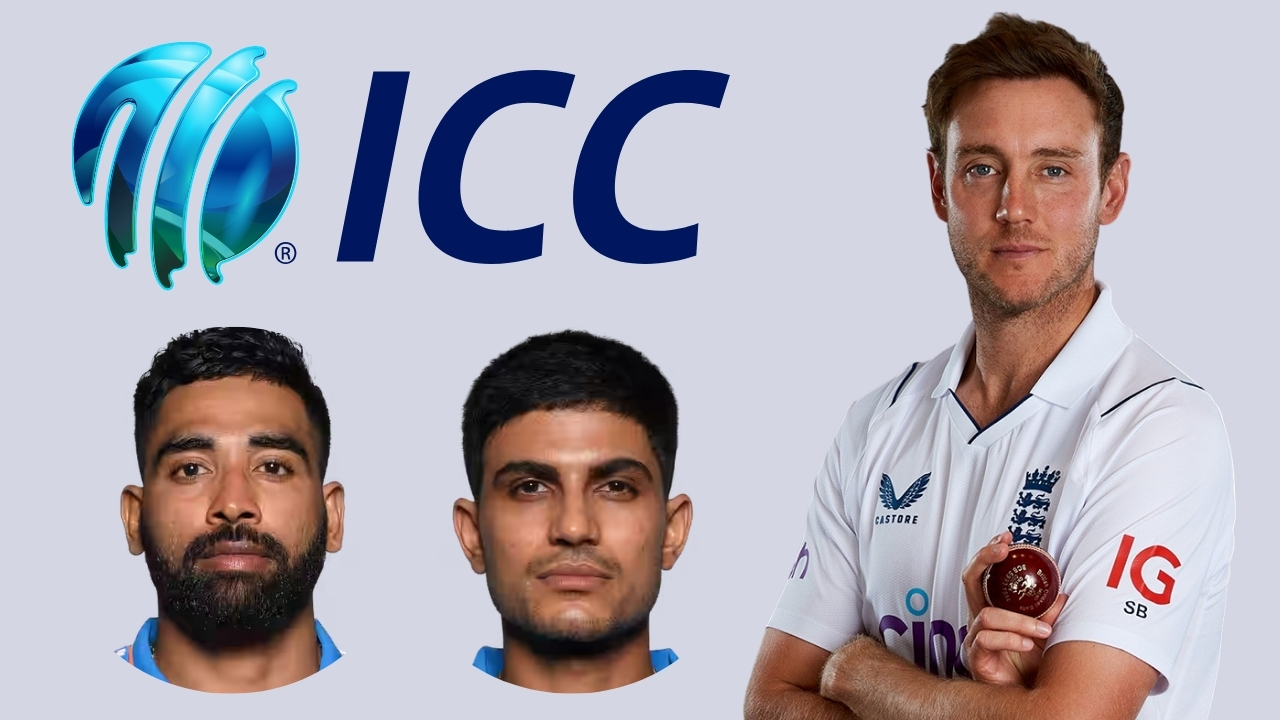
ICC under fire for inconsistent sanctions during fiery Lord’s Test
The International Cricket Council (ICC) is facing sharp criticism from former players and commentators after penalizing India pacer Mohammed Siraj for an aggressive send-off while letting India captain Shubman Gill off without punishment for his on-field outburst — both incidents occurring during the heated third Test between England and India at Lord’s.
Former England fast bowler Stuart Broad and ex-captain Michael Atherton led the criticism, questioning the ICC’s consistency and judgment in disciplinary actions stemming from the emotionally charged match, which England ultimately won by 22 runs to take a 2-1 lead in the five-Test series.
Siraj fined for send-off, Gill not punished for foul language
On Day 4 of the Test, Siraj dismissed England opener Ben Duckett and celebrated by getting in his face — a moment that also saw minor shoulder contact as Duckett walked off. The ICC responded by docking 15% of Siraj’s match fee and adding one demerit point to his disciplinary record. This marked Siraj’s second offence within a 24-month period, following a previous demerit point earned in December 2024 after a verbal altercation with Australia’s Travis Head.
The charge was officially leveled by the on-field umpires and supported by the third and fourth umpires, with match referee Richie Richardson overseeing the final sanction. Siraj admitted to the offence and accepted the penalty without appeal.
However, Broad quickly took to social media to highlight the disparity in how the ICC handled a separate incident involving Shubman Gill on Day 3, when stump mics captured the Indian skipper shouting at England’s Zak Crawley: “grow some f****** b**s.”
Despite the profanity being aired live on television and clearly caught by the microphones, Gill faced no fine or sanction from the ICC — a decision that Broad called out as inconsistent and unjust.
“Find this ridiculous. Siraj 15 per cent for aggressive celebration. Gill swears live on TV & carries on, and what? It’s either both or neither. Players aren’t and shouldn’t be robots, but consistency is key,” Broad wrote on X (formerly Twitter).
Find this ridiculous. Siraj 15% for aggressive celebration. Gill swears live on tv & carries on and what? It’s either both or neither. Players aren’t and shouldn’t be robots but consistency is key https://t.co/5qtpxCmGZs
— Stuart Broad (@StuartBroad8) July 14, 2025
Atherton: Siraj incident “accidental,” reaction “nothing”
Michael Atherton, speaking on Sky Sports, offered a more measured but still critical take, defending Siraj’s celebration as largely innocuous.
“Yesterday, the little shoulder touch was entirely accidental. Siraj tried to get out of the way. Duckett just touched him as he walked off. The match referee has not taken any action on that shoulder barge, rightly, and just said Siraj was in Duckett’s face. To me, that’s something and nothing, 15 per cent of his match fee and one demerit point, let’s move on,” said Atherton.
He added that he saw no major issue with the passion shown by players on both sides during the tense match.
“I’ve enjoyed the needle in the contest and I think the crowd has as well. I would much rather see players care too much than too little. I would much rather see them caring too much about them playing for their country than too little.”
Still, Atherton acknowledged the importance of drawing a line, citing a previous incident involving Virat Kohli.
“There is a line, and no one wants to see physical altercations. So when Virat Kohli diverted his path to give young Sam Konstas a shoulder charge this winter, that’s a no-no. That should be stamped on.”
The broader concern: consistency in player discipline
While the match itself was a thriller, ending with a narrow 22-run victory for England, the post-match focus has largely shifted to the ICC’s disciplinary procedures and perceived inconsistency in enforcing its Code of Conduct.
The contrasting treatment of Siraj and Gill has reignited debate around whether the ICC applies its rules uniformly — especially in an era where stump mics, social media, and 24/7 broadcasts ensure nothing on the field goes unnoticed.
As the series heads into the fourth Test with tensions running high and the margin razor-thin, the ICC may face continued scrutiny over its disciplinary standards — especially from former players who, like Broad and Atherton, believe clear and consistent guidelines are vital for maintaining fairness and credibility on the international stage.